
Application of Kansei Engineering Techniques for the Design and Development of Handbags in the Krajood
Article Sidebar
Main Article Content
Abstract
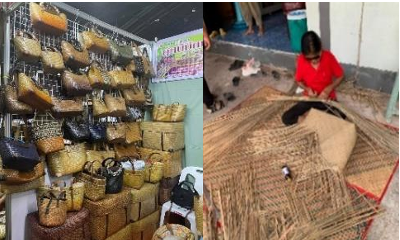
Nowadays, designing and developing products to meet customer needs is an important thing that manufacturers must focus on. The purpose of this research is to investigate the design and development of krajood handbag products using Kansei engineering techniques and assess to customer satisfaction with the newly developed krajood handbag product. The data survey was conducted using a Likert-type questionnaire. Quantitative analysis techniques were used to examine the study data. The quantitative analysis findings are presented as prediction equations that illustrate the connection between sentimental terms and product attributes. The results found that there are 4 sentiment words that match the average: modern, suitable for use, durable, and refined. Then, the study data were used to design and develop product characteristics in terms of shape, pattern, size, opening-closing of the bag, and additional functions. After that, the prototype was made to assess the satisfaction of those involved. The findings revealed that "durability" has the greatest influence on handbag satisfaction. The level of satisfaction was at a good level with an average of 4.42. The results obtained from applying Kansei engineering techniques will serve as guidelines for future product development by community enterprise groups or interested manufacturers.
Article Details

This work is licensed under a Creative Commons Attribution-NonCommercial-NoDerivatives 4.0 International License.
Articles published in Journal of Industrial Technology Ubon Ratchathani Rajabhat University both hard copy and electronically are belonged to the Journal.
References
R. Suksikarn, “Krachud basketry product in Nakhon Si Thammarat,” Journal of Fine and Applied Arts Khon Kaen University, vol. 3, no.2, pp. 69-92, Dec. 2011.
S. Yodwangjai, “Product design and development for dinner chair of Kansei engineering,”. KKU Engineering Journal, vol. 41, no. 2, pp. 191-200, Sep. 2014.
M. Faisha, E. Mohamad, R. Jaafar, A. A. Rahman, O. Adiyanto, H. A. Jatmiko, and I. Novera, “Integrated approach to customer requirement using quality function deployment and Kansei engineering to improve packaging design,” Asia-Pacific Journal of Science and Technology, vol. 26, no. 2, May. 2021. Art. no. APST-26-02-04.
M. Nagamachi, “Kansei engineering as a powerful consumer-oriented technology for product development,” Applied Ergonomics, vol. 33, no.3, pp. 289-294, Jun. 2002.
S. Schutte, “Designing feelings into products: integrating Kansei engineering methodology in product development,” Ph. D. Thesis, Department of Mechanical Engineering, Linkopings Universitet, Sweden, 2002.
P. Pasunon, “Validity of questionnaire for social science research,” Journal of Social Sciences Srinakharinwirot University, vol. 18, pp. 375-396, Jan. 2015.
R. Sinthavalai, and S. Ruengrong, “An applicationof house of quality (HOQ) for designing rice product as a souvenir,” Naresuan University Journal: Science and Technology, vol. 26, no. 3, pp. 36-51, Sep. 2018.
B. Ratner, “The correlation coefficient: Its values range between +1/-1, or do they?.,” Journal of Targeting, Measurement and Analysis for Marketing, vol. 17, pp. 139-142, Jun. 2009.
L. Kennedy-Shaffer, “Before p<0.05 to beyond p<0.05: using history to contextualize p-values and significance testing,” The American Statistician, vol. 73, no. Suppl. 1, pp. 82-90, Mar. 2019.
J. C. Woo, F. Luo, Z.H. Lin, and Y.T. Chen, “Research on the sensory feeling of product design for electric toothbrush based on Kansei engineering and back propagation neural network,” Journal of Internet Technology, vol. 23, no. 4, pp. 863-871, Jun. 2022.
S. Rawangwong, C. Homkhiew, T. Pirom, A. T. Kamnerdwam, and T. Boonyaso, “An application of kansei engineering technique for the design and development of leather product: A case study of leather manufacturer, Muang district, Songkhla province,” Journal of Engineering and Innovation, vol. 15, no. 1, pp. 144-156, Mar. 2022.
M. Kikumoto, Y. Kurita, and S. Ishihara, “Kansei engineering study on car seat lever position,” International Journal of Industrial Ergonomics, vol. 86, Nov. 2021, Art. no. 103215.
T. Boonyaso, T. Ratanawilai, K. Thongkaew, and C. Teelakul, “Classification of children’s toy products in emotional design using an integration of kano model and Kansei engineering,” Songklanakarin Journal of Science and Technology (SJST), vol. 46, no. 2, pp. 148-158, Apr. 2024.
A.T. Kamnerdwam, T. Pirom, S. Rawangwong, and C. Laosat, “Application of Kansei engineering techniques for the design and development of wallet from donax canniformis,” Kasem Bundit Engineering Journal, vol.14, no.3, pp. 70-84, Dec. 2024.
