Development and performance evaluation of an innovative community-scale single-pillar pyrolysis reactor for converting plastic waste into alternative liquid fuel
DOI:
https://doi.org/10.55674/cs.v18i3.268965Keywords:
Plastic waste, Pyrolysis reactor, Alternative liquid fuel, Waste-to-energyAbstract
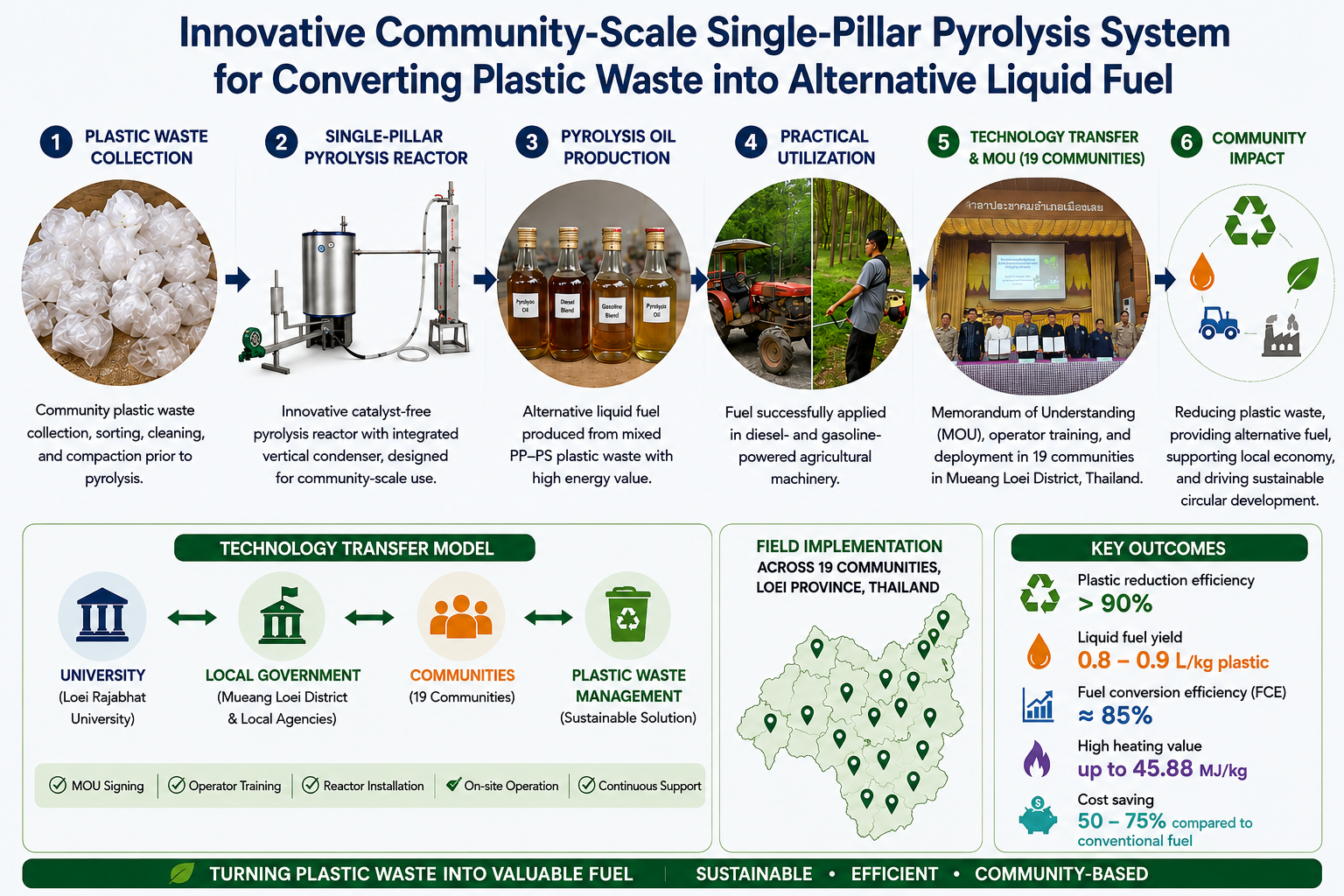
Plastic waste accumulation has become a critical global environmental challenge due to the increasing generation of non-recyclable plastics and the growing demand for sustainable waste-to-energy technologies. This study developed and evaluated an innovative community-scale single-pillar pyrolysis reactor for converting non-recyclable polypropylene (PP) and polystyrene (PS) waste into alternative liquid fuel under catalyst-free, oxygen-limited conditions. The system integrates a pyrolysis chamber, an externally heated combustion chamber fueled by waste lubricating oil, a vertical water-cooled condenser, and a vapor-recycling unit into a compact configuration suitable for decentralized applications. Reactor performance was evaluated using two PP:PS feedstock compositions (50:50 and 60:40, w w-1). Each batch processed 10 kg of plastic waste (n = 3), producing 8.03 – 8.27 L of pyrolysis oil within 190 – 200 min. The 60:40 feedstock yielded numerically higher liquid fuel production (67.00 ± 1.91 wt.%), fuel conversion efficiency (73.85 ± 2.31%), oil productivity (3.73 ± 0.23 L h⁻¹), and higher heating value (45.73 ± 0.23 MJ kg⁻¹), together with a lower estimated gas yield (23.73 ± 2.16 wt.%). However, these differences were not statistically significant (p > 0.05), indicating stable and reproducible reactor performance across both feedstock compositions. Field validation following technology transfer was conducted in
19 communities in Loei Province, Thailand. The system achieved an average plastic reduction efficiency of 92.96 ± 0.87%, reduced accumulated plastic waste by 55.51 ± 22.41%, and demonstrated successful utilization of the recovered fuel in agricultural machinery and municipal crematoriums. These findings demonstrate that the proposed single-pillar reactor provides a practical, low-cost, and scalable decentralized waste-to-energy technology that supports circular economic implementation and sustainable community-based plastic waste management.
GRAPHICAL ABSTRACT
HIGHLIGHTS
- A single-pillar reactor converted PP–PS waste into alternative liquid fuel.
- Liquid fuel yield reached 67.00 wt%, with plastic reduction above 90%.
- Pyrolysis oil achieved a heating value of up to 45.73 MJ kg⁻¹.
- Blended fuels operated successfully in agricultural equipment.
- The reactor was validated across 19 communities in Thailand.
References
Organisation for Economic Co-operation and Development (OECD). (2022), Global Plastics Outlook: Economic Drivers, Environmental Impacts and Policy Options, OECD Publishing. https://doi.org/10.1787/de747aef-en
Geyer, R., Jambeck, J. R., & Law, K. L. (2017). Production, use, and fate of all plastics ever made. Science Advances, 3(7), e1700782. https://doi.org/10.1126/sciadv.1700782
United Nations Environment Programme. (2023, May 16). Turning off the Tap: How the World Can End Plastic Pollution and Create a Circular Economy. UNEP. https://www.unep.org/resources/turning-off-tap-end-plastic-pollution-create-circular-economy
Al-Salem, S. M., Lettieri, P., & Baeyens, J. (2017). A review on thermal and catalytic pyrolysis of plastic solid waste (PSW). Journal of Environmental Management, 197, 177–198. https://doi.org/10.1016/j.jenvman.2017.03.084
Dai, L., Zhou, N., Lv, Y., Cheng, Y., Wang, Y., Liu, Y., & Ruan, R. (2022). Pyrolysis technology for plastic waste recycling: A state-of-the-art review. Progress in Energy and Combustion Science, 93, 101021. https://doi.org/10.1016/j.pecs.2022.101021
Armenise, S., SyieLuing, W., Ramírez-Velásquez, J. M., Launay, F., Wuebben, D., Ngadi, N., & Munoz, M. (2021). Plastic waste recycling via pyrolysis: A bibliometric survey and literature review. Journal of Analytical and Applied Pyrolysis, 158, 105265. https://doi.org/10.1016/j.jaap.2021.105265
Peng, Y., Wang, Y., Ke, L., Dai, L., Wu, Q., Cobb, K., & Ruan, R. (2022). A review on catalytic pyrolysis of plastic wastes to high-value products. Energy Conversion and Management, 254, 115243. https://doi.org/10.1016/j.enconman.2022.115243
Kumar, M., Sharma, M., & Singh, D. (2023). A critical review on pyrolysis method as sustainable conversion of waste plastics into fuels. Fuel, 337, 126890. https://doi.org/10.1016/j.fuel.2022.126890
López, G., Artetxe, M., Amutio, M., Bilbao, J., & Olazar, M. (2017). Thermochemical routes for the valorization of waste polyolefinic plastics to produce fuels and chemicals: A review. Renewable and Sustainable Energy Reviews, 73, 346–368. https://doi.org/10.1016/j.rser.2017.01.142
Singh, R., Kumar, R., & Singh, E. (2021). Pyrolysis of plastic species: A review of resources and products. Journal of Analytical and Applied Pyrolysis, 159, 105295. https://doi.org/10.1016/j.jaap.2021.105295
Jaafar, Y., Abdelouahed, L., Hage, R. E., Taouk, B., & Authier, O. (2022). Pyrolysis of common plastics and their mixtures to produce valuable petroleum-like products. Polymer Degradation and Stability, 195, 109770. https://doi.org/10.1016/j.polymdegradstab.2021.109770
Calero, M., Solís, R. R., Muñoz-Batista, M. J., Pérez, A., Blázquez, G., & Martín-Lara, M. Á. (2023). Oil and gas production from the pyrolytic transformation of recycled plastic waste: An integral study by polymer families. Chemical Engineering Science, 271, 118569. https://doi.org/10.1016/j.ces.2023.118569
Fadillah, G., Fatimah, I., Sahroni, I., Musawwa, M. M., Mahlia, T. M. I., & Muraza, O. (2021). Recent progress in low-cost catalysts for pyrolysis of plastic waste to fuels. Catalysts, 11(7), 837. https://doi.org/10.3390/catal11070837
Biakhmetov, B., Dostiyarov, A., Ok, Y. S., & You, S. (2023). A review on catalytic pyrolysis of municipal plastic waste. Wiley Interdisciplinary Reviews: Energy and Environment, 12(6), e495. https://doi.org/10.1002/wene.495
Li, F., Wang, N., He, X., Deng, M., Yuan, X., Zhang, H., & Ok, Y. S. (2025). Biochar-based catalytic upgrading of plastic waste into liquid fuels towards sustainability. Communications Earth & Environment, 6(1), 329. https://doi.org/10.1038/s43247-025-02286-1
Okaforobah, U. E., Ezenwa, O. N., Okeke, J. C., & Okaforobah, C. S. (2025). Catalytic co-pyrolysis of biomass and plastic waste: A comprehensive review. International Journal of Biomass Utilization and Sustainable Energy, 3, 82–99. https://doi.org/10.58915/ijbuse.v3.2025.2741
Li, C., Sun, Y., Zhang, S., Tang, Y., Wang, D., & Hu, X. (2024). Co-pyrolysis of waste paper and tyre: Exploration of interaction of volatiles of varied origin and the influence on product evolution. Journal of Analytical and Applied Pyrolysis, 178, 106395. https://doi.org/10.1016/j.jaap.2024.106395
Kumar, A., Alawa, B., & Chakma, S. (2024). Influence of banana peel waste biomass ratio in Co-pyrolysis of waste plastics to regulate aromatic content and oxygenated compounds: A study of liquid product characterization and its CI engine performance. Journal of the Energy Institute, 117, 101803. https://doi.org/10.1016/j.joei.2024.101803
Saha, B., Vedachalam, S., Dalai, A. K., Saxena, S., Dally, B., & Roberts, W. L. (2024). Review on production of liquid fuel from plastic wastes through thermal and catalytic degradation. Journal of the Energy Institute, 114, 101661. https://doi.org/10.1016/j.joei.2024.101661
Kabeyi, M. J. B., & Olanrewaju, O. A. (2023). Review and design overview of plastic waste-to-pyrolysis energy conversion systems. International Journal of Energy Research, 2023, 1821129. https://doi.org/10.1155/2023/1821129
Choi, Y., Wang, S., Yoon, Y. M., Jang, J. J., Kim, D., Ryu, H. J., & Hwang, B. (2024). Sustainable strategy for converting plastic waste into energy over pyrolysis: A comparative study of fluidized-bed and fixed-bed reactors. Energy, 286, 129564. https://doi.org/10.1016/j.energy.2023.129564
Laghezza, M., Fiore, S., & Berruti, F. (2024). A review on the pyrolytic conversion of plastic waste into fuels and chemicals. Journal of Analytical and Applied Pyrolysis, 179, 106479. https://doi.org/10.1016/j.jaap.2024.106479
Tasleem, S., Soliman, A., & Alsharaeh, E. H. (2025). Recent developments in catalytic materials and reactors for the catalytic pyrolysis of plastic waste into hydrogen. RSC Advances, 15, 20881–20907. https://doi.org/10.1039/D5RA03170B
Lubongo, C., Congdon, T., McWhinnie, J., & Alexandridis, P. (2022). Economic feasibility of plastic waste conversion to fuel using pyrolysis. Sustainable Chemistry and Pharmacy, 27, 100683. https://doi.org/10.1016/j.scp.2022.100683
Kulas, D. G., Zolghadr, A., Chaudhari, U. S., & Shonnard, D. R. (2023). Economic and environmental analysis of plastics pyrolysis after secondary sortation of mixed plastic waste. Journal of Cleaner Production, 384, 135542. https://doi.org/10.1016/j.jclepro.2022.135542
Roychand, R., Zafar, M. A., Jacob, M., & Ngo, T. (2025). A comprehensive review on the thermochemical treatment of plastic waste to produce high value products for different applications. Materials Circular Economy, 7(1), 3. https://doi.org/10.1007/s42824-024-00157-2
Mani, M., Nagarajan, G., & Sampath, S. (2011). Characterisation and effect of using waste plastic oil and diesel fuel blends in compression ignition engine. Energy, 36(1), 212–219. https://doi.org/10.1016/j.energy.2010.10.049
Murugan, S., Ramaswamy, M. C., & Nagarajan, G. (2008). The use of tyre pyrolysis oil in diesel engines. Waste Management, 28(12), 2743–2749. https://doi.org/10.1016/j.wasman.2008.03.007
Devaraj, J., Robinson, Y., & Ganapathi, P. (2015). Experimental investigation of performance, emission and combustion characteristics of waste plastic pyrolysis oil blended with diethyl ether used as fuel for diesel engine. Energy, 85, 304–309. https://doi.org/10.1016/j.energy.2015.03.075
National Science and Technology Development Agency (NSTDA). (2021, August 21). BCG Concept: Bio-Circular-Green Economy Model. National Science and Technology Development Agency, Thailand. https://www.nstda.or.th/thaibioeconomy/bcg-concept.html
United Nations. (2015). Transforming our world: The 2030 Agenda for Sustainable Development. United Nations.
Downloads
Additional Files
Published
How to Cite
Issue
Section
Categories
License
Copyright (c) 2026 : Vanlop Thathong, Tanunchai Boonnuk, Netnapid Tantamsapya, Nuwut Phimpabut

This work is licensed under a Creative Commons Attribution-NonCommercial-NoDerivatives 4.0 International License.