About the Journal
Aims and Scope
Creative Science is an interdisciplinary, peer-reviewed journal dedicated to advancing science through creativity, innovation, and collaboration. We emphasize the role of imaginative thinking in solving real-world problems, blending rigorous research with inventive approaches to foster discovery, technological progress, and transformative solutions.
We welcome submissions that bridge disciplines, support sustainable development, and empower communities through integrative science. The journal encourages work that connects scientific excellence with creative practice to address global challenges. Topics include the following major scientific areas and their associated subfields:
Biological Sciences
In the spirit of Creative Science, the Biological Sciences section embodies the journal's mission by merging creativity with rigorous research to address modern challenges in life sciences. We seek work that offers novel insights, fosters collaboration, and translates biological knowledge into practical, sustainable applications that benefit both local and global communities. The journal particularly encourages studies and reviews in areas such as:
- Integrative Biology and Systems Science – advancing holistic perspectives on complex biological networks and interactions.
- Biotechnology and Applied Microbiology – fostering creative applications of microorganisms and biotechnological tools for health, environment, industry, and local community advancement.
- Biochemistry and Chemical Biology – exploring molecular mechanisms and innovative biochemical approaches to enhance biological research.
- Other emerging and related disciplines that embody the essence of creative science in biological research, innovation, and community-centered development.
Chemical Sciences
The Chemical Sciences section welcomes innovative research that combines creative rigor with practical applications. We encourage work addressing modern chemical challenges through interdisciplinary collaboration, with emphasis on sustainable solutions that benefit industry, society, and local communities. The journal particularly encourages studies and reviews in areas such as:
- Analytical, Physical, Inorganic, and Organic Chemistry – developing innovative techniques and methodologies that can advance chemical understanding and offer practical solutions for local industries and community needs.
- Biological and Medicinal Chemistry and Biotechnology – creatively applying chemical and biotechnological tools to improve health, environmental quality, and community-centered technologies.
- Sustainable and Environmental Chemistry – promoting green chemistry approaches that reduce environmental impact and support local resource management.
- Computational and Theoretical Chemistry – using modeling and simulations to generate insights that can inform practical, community-relevant chemical solutions.
- Materials and Nanoscience – designing novel materials with applications in energy, health, and local infrastructure development.
- Energy and Catalysis – innovating in renewable energy, energy efficiency, and catalytic processes with potential benefits for community sustainability.
- Chemical Education – advancing creative approaches to teaching and learning chemistry, empowering local communities through knowledge dissemination.
- Other related chemical sciences – research that embodies the essence of Creative Science and contributes to community advancement and local development.
Environmental Sciences
The Environmental Sciences section publishes creative, rigorous research addressing urgent environmental issues. We prioritize interdisciplinary studies that promote sustainability, conserve ecosystems, and support local community development—fostering collaboration among researchers, policymakers, and stakeholders to achieve tangible real-world impact. The journal particularly encourages studies and reviews in areas such as:
- Climate Change – developing creative strategies for adaptation, mitigation, and community resilience.
- Ecology and Biodiversity Conservation – innovative approaches to preserve natural habitats and enhance local biodiversity.
- Environmental Biotechnology – applying microbial and biotechnological tools to solve environmental problems and benefit local communities.
- Environmental Chemistry and Modeling – advancing chemical and computational methods to predict and manage environmental impacts.
- Monitoring, Assessment, and Pollution Control – designing practical tools and interventions for community-level environmental management.
- Environmental Toxicology – understanding and mitigating the effects of pollutants on ecosystems and human health.
- Renewable Energy – creative solutions for sustainable energy production that can be adopted at community scales.
- Waste Management and Recycling – innovative technologies for reducing, reusing, and valorizing waste to support local sustainability.
- Water Resources Management – strategies for improving water quality and availability for communities.
- Sustainable Development and Sustainability Science – interdisciplinary approaches that integrate scientific knowledge, technology, and community engagement.
- Other related topics in environmental science – research that embodies Creative Science principles and contributes to local community advancement.
Physical Sciences
The Physical Sciences section explores matter, energy, and physical laws through innovative and practical approaches. We seek creative yet rigorous research that addresses contemporary challenges and advances sustainable technologies, while promoting societal and local community well-being. The journal particularly encourages studies and reviews in areas such as:
- Physics and Astronomy – advancing fundamental understanding and translating discoveries into technologies that can benefit communities.
- Quantum Technologies – exploring cutting-edge quantum research with potential applications in computing, communication, and local industry development.
- Energy Conversion and Storage – designing innovative solutions for renewable energy, efficient energy use, and community-scale energy projects.
- Interdisciplinary Applied Physics – integrating physics with other scientific disciplines to solve real-world problems and support community-centered innovation.
- Other related physical sciences – research that embodies the essence of Creative Science and contributes to local development and societal advancement.
Applied Sciences and Technology
The Applied Sciences and Technology section highlights the transformation of research into practical innovations. We seek studies that combine creativity and scientific rigor to develop sustainable, community-focused solutions with tangible benefits for both society and industry. The journal particularly encourages studies and reviews in areas such as:
- Green Chemistry and Sustainable Materials – developing environmentally friendly materials and processes that support local sustainability initiatives.
- Applied Science and Technology for Sustainable Community Development – implementing innovative technologies and approaches that directly enhance community resilience, quality of life, and self-reliance.
- Sustainable Chemical Manufacturing – designing chemical production processes that minimize environmental impact while benefiting local industries and communities.
- Food Science and Technology Applications – advancing safe, nutritious, and sustainable food solutions with practical relevance for local populations.
- Agricultural Biotechnology and Development – applying biotechnological innovations to improve crop yields, resource efficiency, and community agricultural practices.
- Other related areas of applied science and technology – research that embodies Creative Science principles and contributes to community advancement and local development.
Peer Review Process
Each manuscript submitted to the journal undergoes a rigorous double-blind peer review process in the spirit of Creative Science, ensuring the highest quality of published research. Each paper is reviewed by at least three experts with specialized knowledge in the relevant field, drawn from a diverse range of institutions both nationally and internationally. In addition to the external peer review, all manuscripts are carefully evaluated by the editorial team to maintain high scientific rigor, originality, and relevance. This comprehensive review process ensures that each published article embodies the principles of Creative Science and contributes meaningfully to the advancement of knowledge.
Types of Published Articles
Creative Science publishes two main types of scholarly contributions: research articles and review articles, both of which are expected to embody the mission of Creative Science by integrating originality, creativity, and rigorous scientific practice. Articles should not only advance disciplinary knowledge but also encourage cross-disciplinary collaboration, promote sustainability, and generate solutions with real-world impact—particularly for local community development.
- Research Articles – present original research findings across the major areas of Biological Sciences, Chemical Sciences, Environmental Sciences, Physical Sciences, and Applied Sciences and Technology. A research article should clearly define its research question, apply robust methodology, and present reliable results leading to well-supported conclusions. The discussion must emphasize the significance of the findings, their broader implications, and their contributions to advancing science, technology, sustainability, or community well-being. Case studies are generally not accepted unless they demonstrate substantial impact on industry, society, or local communities. The length of the content should be 8–12 pages, including tables, figures, and references (not counting the title page).
- Review Articles – provide a critical and integrative overview of current knowledge on a relevant topic within the scope of Creative Science. Review articles should go beyond summarizing the literature by analyzing and synthesizing insights, identifying research gaps, and proposing creative directions for future inquiry. Reviews are encouraged to bridge disciplines, highlight sustainability perspectives, and suggest applications that support technological innovation or community development. While more flexible in structure than research articles, the length of the content should be 15–20 pages, including tables, figures, and references (not counting the title page).
All articles published in Creative Science must be based on rigorous, ethical, and original research. Submissions should demonstrate scientific excellence while reflecting the vision of using creativity and innovation to advance discovery, foster collaboration across disciplines, and deliver transformative solutions that contribute to sustainability, technological progress, and the empowerment of communities.
Publication Frequency
3 issues per year:
Issue 1: January - April
Issue 2: May – August
Issue 3: September – December
Indexed in
Thai Journal Citation Index (TCI), ASEAN Citation Index (ACI) and Google Scholar
ISSN
Open Access Policy
Creative Science is a fully open access journal. All content is freely available without charge to users and their institutions immediately upon publication. Users are permitted to read, download, copy, distribute, print, search, or link to the full texts of the articles for any lawful, non-commercial purpose, without asking prior permission from the publisher or the author, in accordance with the BOAI definition of open access.
Revenue Source
Creative Science is committed to maintaining transparency and integrity in its financial and publishing practices. Detailed information about the journal’s revenue model is publicly available on its website. The journal is primarily supported by Sakon Nakhon Rajabhat University, which provides funding for administrative, editorial, and technological operations necessary for the journal’s publication. Creative Science ensures that its source of financial support does not influence editorial independence. All submitted manuscripts undergo a rigorous peer-review process and are evaluated solely on the basis of their scientific quality, originality, and relevance.
Advertising and Direct Marketing Policy
Creative Science adheres to the principles of transparency, integrity, and editorial independence in all aspects of advertising and direct marketing. The journal may accept limited advertising that is relevant to its academic scope, including announcements of conferences, educational programs, and research-related services. All advertisements are subject to review and approval by the editorial board or a designated body to ensure they meet appropriate academic and ethical standards. Advertising content has no influence on editorial decisions. There is a strict separation between advertising and editorial processes. All manuscripts are evaluated solely on the basis of scholarly merit through a rigorous and independent peer-review process.
Advertisements are clearly distinguished from editorial content and are displayed in designated sections of the journal or website. They are not targeted based on user behavior, nor are they linked to specific articles or editorial outcomes. Creative Science does not engage in direct marketing practices that could compromise the integrity of the journal. All promotional activities are conducted in a professional and ethical manner, ensuring that they do not mislead authors or readers. The journal remains committed to maintaining high standards of publication ethics, safeguarding the credibility of its content, and ensuring full transparency in all advertising and marketing practices.
Direct Marketing
Creative Science conducts direct marketing activities to promote the journal while upholding high ethical standards. The journal’s approach involves targeted communication with researchers, academics, and professionals in relevant fields, ensuring that all information provided is accurate, clear, and aligned with the journal’s aims and scope. The journal prioritizes transparency in all communications, including obtaining appropriate consent where required and respecting applicable data protection and privacy regulations. All outreach activities are designed to be professional and non-intrusive, providing useful and relevant information without overwhelming recipients.
Creative Science ensures that its direct marketing practices do not mislead authors or readers and do not influence editorial decisions. All promotional activities are conducted independently from the editorial process. The journal remains committed to responsible and ethical direct marketing practices, fostering engagement within the scientific community, encouraging collaboration, and supporting the transparent dissemination of high-quality research.
Publication Costs
Free of charge for submission, publication, and access.
Journal History
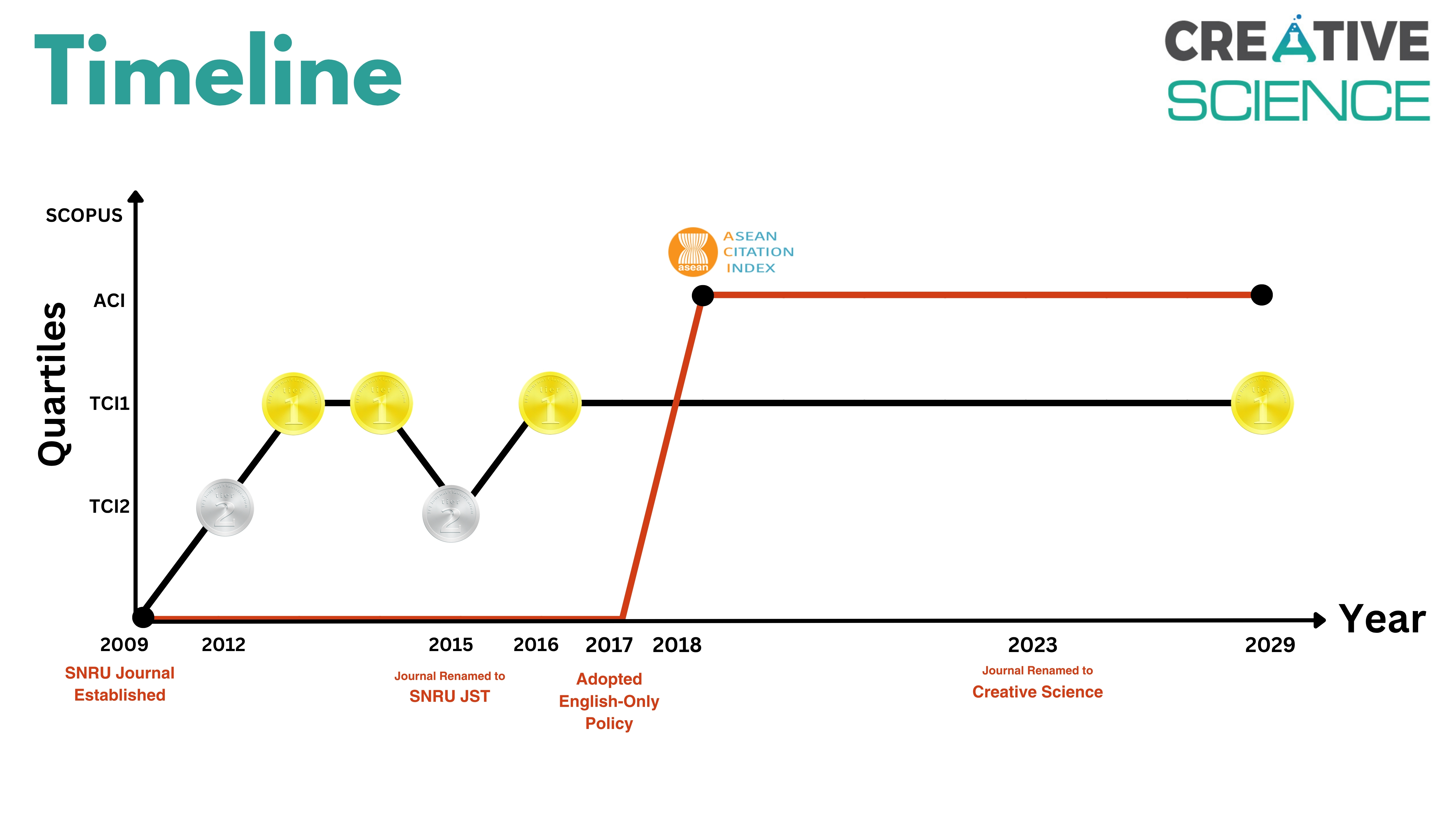
Creative Science has evolved through several stages of development reflecting its continuous improvement in academic quality and international recognition. The journal was first established in 2009 as Sakon Nakhon Rajabhat University Journal. In 2015, it was renamed SNRU Journal of Science and Technology to better emphasize its focus on scientific research.
In 2017, the journal further enhanced its international orientation by publishing articles exclusively in English. This strategic development led to its inclusion in the ASEAN Citation Index (ACI) in 2018, marking an important milestone in expanding its regional visibility.
In 2023, the journal was renamed Creative Science to reflect its broader scope, interdisciplinary focus, and commitment to fostering innovation and creative research across science and technology fields. Creative Science publishes high-quality interdisciplinary studies addressing real-world challenges while fostering sustainable development and community empowerment.
The journal has been continuously indexed in the Thai-Journal Citation Index (TCI), achieving recognition in both TCI Tier 2 and TCI Tier 1, demonstrating its sustained commitment to high academic standards.
Throughout its development, Creative Science has maintained a strong dedication to rigorous peer review, academic integrity, and the dissemination of impactful research at both national and international levels.