Policy
Plagiarism Policy
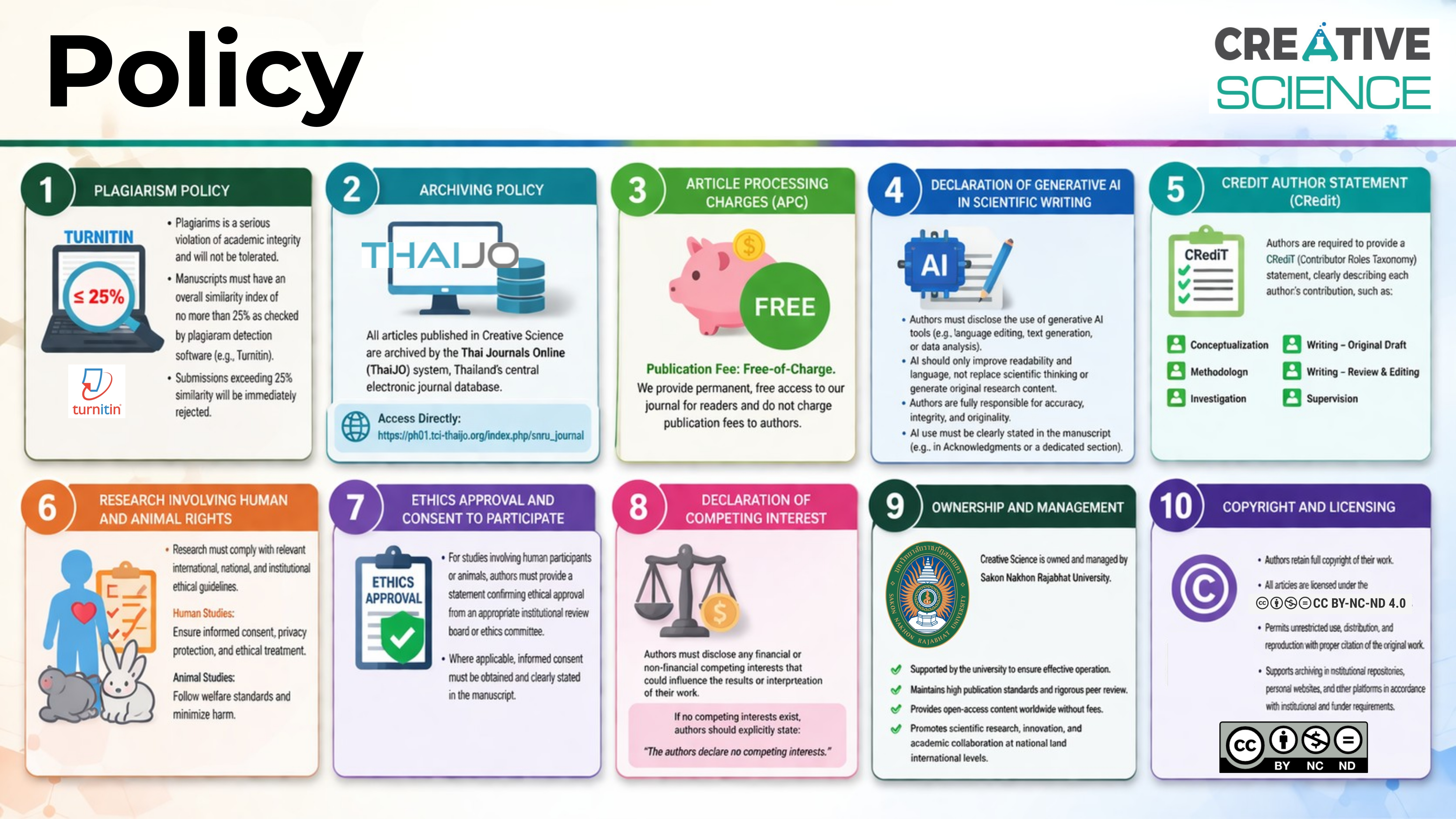
Plagiarism is a serious violation of academic integrity and will not be tolerated. As a form of misrepresentation, it undermines the principles of honest scholarship. Creative Science is committed to maintaining high ethical standards by actively preventing cases of plagiarism, redundant publication (self-plagiarism), misrepresentation of authorship, and content falsification.
Manuscripts submitted to Creative Science must have an overall similarity index of no more than 25%, as determined by plagiarism detection software such as Turnitin. Submissions that do not comply with these requirements will be immediately rejected by the editorial team.
Archiving Policy
All articles published in Creative Science are archived by the Thai Journals Online (ThaiJO) system, which is Thailand's central electronic journal database. Manuscripts can be accessed directly from:
https://ph01.tci-thaijo.org/index.php/snru_journal
Repository Policy
Repository and Self-Archiving Policy
Creative Science allows authors to self-archive their work in any repository or website, with no embargo. Authors retain copyright and may deposit all versions — the submitted version (preprint), accepted version (AAM), and published Version of Record (VoR) — before or after publication.
The Version of Record is shared under CC BY-NC-ND 4.0. For any deposited version, authors should acknowledge first publication in Creative Science and include the DOI link to the Version of Record.
Article Processing Charges (APC)
Publication Fee: Free-of-Charge.
We provide permanent, free access to our journal for readers and do not charge publication fees to authors.
Declaration of Generative AI in Scientific Writing
Authors must disclose the use of generative artificial intelligence (AI) tools (e.g., for language editing, text generation, or data analysis) in the preparation of their manuscripts. Such tools should only be used to improve readability and language, and not to replace critical scientific thinking or generate original research content. Authors remain fully responsible for the accuracy, integrity, and originality of the work. The use of AI must be clearly stated in the manuscript, typically in the acknowledgments or a dedicated section.
CRediT Author Statement
Authors are required to provide a Contributor Roles Taxonomy (CRediT) statement, clearly describing each author’s contribution to the work (e.g., conceptualization, methodology, investigation, writing – original draft, writing – review & editing, supervision). This ensures transparency and appropriate attribution of contributions.
Research Involving Human and Animal Rights
Research involving human participants or animals must comply with relevant international, national, and institutional ethical guidelines. Studies involving humans must ensure informed consent, privacy protection, and ethical treatment. Research involving animals must follow established welfare standards and minimize harm. Authors must clearly state compliance with these ethical requirements in their manuscripts.
Ethics Approval and Consent to Participate
For studies involving human participants or animals, authors must provide a statement confirming that ethical approval was obtained from an appropriate institutional review board or ethics committee. Where applicable, informed consent must be obtained from participants and clearly stated in the manuscript.
Declaration of Competing Interest
Authors must disclose any financial or non-financial competing interests that could influence the results or interpretation of their work. If no competing interests exist, authors should explicitly state: “The authors declare no competing interests.”
Ownership and Management
Creative Science is owned and managed by Sakon Nakhon Rajabhat University. The journal is supported by the university to ensure the effective operation of its editorial, administrative, and publishing processes. This institutional support enables Creative Science to maintain high publication standards, implement a rigorous peer-review system, and provide open-access content to researchers and readers worldwide without charging publication fees. Sakon Nakhon Rajabhat University is committed to promoting scientific research, innovation, and community engagement. Through its support of Creative Science, the university fosters the dissemination of valuable knowledge and encourages academic collaboration at both national and international levels.
Copyright and Licensing
Creative Science is committed to protecting authors' rights while promoting the wide dissemination of scholarly research. Authors retain full copyright of their work. All articles are published open access under a Creative Commons Attribution-NonCommercial-NoDerivatives 4.0 International License (CC BY-NC-ND 4.0). Under this license, users are free to copy and redistribute the article in any medium or format for non-commercial purposes, provided that appropriate credit is given to the author(s) and the original source and a link to the license is included. Users may not use the material for commercial purposes, and may not distribute modified, adapted, or derivative versions of the work.
Creative Science supports authors in archiving and sharing their published articles in institutional repositories, on personal websites, and on other platforms, in accordance with institutional and funding requirements. Through these policies, the journal promotes openness, responsible knowledge sharing, and respect for intellectual property rights.