A health planning expert system for promoting quality of life among older adults in Buriram province
DOI:
https://doi.org/10.55674/cs.v18i3.268731Keywords:
Expert System, Ontology, Health Planning, Quality of Life Enhancement, Life, Elderly SocietyAbstract
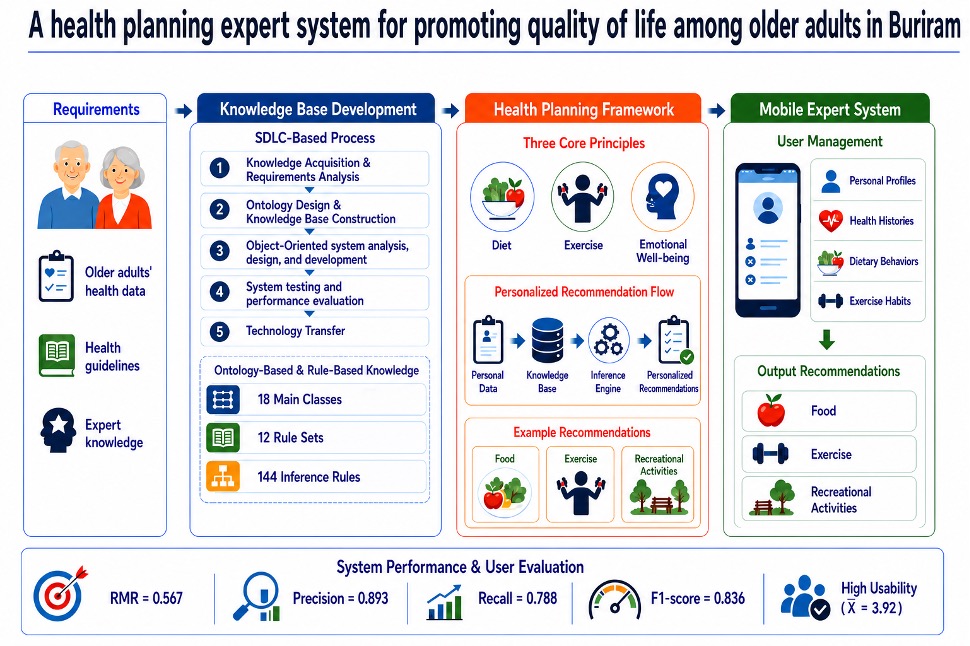
This study aimed to (1) develop a knowledge base for health planning among older adults and (2) develop and transfer an expert system to support personalized health planning and promote the quality of life of older adults in Buriram Province, Thailand. This applied research adopted the System Development Life Cycle (SDLC), comprising five main phases: Knowledge Acquisition and Contextual Requirements Analysis; Ontology Design and Knowledge Base Construction; System Analysis, Design, and Development based on object-oriented principles; System Testing and Performance Evaluation; and Technology Transfer. The knowledge base was developed using an ontology-based approach and was grounded in three core health planning principles: diet, exercise, and emotional well-being. It comprised 18 main classes and 12 rule sets containing a total of 144 inference rules. The developed expert system was implemented as a mobile application for managing personal profiles, health histories, dietary behaviors, and exercise habits. Based on these data, the system generates personalized recommendations for food, exercise, and recreational activities according to the individual health conditions of older adults. The performance of the inference mechanism was evaluated using six case studies by comparing system-generated recommendations with expert judgments. The results showed an average Recommendation Matching Rate (RMR) of 0.567, with average precision, recall, and F1-score values of 0.893, 0.788, and 0.836, respectively. These findings indicate that the system achieved high precision in generating recommendations and demonstrated a good overall level of agreement with expert judgments. The usability evaluation yielded a high overall mean score (X̄ = 3.92), indicating favorable user acceptance of the developed system. The developed technology was subsequently transferred to the target users to support its practical application in health planning for older adults.
GRAPHICAL ABSTRACT
HIGHLIGHTS
- An expert system was developed to transform elderly health information into personalized lifestyle recommendations.
- The system integrates 144 clinical knowledge-based rules for adaptive health planning in older adults.
- Validation with expert judgments demonstrated high recommendation reliability and strong user acceptance.
References
Department of Older Persons. (2025, December 31). Statistics of older persons December 2025. https://www.dop.go.th/th/statistics_page?cat=1&id=2587
Waichompu, N., Boontat, R., & Singweratham, N. (2019). Health promotion for the older adults based on the 3E principles. Journal of Health Science and Community Public Health, 6(2), 262–269.
Department of Older Persons. (2026, May 20). Thailand situation of older persons 2024. Bangkok: Department of Older Persons, Ministry of Social Development and Human Security. https://thaitgri.org/?p=40649
Chen, Y.-C., & Lin, C.-C. (2025). The application of IoT technology in social work: Innovative models for home care of the elderly. Computing & AI Connect, 2, Article 0023. https://doi.org/10.69709/CAIC.2025.198272
Bertolazzi, A., Quaglia, V., & Bongelli, R. (2024). Barriers and facilitators to health technology adoption by older adults with chronic diseases: An integrative systematic review. BMC Public Health, 24, Article 506. https://doi.org/10.1186/s12889-024-18036-5
Facchinetti, G., Petrucci, G., Albanesi, B., De Marinis, M. G., & Piredda, M. (2023). Can Smart Home Technologies Help Older Adults Manage Their Chronic Condition? A Systematic Literature Review. International Journal of Environmental Research and Public Health, 20(2), 1205. https://doi.org/10.3390/ijerph20021205
Wang, S., Bolling, K., Mao, W., Reichstadt, J., Jeste, D., Kim, H.-C., & Nebeker, C. (2019). Technology to Support Aging in Place: Older Adults’ Perspectives. Healthcare, 7(2), 60. https://doi.org/10.3390/healthcare7020060
Slade, P., Tambe, A., & Kochenderfer, M. J. (2021). Multimodal sensing and intuitive steering assistance improve navigation and mobility for people with impaired vision. Science Robotics, 6(59), eabg6594. https://doi.org/10.1126/scirobotics.abg6594
Ahmad, N. A., Mat Ludin, A. F., Vanoh, D., Tohit, N. M., Manaf, Z. A., Mohd Noah, S. A., & Shahar, S. (2024). Mobile health application (WeFit) among community-dwelling older adults: Development, validation, acceptance, and usability study. DIGITAL HEALTH, 10, 1-17. https://doi.org/10.1177/20552076241297213
Srisukkit, R., & Srisawangwong, S. (2020). Mobile application for exercise recommendation among older adults. Journal of Health Science, 29(2), 295–305.
Thiansaad, J., & Imsombut, O. (2012). Expert system for diagnosis and advice for chronic kidney failure patients using ontology knowledge base. Journal of Information Science and Technology, 3(2), 23–30.
Chung, P.-T., & Chen, B.-X. (2011). A knowledge-based decision system for healthcare diagnosis and advisory. In Proceedings of the IEEE International Conference on Systems, Man, and Cybernetics, 2357–2362. https://doi.org/10.1109/ICSMC.2011.6084030
Chen, Y., Hsu, C. Y., Liu, L., & Yang, S. (2012). Constructing a nutrition diagnosis expert system. Expert Systems with Applications, 39(2), 2132–2156. https://doi.org/10.1016/j.eswa.2011.07.069
Uschold, M., & Grüninger, M. (1996). Ontologies: Principles, Methods and Applications. The Knowledge Engineering Review, 11, 93-136.
https://doi.org/10.1017/S0269888900007797
Noy, N. F., & McGuinness, D. L. (2026, May 13). Ontology development 101: A guide to creating your first ontology (Stanford Knowledge Systems Laboratory Technical Report KSL-01-05; Stanford Medical Informatics Technical Report SMI-2001-0880). Stanford University. https://protege.stanford.edu/publications/ontology_development/ontology101.pdf
Greer, D. B., & Abel, W. M. (2022). Exploring Feasibility of mHealth to Manage Hypertension in Rural Black Older Adults: A Convergent Parallel Mixed Method Study. Patient Prefer Adherence, 16, 2135-2148
https://doi.org/10.2147/PPA.S361032
Panthong, R., Phengchata, R., Wongwan, A., & Chuesawathi, S. (2025). Development of management information system for elderly health condition data and evaluation of activities of daily living: A case study of Maeka Health Promoting Hospital. Journal of Information Technology Applications, 11(1), 57–73.
Kaewmanee, G., Mulom, R., & Phucharasupa, K. (2020). Development of a mobile application by using a rule-based technique for recommending paralyzed-patient physiotherapy. VRU Research and Development Journal Science and Technology, 15(3), 73–87.
Downloads
Published
How to Cite
Issue
Section
Categories
License
Copyright (c) 2026 : Wilairat Yathongchai, Chusak Yathongchai, Phuangphet Ratchaprakhon

This work is licensed under a Creative Commons Attribution-NonCommercial-NoDerivatives 4.0 International License.