
Performance evaluation of machine learning models for multi-output building energy prediction
DOI:
https://doi.org/10.55674/cs.v18i3.266914Keywords:
Multi-output regression, Building energy prediction, Heating and cooling load, LightGBM, Gradient boosting, Multi-task learningAbstract
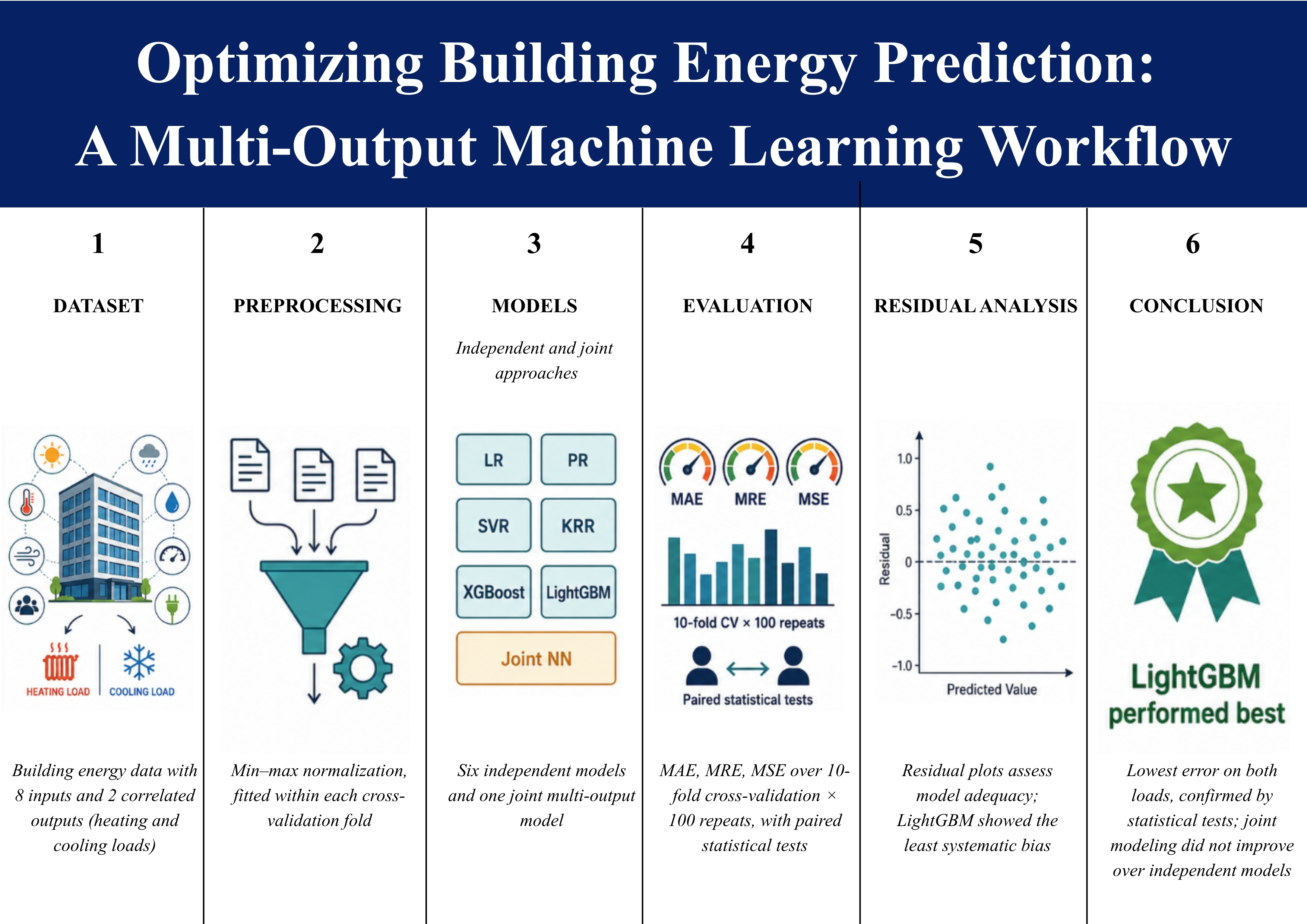
Accurate prediction of building heating and cooling loads is central to energy-efficient design, and because these loads are strongly correlated, they represent a suitable multi-output regression problem. This study compares six models from three families—linear (Linear Regression, Polynomial Regression), kernel-based (Support Vector Regression, Kernel Ridge Regression), and gradient-boosting ensembles (XGBoost, LightGBM)—for predicting the heating (y1) and cooling (y2) loads, and additionally evaluates a joint neural network (Joint NN) that predicts both outputs together. The models were assessed on the publicly available Energy Performance of Buildings dataset, comprising 768 samples with eight input variables and two highly correlated outputs (r = 0.98). Performance was measured by mean absolute error (MAE), mean relative error (MRE), and mean squared error (MSE) using 10-fold cross-validation repeated 100 times, reported as mean ± standard deviation. LightGBM achieved the lowest error on both outputs (MAE = 0.0077 ± 0.0009 for heating and 0.0173 ± 0.0022 for cooling), reducing MAE by 15.4% and 37.5% relative to the next-best model, XGBoost. Paired statistical tests confirmed that this advantage was significant across models. Although the two outputs are strongly correlated, the joint neural network did not outperform the independent ensembles on this moderate-sized dataset, suggesting that strong per-output models are better suited to data of this size. Residual analysis supported these findings, with LightGBM producing residuals randomly dispersed around zero. Overall, the study combines multiple error metrics, statistical testing, and residual diagnostics to guide model selection in correlated multi-output energy prediction.
GRAPHICAL ABSTRACT
HIGHLIGHTS
- Compared six independent models and a joint neural network for multi-output building energy prediction.
- LightGBM gave the lowest error on both heating and cooling loads, confirmed by paired statistical tests.
- Joint modeling did not outperform independent models on this moderately sized, strongly correlated dataset.
- The cooling load was consistently harder to predict than the heating load across all models.
- Feature importance identified relative compactness and glazing variables as the main load drivers.
References
Xu, D., Shi, Y., Tsang, I. W., Ong, Y.-S., Gong, C., & Shen, X. (2020). Survey on Multi-Output Learning. IEEE Transactions on Neural Networks and Learning Systems, 31(7), 2409–2429. https://doi.org/10.1109/TNNLS.2019.2945133
Hashempour, N., Taherkhani, R., & Mahdikhani, M. (2020). Energy performance optimization of existing buildings: A literature review. Sustainable Cities and Society, 54, 101967. https://doi.org/10.1016/j.scs.2019.101967
Jeong, J.-Y., Kang, J.-S., & Jun, C.-H. (2020). Regularization-based model tree for multi-output regression. Information Sciences, 507, 240–255. https://doi.org/10.1016/j.ins.2019.08.034
Ali, U., Bano, S., Shamsi, M. H., Sood, D., Hoare, C., Zuo, W., Hewitt, N., & O’Donnell, J. (2024). Urban building energy performance prediction and retrofit analysis using data-driven machine learning approach. Energy and Buildings, 303, 113768. https://doi.org/10.1016/j.enbuild.2023.113768
Wang, Z., Feng, Z., Ma, Z., & Peng, J. (2024). A multi-output regression model for energy consumption prediction based on optimized multi-kernel learning: A case study of tin smelting process. Processes, 12(1), 32. https://doi.org/10.3390/pr12010032
Rajaperumal, T. A., & Christopher Columbus, C. (2025). Enhanced wind power forecasting using machine learning, deep learning models and ensemble integration. Scientific Reports, 15(1), 20572. https://doi.org/10.1038/s41598-025-05250-3
Zhao, H., Liu, X., & Peng, D. (2025). Multi-energy load forecasting for integrated energy system based on multi-task learning. In Z. Dong, G. Li & Z. Li (Eds.), 2025 5th Power System and Green Energy Conference (PSGEC) (pp. 252–256). IEEE. https://doi.org/10.1109/PSGEC66102.2025.11150989
Cen, S., & Lim, C. G. (2024). Multi-Task Learning of the PatchTCN-TST Model for Short-Term Multi-Load Energy Forecasting Considering Indoor Environments in a Smart Building. IEEE Access, 12, 19553–19568. https://doi.org/10.1109/ACCESS.2024.3355448
Sahoo, K., & Thakur, M. (2025). A Multi-output ensemble learning approach for multi-day ahead index price forecasting. AppliedMath, 5(1), 6. https://doi.org/10.3390/appliedmath5010006
Setiawan, K. E., Shiddiqi, H. A., & Wicaksono, P. (2024). Multi-output machine learning regression for climate prediction: a comparative study of precipitation and temperature forecasting in Jakarta and East Kalimantan, Indonesia. Communications in Mathematical Biology and Neuroscience, 2024, 97. https://doi.org/10.28919/cmbn/8820
Tran, N. K., Kühle, L. C., & Klau, G. W. (2024). A critical review of multi-output support vector regression. Pattern Recognition Letters, 178, 69–75. https://doi.org/10.1016/j.patrec.2023.12.007
Borchani, H., Varando, G., Bielza, C., & Larrañaga, P. (2015). A survey on multi‐output regression. WIREs Data Mining and Knowledge Discovery, 5(5), 216–233. https://doi.org/10.1002/widm.1157
Ahmed, M. I., Nurjahan, Mahbub-Or-Rashid, M., & Islam, F. (2023). Prediction of Death Counts Based on Short-term Mortality Fluctuations Data Series using Multi-output Regression Models. International Journal of Advanced Computer Science and Applications, 14(5), 1165–1171. https://doi.org/10.14569/IJACSA.2023.01405120
Brindha, G. R., Rishiikeshwer, B. S., Santhi, B., Nakendraprasath, K., Manikandan, R., & Gandomi, A. H. (2022). Precise prediction of multiple anticancer drug efficacy using multi target regression and support vector regression analysis. Computer Methods and Programs in Biomedicine, 224, 107027. https://doi.org/10.1016/j.cmpb.2022.107027
Montgomery, D. C., Peck, E. A., & Vining, G. G. (2021). Introduction to linear regression analysis (6th ed.). John Wiley & Sons.
Rath, S., Tripathy, A., & Tripathy, A. R. (2020). Prediction of new active cases of coronavirus disease (COVID-19) pandemic using multiple linear regression model. Diabetes & Metabolic Syndrome: Clinical Research & Reviews, 14(5), 1467–1474. https://doi.org/10.1016/j.dsx.2020.07.045
Yang, S. J. H., Lu, O. H. T., Huang, A. Y. Q., Huang, J. C. H., Ogata, H., & Lin, A. J. Q. (2018). Predicting Students’ Academic Performance Using Multiple Linear Regression and Principal Component Analysis. Journal of Information Processing, 26, 170–176. https://doi.org/10.2197/ipsjjip.26.170
Cheng, C., & Schneeweiss, H. (1998). Polynomial Regression With Errors in the Variables. Journal of the Royal Statistical Society Series B: Statistical Methodology, 60(1), 189–199. https://doi.org/10.1111/1467-9868.00118
Shi, M., Hu, W., Li, M., Zhang, J., Song, X., & Sun, W. (2023). Ensemble regression based on polynomial regression-based decision tree and its application in the in-situ data of tunnel boring machine. Mechanical Systems and Signal Processing, 188, 110022. https://doi.org/10.1016/j.ymssp.2022.110022
Amrutphale, J., Rathore, P., & Malviya, V. (2020). A Novel Approach for Stock Market Price Prediction Based on Polynomial Linear Regression. In R. Shukla, J. Agrawal, S. Sharma, N. Chaudhari, & K. Shukla (Eds), Social Networking and Computational Intelligence: Proceedings of SCI-2018 (pp. 161–171). Springer. https://doi.org/10.1007/978-981-15-2071-6_13
Zhang, F., & O’Donnell, L. J. (2020). Support vector regression. In A. Mechelli & S. Vieira (Eds), Machine Learning (pp. 123–140). Elsevier. https://doi.org/10.1016/B978-0-12-815739-8.00007-9
Ma, Z., Ye, C., & Ma, W. (2019). Support vector regression for predicting building energy consumption in southern China. Energy Procedia, 158, 3433–3438. https://doi.org/10.1016/j.egypro.2019.01.931
Hasan, M. S., Tarequzzaman, M., Moznuzzaman, M., & Ahad Juel, M. A. (2025). Prediction of energy consumption in four sectors using support vector regression optimized with genetic algorithm. Heliyon, 11(2), e41765. https://doi.org/10.1016/j.heliyon.2025.e41765
Vovk, V. (2013). Kernel ridge regression. In B. Schölkopf, Z. Luo, & V. Vovk, (Eds), Empirical inference: Festschrift in honor of vladimir n. vapnik (pp. 105–116). Springer Berlin Heidelberg. https://doi.org/10.1007/978-3-642-41136-6_11
Panigrahy, S. K., & Chiang, K.-N. (2021). Study on an Artificial Intelligence Based Kernel Ridge Regression Algorithm for Wafer Level Package Reliability Prediction. In L. O’Conner (Ed), 2021 IEEE 71st Electronic Components and Technology Conference (ECTC) (pp.1435–1441). https://doi.org/10.1109/ECTC32696.2021.00229
Zhang, R., Li, Y., & Gui, Y. (2023). Prediction of rock blasting induced air overpressure using a self-adaptive weighted kernel ridge regression. Applied Soft Computing, 148, 110851. https://doi.org/10.1016/j.asoc.2023.110851
Chen, T., & Guestrin, C. (2016). XGBoost: A Scalable Tree Boosting System. In Proceedings of the 22nd ACM SIGKDD International Conference on Knowledge Discovery and Data Mining (pp.785–794). Association for Computing Machinery. https://doi.org/10.1145/2939672.2939785
Islam, S. F. N., Sholahuddin, A., & Abdullah, A. S. (2021). Extreme gradient boosting (XGBoost) method in making forecasting application and analysis of USD exchange rates against rupiah. Journal of Physics: Conference Series, 1722(1), 012016. https://doi.org/10.1088/1742-6596/1722/1/012016
Noorunnahar, M., Chowdhury, A. H., & Mila, F. A. (2023). A tree based eXtreme Gradient Boosting (XGBoost) machine learning model to forecast the annual rice production in Bangladesh. PLOS ONE, 18(3), e0283452. https://doi.org/10.1371/journal.pone.0283452
Ke, G., Meng, Q., Finley, T., Wang, T., Chen, W., Ma, W., Ye, Q., & Liu, T.-Y. (2017). Lightgbm: A highly efficient gradient boosting decision tree. In Proceedings of the 31st International Conference on Neural Information Processing Systems (pp.3149 - 3157). Curran Associates Inc.. https://dl.acm.org/doi/10.5555/3294996.3295074
Chowdhury, S. R., Mishra, S., Miranda, A. O., & Mallick, P. K. (2021). Energy Consumption Prediction Using Light
Gradient Boosting Machine Model. In N. Priyadarshi, S. Padmanaban, R. K. Ghadai, A. R. Panda, & R. Patel (Eds), Advances in Power Systems and Energy Management. ETAEERE ETAEERE 2020 2020. Lecture Notes in Electrical Engineering, vol 690. (pp. 413–422). Springer. https://doi.org/10.1007/978-981-15-7504-4_39
Ramalingam, K., Yadalam, P. K., Ramani, P., Krishna, M., Hafedh, S., Badnjević, A., Cervino, G., & Minervini, G. (2024). Light gradient boosting-based prediction of quality of life among oral cancer-treated patients. BMC Oral Health, 24(1), 349. https://doi.org/10.1186/s12903-024-04050-x
Tsanas, A., & Xifara, A. (2012). Accurate quantitative estimation of energy performance of residential buildings using statistical machine learning tools. Energy and Buildings, 49, 560–567. https://doi.org/10.1016/j.enbuild.2012.03.003
Downloads
Published
How to Cite
Issue
Section
Categories
License
Copyright (c) 2026 : Tidarat Luangrungruang, Gawalee Phatai

This work is licensed under a Creative Commons Attribution-NonCommercial-NoDerivatives 4.0 International License.