Impact of alkaline salts loading on structural, optical and Near-infrared shielding properties of potassium tungsten bronze materials
DOI:
https://doi.org/10.55674/cs.v18i3.266086Keywords:
Potassium tungsten bronze, Ball milling process, Near-infrared shieldingAbstract
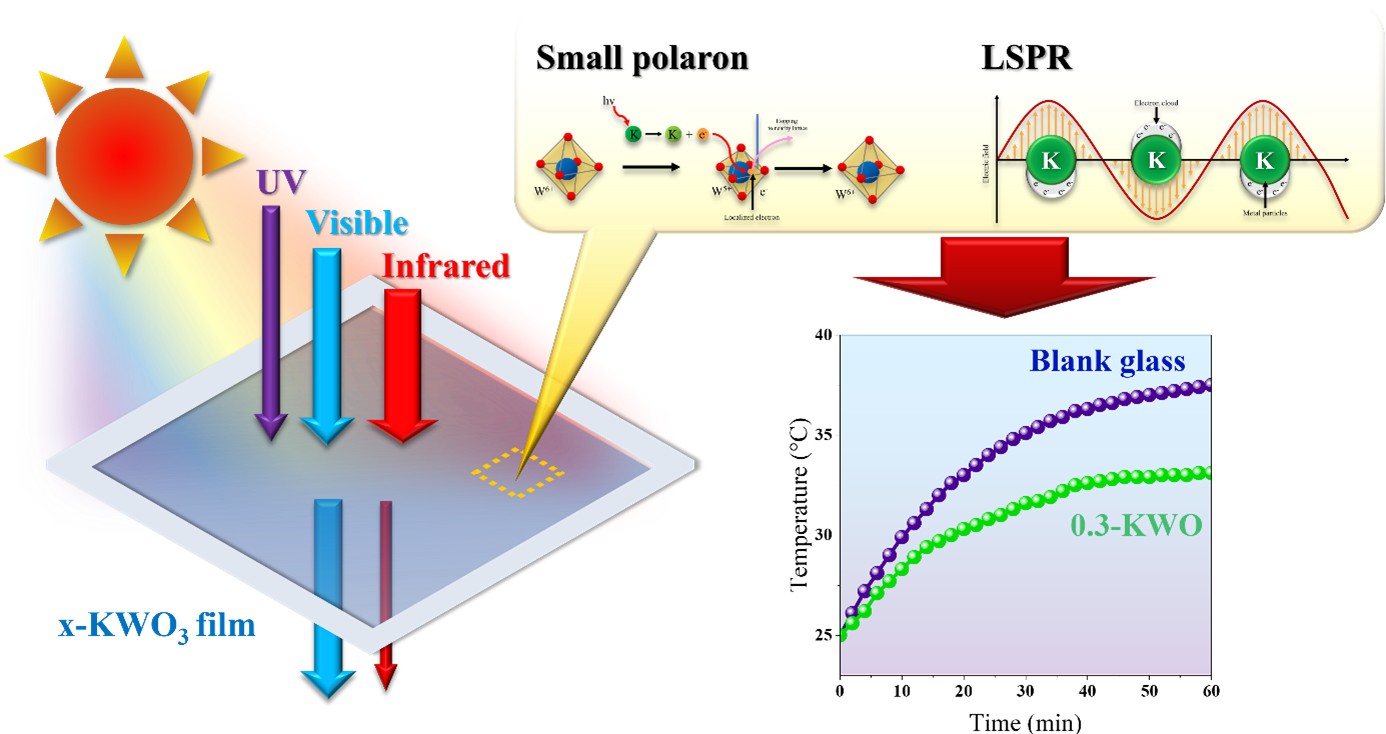
Increasing heat emissions through windows directly affect energy consumption in air conditioner systems. To address this challenge, potassium tungsten bronze (KxWO3) materials are used for near-infrared shielding. The materials provide high transmission in the visible region and strong absorption at infrared wavelengths. The optical properties of these materials depend on the ratio of alkali metal to tungsten, which determines the number of donor electrons available from the alkali metal, and also the extent of reduction of tungsten from its W6+ oxidation state to its W5+ state. This interplay between oxidation states gives rise to the phenomena of localized surface plasmon resonance (LSPR) and small polaron absorption. In this work, we investigated various values of x in KxWO3 where x = 0.1, 0.3, 0.5, and 0.7, using a high-energy ball milling method to synthesize the KxWO3 powders. Characterization was conducted using X-ray diffraction (XRD) for crystalline structure, field emission scanning electron microscopy (FESEM) for powder morphology determination, X-ray photoelectron spectroscopy (XPS) for the study of the oxidation states of tungsten (W), and ultraviolet–visible–near-infrared) spectroscopy (UV–vis–NIR) for optical property investigation. The results provide correlations between the potassium ratio, the crystal structure, and the NIR shielding performance of potassium tungsten bronze materials.
GRAPHICAL ABSTRACT
HIGHLIGHTS
- Hexagonal tungsten bronze particles were successfully synthesized by a facile ball milling process.
- The optimal potassium loading with K/W ratio at 0.3 stabilized the hexagonal structure, which induced near-infrared absorption efficiency.
- 3-KWO film exhibited near-infrared shielding performance, which reduced indoor temperature by up to 4.6 °C compared with blank glass.
References
Arif, R., Tabrej, M. Q., Equbal, A., Equbal, M. A., Badruddin, I. A., Mahmoud, E. R. I., & Zuber, M. (2025). Multi-objective optimization approaches for enhancing building energy efficiency through material and equipment selection. Case Studies in Thermal Engineering, 75, 107209. https://doi.org/10.1016/j.csite.2025.107209
Bakhshi, M. H., Eftekhari Yekta, B., Rezaie, H., & Ashjari, A. (2024). Synthesis of transparent tin-doped indium oxide (ITO)-containing glass-ceramic coating by the sol-gel route for UV/NIR-shielding. Optical Materials, 153, 115568. https://doi.org/10.1016/j.optmat.2024.115568
Cai, Q., Li, X., Wen, L., Du, Y., Shi, Y., Sun, Y., Ding, B., Wang, Y., & Wang, S. (2024). In-situ growth of Cs0·33WO3@ATO composite material with enhanced NIR shielding rate for energy-saving coating. Ceramics International, 50(19), 36691-36702. https://doi.org/10.1016/j.ceramint.2024.07.056
Chao, L., Bao, L., Wei, W., & Tegus, O. (2019). A review of recent advances in synthesis, characterization and NIR shielding property of nanocrystalline rare-earth hexaborides and tungsten bronzes. Solar Energy, 190, 10-27. https://doi.org/10.1016/j.solener.2019.07.087
Guo, C., Yin, S., Huang, L., & Sato, T. (2011). Synthesis of one-dimensional potassium tungsten bronze with excellent near-infrared absorption property. ACS Appl Mater Interfaces, 3(7), 2794-2799. https://doi.org/10.1021/am200631e
Gupta, V., & Deb, C. (2023). Envelope design for low-energy buildings in the tropics: A review. Renewable and Sustainable Energy Reviews, 186, 113650. https://doi.org/10.1016/j.rser.2023.113650
He, Z., Xie, W., Zhang, S., Gao, Y., Elnaggar, A. Y., Ren, J., El Azab, I. H., El-Bahy, Z. M., Yang, M., Zhang, H., & Guo, Z. (2024). Optimizing Spectral Properties of Cesium Tungsten Bronze Films Doped with Silver Nanowires Based on the Machine Learning Method. The Journal of Physical Chemistry C, 128(38), 16093-16109. https://doi.org/10.1021/acs.jpcc.4c03634
Kaspera, W., Wojas, J., Molenda, M., & Kotarba, A. (2016). Parallel migration of potassium and oxygen ions in hexagonal tungsten bronze – Bulk diffusion, surface segregation and desorption. Solid State Ionics, 297, 1-6. https://doi.org/10.1016/j.ssi.2016.09.029
Kim, M. S., Lee, H. K., Yoon, J. H., Kim, H. M., Kim, Y. S., & Kim, J. P. (2024). Improving dispersibility of tungsten oxide particles with organic ligands for photochromic films. Colloids and Surfaces A: Physicochemical and Engineering Aspects, 694, 134083. https://doi.org/10.1016/j.colsurfa.2024.134083
Kim, M. S., Yoon, J. H., Lee, H. K., Hirose, T., Takeda, Y., & Kim, J. P. (2024). Binder-enhanced reversible photochromic films by tungsten oxide hybrid composites for advanced applications. Colloids and Surfaces A: Physicochemical and Engineering Aspects, 703, 135118.https://doi.org/10.1016/j.colsurfa.2024.135118
Lee, J.-S., Liu, H.-C., Peng, G.-D., & Tseng, Y. (2017). Facile synthesis and structure characterization of hexagonal tungsten bronzes crystals. Journal of Crystal Growth, 465, 27-33. https://doi.org/10.1016/j.jcrysgro.2017.02.044
Li, P., Jiang, R., Zhao, L., Peng, H., Zhao, P., Jia, S., Zheng, H., & Wang, J. (2021). Cation Defect Mediated Phase Transition in Potassium Tungsten Bronze. Inorg Chem, 60(23), 18199-18204. https://doi.org/10.1021/acs.inorgchem.1c02839
Li, Q., Deng, S., Li, D., Yang, J., Jin, H., & Li, J. (2023). Tungsten bronze CsxWO3 nanopowders doped by Ti to enhance transparent thermal insulation ability for energy saving. Journal of Alloys and Compounds, 944, 169164. https://doi.org/10.1016/j.jallcom.2023.169164
Liu, C., Peng, Y., Zhou, F., Yin, Y., Huang, X., Wang, L., Wang, W., Zhou, W., & Tang, D. (2018). Large-scale synthesis and quantitative characterization of size-controllable potassium tungsten bronze nanowires. Journal of Physics D: Applied Physics, 51(9), 095305. https://doi.org/10.1088/1361-6463/aaa9dd
Liu, J.-X., Shi, F., Dong, X.-L., Liu, S.-H., Fan, C.-Y., Yin, S., & Sato, T. (2015). Morphology and phase controlled synthesis of CsxWO3 powders by solvothermal method and their optical properties. Powder Technology, 270, 329-336. https://doi.org/10.1016/j.powtec.2014.10.032
Liu, J., Ran, S., Fan, C., Qiao, Y., Shi, F., Yang, J., Chen, B., & Liu, S. (2019). One pot synthesis of Pt-doped CsxWO3 with improved near infrared shielding for energy-saving film applications. Solar Energy, 178, 17-24. https://doi.org/10.1016/j.solener.2018.12.007
Machida, K., Wakabayashi, M., Ono, K., & Adachi, K. (2024). Oxygen vacancy-induced plasmonic and polaronic excitations in rubidium- and potassium-doped hexagonal tungsten bronzes. Journal of Solid State Chemistry, 332, 124577. https://doi.org/10.1016/j.jssc.2024.124577
Pathak, N., Pilania, R. K., Sooraj, K. P., Ranjan, M., Sarker, D., & Dube, C. L. (2025). Microwave-assisted rapid synthesis of non-stoichiometric tungsten oxide doped borosilicate glasses for NIR shielding application. Ceramics International, 51(18), 24470-24480. https://doi.org/10.1016/j.ceramint.2025.03.130
Ran, S., Liu, J., Shi, F., Fan, C., Chen, B., Zhang, H., Yu, L., & Liu, S.-H. (2018). Greatly improved heat-shielding performance of KxWO3 by trace Pt doping for energy-saving window glass applications. Solar Energy Materials and Solar Cells, 174, 342-350. https://doi.org/10.1016/j.solmat.2017.08.013
Shen, B., Wang, Y., Lu, L., & Yang, H. (2020). Synthesis and characterization of Sb-doped SnO2 with high near-infrared shielding property for energy-efficient windows by a facile dual-titration co-precipitation method. Ceramics International, 46(11), 18518-18525.https://doi.org/10.1016/j.ceramint.2020.04.157
Shen, B., Wang, Y., Lu, L., & Yang, H. (2021). Spraying fabrication of spectrally selective coating with improved near-infrared shielding performance for energy-efficient glazing. Ceramics International, 47(13), 18991-18997. https://doi.org/https://doi.org/10.1016/j.ceramint.2021.03.243
Song, K., Weng, S., Zhou, J., Jiang, R., Cao, H., & Zhang, H. (2023). Tunable Optical Constants of Aluminum Tungsten Bronzes in Electrochromic Tungsten Oxide Thin Films. The Journal of Physical Chemistry C, 127(36), 18036-18042.https://doi.org/10.1021/acs.jpcc.3c03521
Song, X., Liu, J., Shi, F., Fan, C., Ran, S., Zhang, H., & Zou, Z. (2020). Facile fabrication of KmCsnWO3 with greatly improved near-infrared shielding efficiency based on W5+-induced small polaron and local surface plasmon resonance (LSPR) modulation. Solar Energy Materials and Solar Cells, 218, 110769. https://doi.org/10.1016/j.solmat.2020.110769
Suleiman, A. A., Parsi, A., Shakir, H. M., Rasouli, H. R., Pehlivanoğlu, D., & Kasırga, T. S. (2026). Synthesis of ultra-thin potassium tungsten bronze single crystals with optically contrasting domains and resistive switching. Materials Today Nano, 33, 100735.https://doi.org/10.1016/j.mtnano.2025.100735
Ta, N., Huang, J.-Y., He, S., Hanggai, W., & Chao, L.-M. (2024). Applications of optical control materials based on localized surface plasmon resonance effect in smart windows. Tungsten, 6(4), 711-731. https://doi.org/10.1007/s42864-024-00273-1
Wang, P., Liu, T., Zhao, S., Yang, Z., Ren, Z., Jiang, W., & Jiang, X. (2023). One-step ball-milling synthesis of cesium tungsten bronze nanoparticles and near-infrared shielding performance. Ceramics International, 49(13), 21393-21401. https://doi.org/10.1016/j.ceramint.2023.03.268
Wu, C.-M., Naseem, S., Chou, M.-H., Wang, J.-H., & Jian, Y.-Q. (2019). Recent Advances in Tungsten-Oxide-Based Materials and Their Applications. Frontiers in Materials, 6, 49. https://doi.org/10.3389/fmats.2019.00049
Wu, S., Wu, X., & Gao, Q. (2025). Modulation of NIR LSPR response via radial dopant inhomogeneity in tri-doped TiO2 for energy-saving window. Ceramics International, 51(1), 386-392. https://doi.org/10.1016/j.ceramint.2024.11.008
Wu, X., Wang, J., Zhang, G., Katsumata, K.-i., Yanagisawa, K., Sato, T., & Yin, S. (2017). Series of MxWO3/ZnO (M = K, Rb, NH4) nanocomposites: Combination of energy saving and environmental decontamination functions. Applied Catalysis B: Environmental, 201, 128-136. https://doi.org/10.1016/j.apcatb.2016.08.030
Yang, C., Chen, J. F., Zeng, X., Cheng, D., Huan, H., & Cao, D. (2016). Enhanced near-infrared shielding ability of (Li,K)-codoped WO3 for smart windows: DFT prediction validated by experiment. Nanotechnology, 27(7), 075203. https://doi.org/10.1088/0957-4484/27/7/075203
Yang, G., Hu, D., Yang, C., Qi, Y., Liu, B., Chen, H., Zhang, L., Cui, Y., Yao, X., & Takats, V. (2021). Alkali metal tungsten bronze-doped energy-saving glasses for near-infrared shielding applications. Ceramics International, 47(22), 31122-31129. https://doi.org/10.1016/j.ceramint.2021.07.286
Yao, Y., Zhang, L., Chen, Z., Cao, C., Gao, Y., & Luo, H. (2018). Synthesis of CsxWO3 nanoparticles and their NIR shielding properties. Ceramics International, 44(12), 13469-13475. https://doi.org/10.1016/j.ceramint.2018.04.158
Zhang, D., Liu, Y., & Tan, Y. (2026). Morphology-controlled synthesis of cesium tungsten bronze nanocrystals for enhanced NIR shielding performance. Applied Surface Science, 720, 165270. https://doi.org/10.1016/j.apsusc.2025.165270
Zhang, Y., Guo, D., & Li, R. (2022). Synthesis of Cs0.3WO3 with visible transparency and near-infrared absorption from commercial WO3. Journal of Solid State Chemistry, 306, 122768. https://doi.org/10.1016/j.jssc.2021.122768
Zhao, J., & Du, Y. (2020). Multi-objective optimization design for windows and shading configuration considering energy consumption and thermal comfort: A case study for office building in different climatic regions of China. Solar Energy, 206, 997-1017. https://doi.org/10.1016/j.solener.2020.05.090
Downloads
Published
How to Cite
Issue
Section
Categories
License
Copyright (c) 2026 : Phonlawee Pinthong, Maneerat Songpanit, Thanaphon Kansaard, Wanichaya Mekprasart, Kanokthip Boonyarattanakalin, Wisanu Pecharapa

This work is licensed under a Creative Commons Attribution-NonCommercial-NoDerivatives 4.0 International License.