Formulation development, physical stability, and preliminary safety screening of cosmetic emulsions containing banana peel extract
DOI:
https://doi.org/10.55674/cs.v18i3.265827Keywords:
Banana peel extract, Emulsion, Skin safetyAbstract
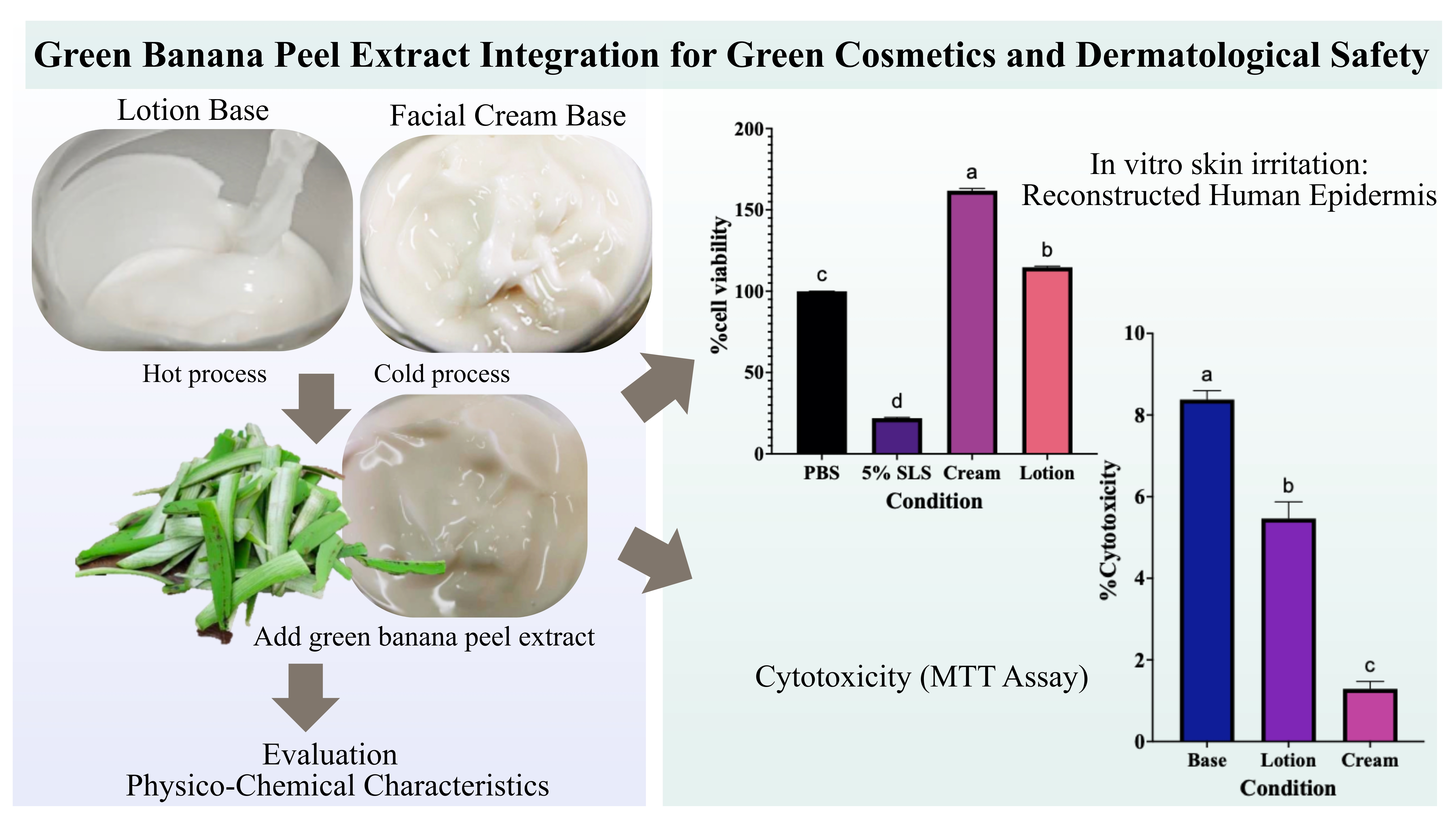
The purpose of the present study was to prepare and evaluate a lotion and cream containing banana peel extract for cosmetic application. The developed prototype formulations contained thickeners and emollients, and their physical, chemical, and preliminary sensory characteristics were evaluated. Experimental techniques used particle size analysis, viscosity and pH measurement as well as in vitro irritancy on reconstructed human epidermis (OECD 439). Cytocompatibility was also evaluated using HaCaT cell lines through the MTT assay. Both lotion and cream formulations containing banana peel extract (0.1% w w-1) showed consistent appearance and physical properties under the tested conditions. Skin irritation test results showed that the formulations are classified as non-irritant (viability > 50% relative to the negative control) according to OECD TG 439 criteria. Cytotoxicity studies revealed that all formulations at 1000 µg mL⁻¹ (extract-equivalent) were non-cytotoxic, maintaining cell viability above 70% in accordance with ISO 10993-5. These results suggest preliminary feasibility and in vitro safety under the tested conditions, indicating the potential of banana peel extract as a sustainable cosmetic ingredient for further dermatological development.
GRAPHICAL ABSTRACT
HIGHLIGHTS
- Both the lotion and cream formulations with banana peel extract demonstrated excellent physical stability, uniform particle distribution, and superior skin-friendly sensory attributes, confirming their suitability as safe topical cosmetic products.
- In vitro safety testing showed that all developed formulations were non-cytotoxic (viability >80% and <20% cytotoxicity at 1,000 µg ml-1), with cream exhibiting the lowest cytotoxicity—highlighting the potential of banana peel extract as a biocompatible ingredient for advanced dermatological applications.
References
Anjum, S., & Sundaram, S. (2023). Comparative analysis of antibacterial activity of banana peel at different stages of ripening. International Journal of Pharmaceutical Sciences and Drug Research, 15(1), 1–11. https://doi.org/10.25004/ijpsdr.2023.150101
Semangoen, T., Chotigawin, R., Sangmin, T., Chailerd, N., Pahasup-anan, T., & Huanbutta, K. (2024). Evaluation of banana peel extract (Musa sapientum L.) as a natural antimicrobial for livestock farming. Journal of Sustainable Agriculture and Environment, 3(2), 12118.
https://doi.org/10.1002/sae2.12118
Rukayi, H., Parmanamesti, D. A., Widyastari, S., & Kristiantingrum, Y. P. (2023). The effect of Kepok banana (Musa paradisiaca) peel extract on macroscopic and histopathological features of excision wound healing in mice skin. World Veterinary Journal, 13(1), 96–104.
https://doi.org/10.54203/scil.2025.wvj12
Cendani, W., Diadoari, A. D. S., Martianti, A. R., & Ikhtiar, R. (2019). Potential effect of Musa paradisiaca peel extract on skin hydration. In Proceedings of the International Conference on Health Informatics and Medical Application Technology (ICHI-MAT 2019), 379–384. https://doi.org/10.5220/0009515803790386
Cheng, Y. Z., Liu, I. M., Cheng, J. T., Lin, B. S., & Liu, F. (2020). Wound healing is promoted by Musa paradisiaca (banana) extract in diabetic rats. Archives of Medical Science, 20(2), 632–640. https://doi.org/10.5114/aoms.2020.92344
Mohd Zaini, H., Roslan, J., Saallah, S., Munsu, E., Sulaiman, N. S., & Pindi, W. (2022). Banana peels as a bioactive ingredient and its potential application in the food industry. Journal of Functional Foods, 92, 105054. https://doi.org/10.1016/j.jff.2022.105054
Hikal, W. M., Said-Al Ahl, H. A. H., Bratovcic, A., Tkachenko, K. G., Sharifi-Rad, J., Kačániová, M., Elhourri, M., & Atanassova, M. (2022). Banana peels: A waste treasure for human being. Evidence-Based Complementary and Alternative Medicine, 2022, 7616452.
https://doi.org/10.1155/2022/7616452
Bhavani, M., Moray, S., Saxena, D., & Awuuch, C. G. (2023). Bioactive, antioxidant, industrial, and nutraceutical applications of banana peel. International Journal of Food Properties, 26(1), 1277–1289.https://doi.org/10.1080/10942912.2023.2209701
Mayangsari, E., Mustika, A., Nurdiana, N., & Samad, N. A. (2024). Ameliorative effect of transfersome gel of kepok banana peel extract (Musa balbisiana) against photoaging in Wistar rat skin. Open Veterinary Journal, 14(8), 1990–1998. https://doi.org/10.5455/ovj.2024.v14.i8.28
Aswathi, V. V., Ravindran, N., Joy, A., Musthafa, F. S., Suha, & Mariyam, R. (2024). Formulation and evaluation of anti-aging cream containing banana peel extract and pumpkin seed oil. International Journal of Pharmaceutical Sciences, 2(2), 994–1001. https://doi.org/10.5281/zenodo.13820356
Rizka, R., Yuandani, Y., & Sumiyah. S. (2023). Wound healing and antimicrobial activities of a spray gel of banana (Musa paradisiaca L.) peel extract in rabbit (Oryctolagus cuniculus) models. Journal of Herbmed Pharmacology, 12(4), 567–574. https://doi.org/10.34172/jhp.2023.48080
Salve, Y. M., Dandekar, M. R., Mandhane, S., Mirzapure, I., & Telrandhe, U. B. (2025). Formulation and evaluation of herbal antioxidant cream from papaya latex and banana peel extract. Asian Journal of Pharmaceutics, 19(2), 722–730.
[Asuquo, E. O., Ukam, E. E., Edet, E. E., & Ufala, V. O. (2025). Formulation and evaluation of banana peel-based herbal cream for antibacterial and antifungal applications in cosmetic products. Journal of Dermatologic Science and Cosmetic Technology, 2(3), 100106.
https://doi.org/10.1016/j.jdsct.2025.100106
Savitri, D., Wahyuni, S., Bukhari, A., Djawad, K., Hatta, M., Riyanto, P., Bahar, B., Wahab, S., Hamid, F., & Rifai, Y. (2023). Anti-inflammatory effects of banana (Musa balbisiana) peel extract on acne vulgaris: In vivo and in silico study. Journal of Taibah University Medical Sciences, 18(6), 1586–1598. https://doi.org/10.1016/j.jtumed.2023.07.008
Alam, F., Dutta, A., Ghosh, A., Bora, R., Ghora, S. S., Guchhait, S., & Mallick, A. (2024). The potential effect of peel extracts of banana varieties: An in-vitro assessment. Journal of Applied Pharmaceutical Research, 12(4), 114–123. https://doi.org/10.69857/joapr.v12i4.621
Rahmadani, R. A., Nisafriandi, C. A. S., & Zaginadevi, A. S. (2023). Utilization of banana peel mask as a natural solution for prevention and treatment of acne in teenagers. Journal of Applied Science and Engineering Management Research, 1(3), 50–56.
Davy, P., Vu, H. T., & Vuong, Q. V. (2024). Extraction and formulation of valuable components from banana peels. Banana Peels Valorization: Sustainable and Eco-friendly Applications, 61–94. https://doi.org/10.1016/b978-0-323-95937-7.00003-2
Kongngoen, R., Ploykawethpon, P., Cheewakhunkheeree, P., Deesaman, N., Tepjaiakad, T., & Wongsiri, S. (2025). The influence of coffee bean processing, extraction temperature and time on the quality of cold brew coffee. Journal of Food Technology Mahasarakham University, 20(2), 83–94.
Watrobska-Swietlikowska, D. (2019). Stability of commercial parenteral lipid emulsions repacking to polypropylene syringes. PLOS ONE, 14(4), 0214451. https://doi.org/10.1371/journal.pone.0214451
OECD. (2025). Test No. 439: In vitro skin irritation: Reconstructed human epidermis test method. OECD Guidelines for the Testing of Chemicals, Section 4. OECD Publishing.
Forouz, F., Mohammed, Y., Shobeiri Nejad, H. S. A., Roberts, M. S., & Grice, J. E. (2023). In vitro screening of topical formulation excipients for epithelial toxicity in cancerous and non-cancerous cell lines. EXCLI Journal, 22, 1173–1199. https://doi.org/10.17179/excli2023-6072
Xiao, T., Ma, X., Hu, H., Xiang, F., Zhang, X., Zheng, Y., Dong, H., Adhikari, B., Wang, Q., & Shi, A. (2025). Advances in emulsion stability: A review on mechanisms, role of emulsifiers, and applications in food. Food Chemistry: X, 29, 102792. https://doi.org/10.1016/j.fochx.2025.102792
Ghule, A. K., Asif, S., & Udapurkar, P. (2024). Formulation and evaluation of cold creams from natural ingredients. International Research Journal of Modernization in Engineering Technology and Science, 6(6), 4930–4943.
Min, R. (2023). Chemical stability of cosmetic ingredients: Mechanisms of degradation and influencing factors. In Proceedings of the 2023 International Conference on Functional Materials and Civil Engineering, 35–44. https://doi.org/10.54254/2755-2721/2025.mh25102
Calvo, F., Gómez, J. M., Alvarez, O., & Ricardez-Sandoval, L. (2022). Effect of emulsification parameters on the rheology, texture, and physical stability of cosmetic emulsions: A multiscale approach. Chemical Engineering Research and Design, 186, 407–415.
https://doi.org/10.1016/j.cherd.2022.08.011
Nerkar, C., Wagh, S., Gaurav, M., & Borse, S. (2025). Formulation of banana herbal cream by using estimation of phytoconstituents from banana peel. International Journal of Plant Pathology and Microbiology, 5(1), 85–89.
Juttulapa, M., Piriyaprasarth, S., & Sriamornsak, P. (2013). Effect of pH on stability of oil-in-water emulsions stabilized by pectin-zein complexes. Advanced Materials Research, 747, 127–130. https://doi.org/10.4028/www.scientific.net/amr.747.127
Shafiei, M., Kazemzadeh, Y., Martyushev, D. A., Dai, Z., & Riazi, M. (2023). Effect of chemicals on the phase and viscosity behavior of water in oil emulsions. Scientific Reports, 13, 3194. https://doi.org/10.1038/s41598-023-31379-0
Hunter, T. N., Pugh, R. J., Franks, G. V., & Jameson, G. J. (2008). The role of particles in stabilising foams and emulsions. Advances in Colloid and Interface Science, 137(2), 57–81.
López-García, J., Lehocký, M., Humpolíček, P., & Sáha, P. (2014). HaCaT keratinocytes response on antimicrobial atelocollagen substrates: Extent of cytotoxicity, cell viability and proliferation. Journal of Functional Biomaterials, 5(2), 43–57. https://doi.org/10.1016/j.cis.2007.07.007
Zerbinati, N., Sommatis, S., Maccario, C., Di Francesco, S., Capillo, M. C., Grimaldi, G., Rauso, R., Herrera, M., Bencini, P. L., & Mocchi, R. (2021). A practical approach for the in vitro safety and efficacy assessment of an anti-ageing cosmetic cream enriched with functional compounds. Molecules, 26(24), 7592. https://doi.org/10.3390/molecules26247592
Gruber, S., & Nickel, A. (2023). Toxic or not toxic? The specifications of the standard ISO 10993-5 are not explicit enough to yield comparable results in the cytotoxicity assessment of an identical medical device. Frontiers in Medical Technology, 5, 1195529. https://doi.org/10.3389/fmedt.2023.1195529
Downloads
Published
How to Cite
Issue
Section
Categories
License
Copyright (c) 2026 : Pranudda Pimsee, Atittaya Meenongwa, Warongporn Rattanabun, Nichthima Warinthip, Pattaraphorn Panomai, Wannisa Keawbankrud, Duangsuree Sanseera, Supaporn Khangkham , Pattarawat Kraipiyaset, Wongnapa Nakyai, Natnicha Phungsara

This work is licensed under a Creative Commons Attribution-NonCommercial-NoDerivatives 4.0 International License.