
Rotational Effects on Heat Transfer for In-Line Jet Impingement Array in a Mid-Span Turbine Channel: An Experimental Study
Article Sidebar
Main Article Content
Abstract
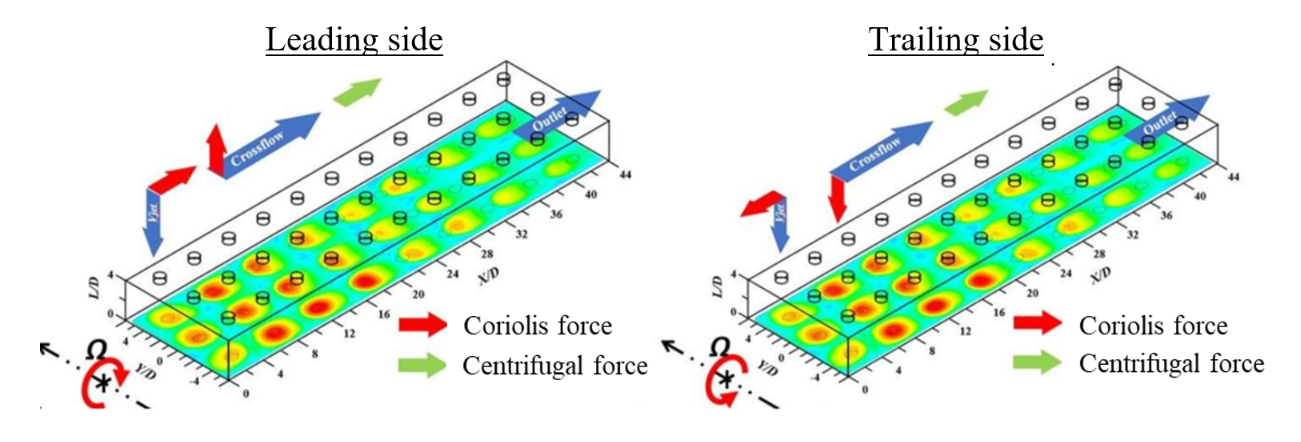
This study examined heat transfer for a 3x11 inline impinging jet array within a rotating channel that simulates the turbine blade cooling in mid-span region. The heat transfer on the impingement surface was investigated using Thermochromic Liquid Crystals and a thin-foil heater under steady-state conditions. The influence of impingement distance (L/D=2, 4, 6) and Rotation number (Ro=0.0-0.0083) was examined at a constant Reynolds number of Re=10,000. Results indicate intricate relationships between impingement distance, Coriolis forces, and crossflow. Increased rotation numbers generally diminish heat transfer on both of leading and trailing sides relative to the stationary condition. At a small L/D of 2, crossflow effects predominated over rotational effects, resulting in gradual decrease in downstream region. In contrast to distances L/D=4 and 6, the Nusselt number declined rapidly in the upstream region, whereas the influence of rotation lessened in the downstream region.
Article Details

This work is licensed under a Creative Commons Attribution-NonCommercial-ShareAlike 4.0 International License.

This work is licensed under a Creative Commons Attribution-NonCommercial-ShareAlike 4.0 International License.
References
Patil PS, Borse SL. Recent studies in internal cooling of gas turbine blade: A review. International Journal of Applied Engineering Research. 2018;13(9):7131-7141.
Unnikrishnan U, Yang V. A review of cooling technologies for high temperature rotating components in gas turbine. Propulsion and Power Research. 2022;11(4):1-18.
Kirttayoth Y, Rao Y. A review of recent studies on rotating internal cooling for gas turbine blades. Chinese Journal of Aeronautics. 2021.
Elston CA, Wright LM. Leading edge jet impingement under high rotation numbers. Journal of Thermal Science and Engineering Applications. 2017;9(2):021010.
Chang SW, Yu KC. Thermal performance of radially rotating trapezoidal channel with impinging jet-row. International Journal of Heat and Mass Transfer. 2019;136:246-264.
Yang L, Tyagi K, Ekkad S, Ren J. Influence of rotation on heat transfer in a two-pass channel with impingement under high Reynolds number. Proceedings of ASME Turbo Expo 2015: Turbine Technical Conference and Exposition; 2015; Montréal, Canada. USA: ASME; 2015.
Nontula T, Kaewchoothong N, Kaew-apichai W, Nuntadusit C. Effect of rotation number on heat transfer characteristics of a row of impinging jets in confined channel. Journal of Advanced Research in Fluid Mechanics and Thermal Sciences. 2021;77(1):161-171.
Singh P, Ekkad SV. Detailed heat transfer measurements of jet impingement on dimpled target surface under rotation. Journal of Thermal Science and Engineering Applications. 2018;10(3):031006.
Kaewchoothong N, Nontula T, Nuntadusit C. Effect of crossflow orientations in the impinging jet flow channel on flow and heat transfer enhancement under rotations. International Journal of Thermal Sciences. 2025;208:109478.
Moffat RJ. Describing the uncertainties in experimental results. Experimental Thermal and Fluid Science. 1988;1(1):3-17.
