
Role of Shape Factor in Wake Width Development at Moderate Reynolds Number
Article Sidebar
Main Article Content
Abstract
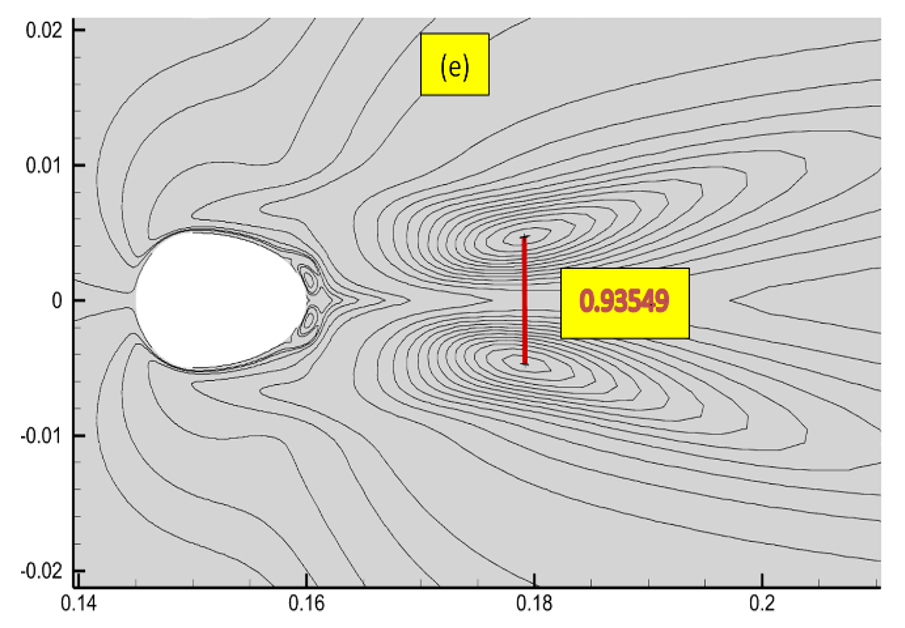
This paper addresses the wake width variability downstream of bluff bodies with variable shape factors. The numerical investigation is conducted at the laminar vortex shedding regime with moderate Reynolds numbers (Re) ranging from 80 to 160. Shape factor (S.F.) is decided by the extent of the bluffness imparted to the rear part of the body, 0.5 being the bluffest, while 2.0 is the streamlined. The results point out that Re had a consistent impact on wake width for all body shapes, while the same couldn’t be stated for the shape factor. The shape factor had a non-intrusive effect on wake behaviour, and all shape factor configurations produced wakes of an identical structure at a particular Reynolds number. Quantitative comparisons also indicate that wake width stays on the same scale as projected body length. It seems that the Reynolds number plays a more significant role than shape in establishing wake structure for the laminar regime. The findings of this paper provide relevant information for passive flow control and bluff body design with small geometric variations in moderate Reynolds number regimes.
Article Details

This work is licensed under a Creative Commons Attribution-NonCommercial-ShareAlike 4.0 International License.

This work is licensed under a Creative Commons Attribution-NonCommercial-ShareAlike 4.0 International License.
References
Roshko A. Perspectives on bluff body aerodynamics. Journal of Wind Engineering and Industrial Aerodynamics. 1993;49:79–100.
Gerrard JH. The mechanics of the formation region of vortices behind bluff bodies. Journal of Fluid Mechanics. 1966;25(2):401–13.
Bloor MS. The transition to turbulence in the wake of a circular cylinder. Journal of Fluid Mechanics. 1964;19(2):290–304.
Williamson CHK. Vortex dynamics in the cylinder wake. Annual Review of Fluid Mechanics. 1996;28:477–539.
Duda D, Uruba V, Yanovych V. Wake width: Discussion of several methods how to estimate it by using measured experimental data. Energies. 2021;14(15).
Kolář V. Vortex identification: New requirements and limitations. International Journal of Heat and Fluid Flow. 2007;28(4):638–52.
Jeong J, Hussain F. On the identification of a vortex. Journal of Fluid Mechanics. 1995;285:69–94.
Bloor MS, Gerrard JH. Measurements on turbulent vortices in a cylinder wake. Proceedings of the Royal Society of London A: Mathematical, Physical and Engineering Sciences. 1966;294(1438):319–42.
Alam MM. Fluctuating forces on bluff bodies and their relationships with flow structures. Ocean Engineering. 2023;273:113870.
Balachandar S, Mittal R, Najjar FM. Properties of the mean recirculation region in the wakes of two-dimensional bluff bodies. Journal of Fluid Mechanics. 1997;351:167–99.
Griffin OM. A note on bluff body vortex formation. Journal of Fluid Mechanics. 1995;284:217–24
Holloway DS, Walters DK, Leylek JH. Prediction of unsteady, separated boundary layer over a blunt body for laminar, turbulent, and transitional flow. International Journal for Numerical Methods in Fluids. 2004;45(12):1291–315.
Posdziech O, Grundmann R. A systematic approach to the numerical calculation of fundamental quantities of the two-dimensional flow over a circular cylinder. Journal of Fluids and Structures. 2007;23(3):479–99.
Rastan MR, Alam MM, Zhu H, Ji C. Onset of vortex shedding from a bluff body modified from square cylinder to normal flat plate. Ocean Engineering. 2022;244:110393.
Sohankar A, Norberg C, Davidson L. Low-Reynolds-number flow around a square cylinder at incidence: Study of blockage, onset of vortex shedding and outlet boundary condition. International Journal for Numerical Methods in Fluids. 1998;26(1):39–56.
Durante D, Giannopoulou O, Colagrossi A. Regimes identification of the viscous flow past an elliptic cylinder for Reynolds number up to 10000. Communications in Nonlinear Science and Numerical Simulation. 2021;102:105902.
Farsad S, Ardekani E, Farhani F, Parpanchi SM, Rezaei M, Ardekani MA. Experimental study of vortex shedding phenomenon induced by various bluff body geometries for use in vortex flowmeters. European Journal of Mechanics B/Fluids. 2025;111:188–200.
Karlson M, Nita BG, Vaidya A. Numerical computations of vortex formation length in flow past an elliptical cylinder. Fluids. 2020;5(3):1–11.
Forouzi Feshalami B, He S, Scarano F, Gan L, Morton C. A review of experiments on stationary bluff body wakes. Physics of Fluids. 2022;34(1).
Kumar R, Kumar MH. A review study on fluid flow past bluff bodies of various cross-section placed in different configurations. International Journal of Energy. Environment and Economics. 2023;31(2), 243-252
Teimourian A, Teimourian H. Vortex shedding suppression: A review on modified bluff bodies. Engineering. 2021;2(3):325–339.
Ren H, Zheng TY, Lin WY, Li HT, Qin WY, Yurchenko D. Dynamics and performance evaluation of wind-induced vibration of a cuboid bluff body with two ornaments. Ocean Engineering. 2023;286:115517.
Mittal R, Balachandar S. Effect of three-dimensionality on the lift and drag of nominally two-dimensional cylinders. Physics of Fluids. 1995;7(8):1841–65.
Norberg C. Fluctuating lift on a circular cylinder: Review and new measurements. Journal of Fluids and Structures. 2003;17(1):57–96.
Thompson MC, Leweke T, Hourigan K. Bluff bodies and wake-wall interactions. Annual Review of Fluid Mechanics. 2021;53:347–76.
Chandra D, Dobriyal R, Kharola A, Sharma RC. Effect of bluff body shape on the growth rate of wake instability. SAE Technical Paper. 2023:1–6.
Dobriyal R, Mishra M, Bölander M, Skote M. Effects of streamlining a bluff body in the laminar vortex shedding regime. Journal of Fluids Engineering, Transactions of the ASME. 2020;142(2).
Park J, Choi H. Numerical solutions of flow past a circular cylinder at Reynolds numbers up to 160. KSME International Journal. 1998;12(6):1200–5.
Norberg C. Interaction between freestream turbulence and vortex shedding for a single tube in cross-flow. Journal of Wind Engineering and Industrial Aerodynamics. 1986;23:501–14.
