
A Digital Twin and Probabilistic Optimization Framework for Resistance Spot-Welded Joints in Automotive Applications
Article Sidebar
Main Article Content
Abstract
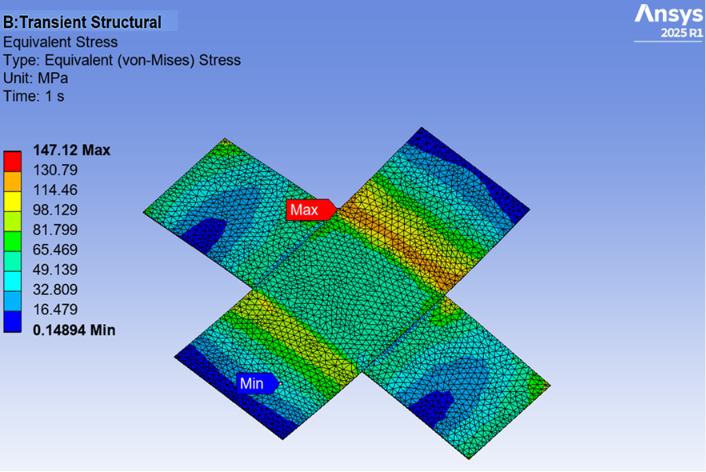
This study formulates a digital twin–driven probabilistic model to forecast and optimize the tensile behavior of resistance spot-welded (RSW) galvanized steel auto-body joints. Experimental experimentation was performed on multi-spot cross-tension specimens by a Taguchi L27 design with the considerations of welding current (8959–9554 A), sheet thickness (0.19–0.30 mm), electrode force (350–497 N), weld spot number (2–8), and radial distance (12–16 mm). Tensile strength varied from 4.08 Kgf to 150.91 Kgf. A linear regression model accomplished ±5% prediction accuracy in this range, with thickness and number of welds as the most significant parameters, and radial distance as having a significantly negative effect on strength. To offset the weakness of regression, finite element analysis (FEA) was systematically incorporated, allowing for a mechanistic understanding of stress concentrations due to off-center weld placement and to confirm the observed empirical trends. The FEA also showed predictive validity, with calculations at an unseen parameter set (9554 A, 0.27 mm, 350 N, 8 spots) approximating tensile strength to 145.2 Kgf versus the tested 150.9 Kgf (3.7% error). Parameter uncertainty was quantified using Monte Carlo simulations with Latin Hypercube Sampling (170 runs), and Global Sensitivity Analysis indicated sheet thickness and weld radius as overall factors on strength variability. Dynamic tensile testing (1.32–2.00 m/min) validated the model's insensitivity to service-relevant strain rates. Together, the synergy from the combination of regression, FEA, and probabilistic simulations provides a predictive digital twin approach that is both statistically sound and mechanistically interpretable. The approach improves weld performance assessment reliability and provides scalable applicability towards lightweight and safe automotive structures.
Article Details

This work is licensed under a Creative Commons Attribution-NonCommercial-ShareAlike 4.0 International License.

This work is licensed under a Creative Commons Attribution-NonCommercial-ShareAlike 4.0 International License.
References
Yasin NA, Alisibramulisi A, Salleh Z, Ghazali FA, Pawan A. Optimization of resistance spot welding (RSW) parameters using Taguchi method. International Journal of Innovative Technology and Exploring Engineering. 2020;9(3):2795-2800.
Budianto A, Sukarman S, Jumawan SB, Abdulah A. Optimization of tensile-shear strength in the dissimilar joint of Zn-coated steel and low carbon steel. Automotive Experiences. 2020;3(3):115-125.
Arinate M, Elayachi I, Akourri O. Optimization of spot welding conditions and effect on nugget diameter using Taguchi methodology. International Journal of Materials Science and Engineering. 2020;8(4):118-129.
Sukarman S, Abdulah A, Rajab DA, Anwar C. Optimization of resistance spot welding parameters in dissimilar joining of galvanized and low carbon steel. Dinamika Teknik Mesin. 2021;11(1):39-48.
Mishra D. Dissimilar resistance spot welding of mild steel and stainless steel for optimum weld nugget size. Materials Today: Proceedings. 2021;46:919-924.
Capezza C, Centofanti F, Lepore A, Frosolini M, Macchiaroli R. Optimisation of RSW process data clustering in the automotive industry. Applied Stochastic Models in Business and Industry. 2020;36(5):1103-1120.
Rajasekar G, Gurusami K. Investigating the effect of tensile shear strength of resistance spot welding using a neuro-fuzzy control system. International Journal of Interactive Design and Manufacturing. 2024;19(5):3267-3275.
Stavropoulos P, Sabatakakis K. Quality assurance in resistance spot welding: state of practice, state of the art, and prospects. Metals. 2024;14(2):185.
Hayazi NF, Jaraman P, Che Halin DS, et al. Analysis of process parameters for RSW on galvanized steel using the Taguchi method. Archives of Metallurgy and Materials. 2025;70(1):39-46.
Chinvorarat S, Watjatrakul B, Nimdum P, Sangpet T, Vallikul P. Six-degree-of-freedom dynamic model of a light sport aircraft. IOP Conference Series: Materials Science and Engineering. 2020;886:012011.
Chinvorarat S, Vallikul P. A novel retractable landing gear for a light amphibious airplane: design, synthesis, analysis, and implementation. Aircraft Engineering and Aerospace Technology. 2021;93(10):1547-1558.
Chinvorarat S. Composite wing structure of a light amphibious airplane: design, optimization, and experimental testing. Heliyon. 2021;7:e08410.
Jiao H, Jin H. Monte Carlo simulation of grain growth in the heat-affected zone during welding of cast steel joints. Welding in the World. 2024;68(5):2501-2509.
