
Evaluation of Conical Pin Fin Arrangements on Heat Sink Heat Transfer and Flow Characteristics
Article Sidebar
Main Article Content
Abstract
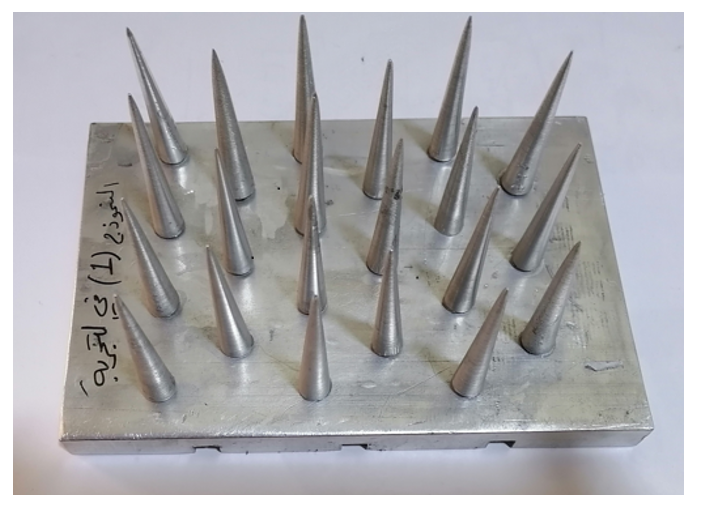
This study experimentally evaluates the thermal and hydraulic performance of conical pin-fin heat sinks under varying airflow rates, power inputs, and fin spacing configurations. Four heat sink designs were fabricated from aluminum alloy 6061-T6 and tested in an open-loop wind tunnel. Key performance metrics, including the Nusselt number and apparent friction factor, were assessed across Reynolds numbers ranging from 10,480 to 23,900 and power inputs of 180, 285 and 480 W. Results indicate that the configuration with a longitudinal-to-transverse pitch ratio (R) of 1 achieved the highest thermal performance, enhancing the Nusselt number by up to 19.4% compared to other arrangements. In contrast, the R = 2 configuration exhibited the highest friction factor due to increased flow resistance. Experimental outcomes were validated using established correlations from Zukauskas, Colburn, and Jacob, showing strong agreement. These findings support the design optimization of heat sinks for efficient thermal management in electronic applications.
Article Details

This work is licensed under a Creative Commons Attribution-NonCommercial-ShareAlike 4.0 International License.

This work is licensed under a Creative Commons Attribution-NonCommercial-ShareAlike 4.0 International License.
References
Smith KL. Heat transfer in electronic equipment. Electronics and Wireless World. 1986;92(1606).
Kepekci H, Asma A. Comparative analysis of heat sink performance using different materials. American Journal of Engineering Research. 2020;9(4).
Lee S. Optimum design and selection of heat sinks. IEEE Transactions on Components, Packaging, and Manufacturing Technology Part A. 1995;18(4):812–817.
Delibaş H, Yılmaz İH. Thermo-economic optimization for the advanced material selection of fins and heat sinks. Chemical Engineering and Processing Process Intensification. 2025;208:110109.
Wu JM, Zhao JY, Tseng KJ. Parametric study on the performance of double-layered microchannels heat sink. Energy Conversion and Management. 2014;80:550–560.
Bhandari P, Prajapati YK. Thermal performance of open microchannel heat sink with variable pin fin height. International Journal of Thermal Sciences. 2021;159:106609.
Subramani S, Devarajan M. Influence of extended surface area of heatsink on heat transfer design and analysis. Microelectronics International. 2024;41(2).
Gaikwad A, Sathe A, Sanap S. A design approach for thermal enhancement in heat sinks using different types of fins: A review. Frontiers in Thermal Engineering. 2023;2.
Maji A, Choubey G. Improvement of heat transfer through fins: A brief review of recent developments. Heat Transfer. 2020;49(3).
Abbas EF, Jassim AH, Salem TK. Review of the fin optimization in the heat sink design. International Review of Mechanical Engineering. 2023;17(10).
Ehsan B, Abbas F. The performance optimization of conical pin fin heat sink on the condensation process.
Hempijid T, Kittichaikarn C. Effect of heat sink inlet and outlet flow direction on heat transfer performance. Applied Thermal Engineering. 2020;164:114375.
Hussain AA, Freegah B, Khalaf BS, Towsyfyan H. Numerical investigation of heat transfer enhancement in plate-fin heat sinks: Effect of flow direction and fillet profile. Case Studies in Thermal Engineering. 2019;13:100388.
Khan WA, Culham JR, Yovanovich MM. The role of fin geometry in heat sink performance. Journal of Electronic Packaging. 2006;128(4).
Chapman CL, Lee S, Hampshire N, Schmidt BL. Thermal performance of an elliptical pin fin heat sink. In: Tenth IEEE SEMI-THERM; 1994; 24–31.
Deshmukh PA, Warkhedkar RM. Thermal performance of elliptical pin fin heat sink under combined natural and forced convection. Experimental Thermal and Fluid Science. 2013;50.
Nilpueng K, Mesgarpour M, Asirvatham LG, Dalkılıç AS, Ahn HS, Mahian O, Wongwises S. Effect of pin fin configuration on thermal performance of plate pin fin heat sinks. Case Studies in Thermal Engineering. 2021;27.
Xie GF, Zhao L, Dong YY, Li YG, Zhang SL, Yang C. Hydraulic and thermal performance of microchannel heat sink inserted with pin fins. Micromachines. 2021;12(3).
Abdelmohimen MAH, Almutairi K, Elkotb MA, Abdelrahman HE, Algarni S. Numerical investigation of using different arrangement of fin slides on the plate-fin heat sink performance. Thermal Science. 2021;25(6).
Abbas EF, Jassim AH, Salem TK. Examining the impact of conical fin shape on hydrothermal characteristics. International Journal of Heat and Technology. 2025;43(1):29–38.
Wang P, Chen L. Thermal and hydraulic performance of micro pin fin heat sinks with different pin fin shapes. In: IOP Conference Series Materials Science and Engineering; 2019.
Abbas EF, Jassim AH, Salem TK. Investigation on the thermohydraulic characteristics of converting a cone fin to a truncated cone fin: an experimental study. International Review of Mechanical Engineering. 2024;18(12):653.
Shah RK, Sekuli DP. Fundamentals of heat exchanger design. 2003.
Abbas EF. An analytical and experimental evaluation of a heat sink under constant heat flow and forced convection heat transfer. Journal of Engineering and Technological Sciences. 2021;53(4).
Choudhary V, Kumar M, Patil AK. Experimental investigation of enhanced performance of pin fin heat sink with wings. Applied Thermal Engineering. 2019;155.
Jia Y, Huang J, Wang J, Li H. Heat transfer and fluid flow characteristics of microchannel with oval-shaped micro pin fins. Entropy. 2021;23(11).
Žukauskas A. Heat transfer from tubes in crossflow. Advances in Heat Transfer. 1972;8:93–160.
Colburn AP. A method of correlating forced convection heat-transfer data and a comparison with fluid friction. International Journal of Heat and Mass Transfer. 1964;7(12):1359–1384.
Jakob M. Discussion heat transfer and flow resistance in cross flow of gases over tube banks. Transactions of the American Society of Mechanical Engineers. 2023;60(4):384–386.
Kailash OP, Bishwajeet NKC, Umang BG, Sumit BP, Gopal K. Design and experimental analysis of pipe in pipe heat exchanger. International Journal of Modern Engineering Research. 2015. Available from: http://www.ijmer.com
