
Mechanical and Thermal Characterization of Natural Composites for Sustainable Applications
Article Sidebar
Main Article Content
Abstract
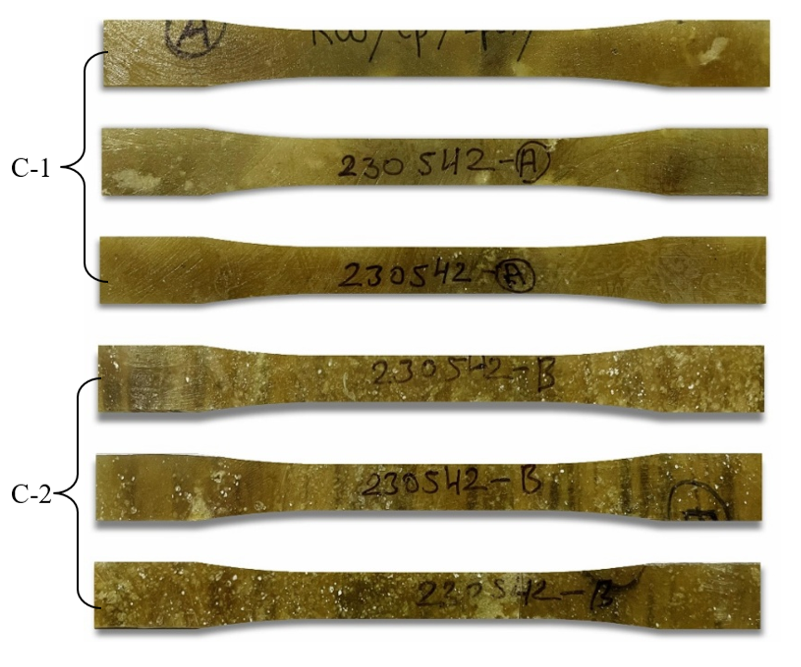
This study explores the development and mechanical characterization of sustainable hybrid composites reinforced with rockwool, conch shell powder, and flax fibers within an epoxy matrix. Two distinct composite formulations were fabricated: Rockwool/Conch/Epoxy (C-1) and Rockwool/Flax/Epoxy (C-2), each comprising 30 wt.% reinforcement (15 wt.% rockwool fibers and 15 wt.% conch powder or flax fibers) and 70 wt.% epoxy resin. The composites were produced using the hand lay-up method followed by compression molding. Comprehensive mechanical tests, including tensile and flexural strength assessments, were conducted in accordance with ASTM standards. Additionally, thermogravimetric analysis (TGA), water-absorption testing and scanning electron microscopy (SEM) were employed to evaluate thermal stability, moisture affinity, and microstructural characteristics. The results indicated that C-2 exhibited superior tensile and flexural strengths compared to C-1, attributed to the enhanced fiber–matrix bonding facilitated by flax fibers. Conversely, C-1 demonstrated better thermal stability but also higher water uptake, reflecting the porous, hydrophilic nature of conch shell particles. SEM analysis revealed effective dispersion of reinforcements and strong interfacial adhesion in C-2, whereas C-1 showed minor voids around conch particles. These findings highlight the potential of integrating natural and industrial waste materials to develop high-performance, eco-friendly composites with tailored mechanical, thermal, and moisture-management properties suitable for various structural applications.
Article Details

This work is licensed under a Creative Commons Attribution-NonCommercial-ShareAlike 4.0 International License.

This work is licensed under a Creative Commons Attribution-NonCommercial-ShareAlike 4.0 International License.
References
Seraji M.M, Kianersi S, Hosseini SH, Davarpanah J, Elahi S. Performance evaluation of glass and rock wool fibers to improve thermal stability and mechanical strength of monolithic phenol-formaldehyde based carbon aerogels. Journal of Non Crystalline Solids. 2018;491:89–97.
Siligardi C, Miselli P, Francia E, Gualtieri M.L. Temperature-induced microstructural changes of fiber-reinforced silica aerogel (FRAB) and rock wool thermal insulation materials: A comparative study. Energy and Buildings. 2017;138:80–87.
Vinoth Kumar K, Pavendhan R, Gopala Rama Subramaniyan G, Loganathan TG. Effect of bio waste (conch shell) particle dispersion on the performance of glass fiber reinforced polymer composite. Journal of Materials Research and Technology. 2020;9(4):7123–7135.
Elfaleh I, Abbassi F, Habibi M, Ahmad F, Guedri M, Nasri M, Garnier C. A comprehensive review of natural fibers and their composites: an eco-friendly alternative to conventional materials. Results in Engineering. 2023;19:101271.
Raponi E, Sergi C, Boria S, Tirillò J, Sarasini F, Calzolari A. Temperature effect on impact response of flax and epoxy laminates: analytical, numerical and experimental results. Composite Structures. 2021;274:114316.
Wang J, Bennett GJ. Multi-chamber micro-perforated panel absorbers optimised for high amplitude broadband absorption using a two-point impedance method. Journal of Sound and Vibration. 2023;547:117527.
Thilagavathi G, Muralikrishnan A, Muthukumar N, Neelakrishnan S. Investigation on sound absorption characteristics of nonwoven coir mats. Functional Textiles and Clothing. Singapore: Springer; 2019:37–45.
Taban E, Khavanin A, Faridan M, Samaei SE, Samimi K, Rashidi R. Comparison of acoustic absorption characteristics of coir and date palm fibers: experimental and analytical study of green composites. International Journal of Environmental Science and Technology. 2020;17:39–48.
Sekar V, Fouladi MH, Namasivayam SN, Sivanesan S. Additive manufacturing: a novel method for developing an acoustic panel made of natural fiber-reinforced composites with enhanced mechanical and acoustical properties. Journal of Engineering. 2019;2019.
Prabhakaran S, Krishnaraj V, Shankar K, Senthilkumar M, Zitoune R. Experimental investigation on impact, sound, and vibration response of natural-based composite sandwich made of flax and agglomerated cork. Journal of Composite Materials. 2020;54(5):669–680.
Kishore SE, Sujithra R, Dhatreyi B. A review on latest acoustic noise mitigation materials. Materials Today Proceedings. 2021;47:4700–4707.
Samaei SE, Amininasab S, Salimi F, Sheikhmozafari MJ, Nadianmehr R, Kazemi Tabrizi A, Taban E. Investigation of the effect of nanoparticles on the acoustic and flammability behavior of natural kenaf fibers. Iranian Occupational Health. 2022;19(1):167–182.
Samaei SE, Mahabadi HA, Mousavi SM, Khavanin A, Faridan M, Taban E. The influence of alkaline treatment on acoustical, morphological, tensile and thermal properties of kenaf natural fibers. Journal of Industrial Textiles. 2022;51(5 Suppl):8601S–8625S.
Yang T, Hu L, Xiong X, Petrů M, Noman MT, Mishra R, Militký J. Sound absorption properties of natural fibers: a review. Sustainability. 2020;12(20):8477.
Taban E, Mirzaei R, Faridan M, Samaei E, Salimi F, Tajpoor A, Ghalenoei M. Morphological, acoustical, mechanical and thermal properties of sustainable green Yucca fibers: an exploratory investigation. Journal of Environmental Health Science and Engineering. 2020;18:883–896.
SheikhMozafari MJ, Taban E, Soltani P, Faridan M, Khavanin A. Sound absorption and thermal insulation performance of sustainable fruit stone panels. Applied Acoustics. 2024;217:109836.
Halashi K, Taban E, Soltani P, Amininasab S, Samaei E, Moghadam DN, Khavanin A. Acoustic and thermal performance of luffa fiber panels for sustainable building applications. Building and Environment. 2024;247:111051.
Chauhan V, Karki T, Varis J. Review of natural fiber-reinforced engineering plastic composites, their applications in the transportation sector and processing techniques. Journal of Thermoplastic Composite Materials. 2022;35(8):1169–1209.
Aziz SH, Ansell MP. The effect of alkalization and fiber alignment on the mechanical thermal properties of kenaf and hemp bast fiber composite. Part 1: polyester resin matrix. Composites Science and Technology. 2004;64:1219–1230.
Faruk O, Bledzki AK, Fink H, Sain M. Biocomposites reinforced with natural fibers. Progress in Polymer Science. 2012;37:1552–1596.
Bledzki AK, Reihmane S, Gassan J. Properties and modification methods for vegetable fibers for natural fiber composites. Journal of Applied Polymer Science. 1996;59(8):1329–1336.
Liu L, Yu J, Cheng L, Yang X. Biodegradability of poly butylene succinate composite reinforced with jute fiber. Polymer Degradation and Stability. 2009;94(1):90–94.
Khalil HPSA, Tehrani M, Davoudpour Y, Bhat AH, Jawaid M, Hassan A. Natural fiber reinforced poly vinyl chloride composites: a review. Journal of Reinforced Plastics and Composites. 2012;32(5):330–356.
Hassan E, Wei Y, Jiao H, Huo YM. Plant fibers reinforced poly lactic acid as a green composites: review. International Journal of Engineering Science and Technology. 2012;4(10):4429–4439.
Shahzad A. Hemp fiber and its composites: a review. Journal of Composite Materials. 2011;46(8):973–986.
Xi L, Tapil LG, Panigrahi S. Chemical treatments of natural fiber for use in natural fiber-reinforcement composites: a review. Journal of Polymers and the Environment. 2007;15(1):25–33.
Xue Y, Veazie DR, Glinsey C, Horstemeyer MF, Rowell RM. Environmental effects of mechanical and thermomechanical properties of aspen fiber polypropylene composites. Composites Part B Engineering. 2007;38(2):152–158.
Kadhum AQ. Dynamical properties of epoxy chopped rock wool composites. Journal of Al Nahrain University. 2011;14(3):50–57.
Lee HL, Neville G. Handbook of epoxy resins. New York: McGraw Hill; 1967.
Shah D, Patel M. Recent development of flax fibres and their reinforced composites. Polymers. 2018;10(12):1375.
Chaudhary A, Singh N, Singh R, Yadav H. Evaluation of physicochemical properties of conch shell and its standardization. Journal of Ayurveda and Integrative Medicine. 2018;9(4):300–306.
