
Enhancement of Used Temple Oil Biofuel Blends Using Artificial Intelligence for Eco-Friendly Cities Medium Duty Commercial Vehicles in India
Article Sidebar
Main Article Content
Abstract
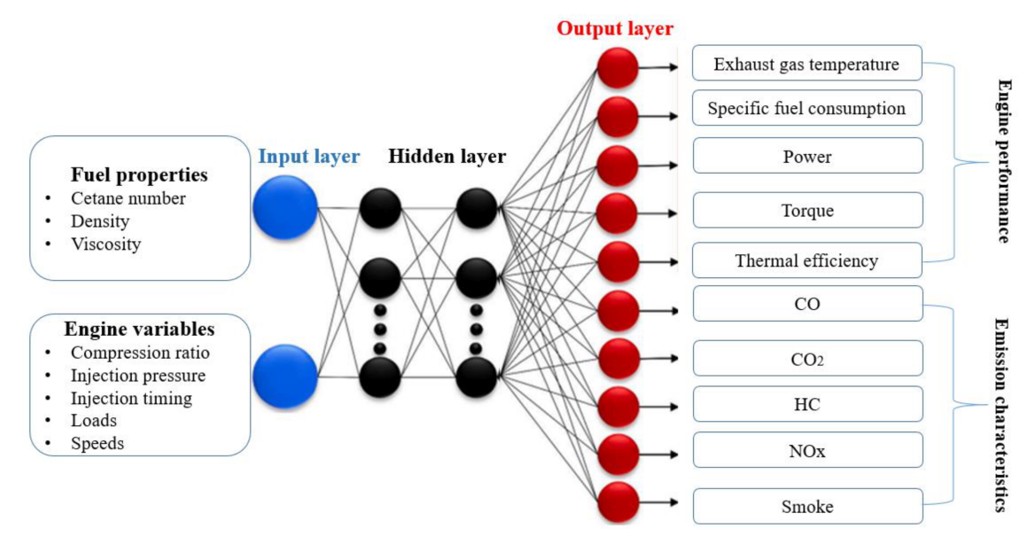
The efficiency of bio-blends made from seeds for medium-duty urban commercial vehicles is the subject of a study whose results are presented in this article. The analysis took into account a number of variables, such as engine specifications, economic consequences, and production capacity. An artificial intelligence algorithm was trained to predict emission characteristics, combustion, and performance using experimental data. The findings showed that while brake-specific fuel consumption (BSFC) increased at full load, brake thermal efficiency (BTE) dropped for both diesel and bio-fuel combinations as engine speed increased. In particular, there was an 11.9% increase in BSFC when diesel was used instead of mixtures of biofuel and diesel. The bio fuel-diesel blends also reduced maximum cylinder pressure and NOx emissions, with maximum reductions of 9.8% and 22.2% at specific RPMs, respectively. Additionally, these blends significantly decreased emissions of carbon dioxide (CO2) and smoke. Overall, biofuel blends provide substantial benefits by reducing exhaust pollutants and improving engine efficiency.
Article Details

This work is licensed under a Creative Commons Attribution-NonCommercial-ShareAlike 4.0 International License.

This work is licensed under a Creative Commons Attribution-NonCommercial-ShareAlike 4.0 International License.
References
Abishek MS, Kachhap S, Rajak U, Verma TN, Singh TS, Saboor S, Cuce E, Saleel CA. Alumina and titanium nanoparticles to diesel–Guizotia abyssinica (L.) biodiesel blends on MFVCR engine performance and emissions. Sustainable Energy Technologies and Assessments. 2024;61:103580.
Afzal A, V SH, Agbulut U, Alahmadi AA, Gowda AC. Poultry fat biodiesel as a fuel substitute in diesel–ethanol blends for direct injection compression ignition engine: experimental, modeling and optimization. Energy. 2023;270:126826.
Agbulut U, Karagöz M, Saridemir S, Öztürk A. Impact of various metal-oxide based nanoparticles and biodiesel blends on the combustion, performance, emission, vibration and noise characteristics of a compression ignition engine. Fuel. 2020;270:117521.
Altun Ş, Fırat M, Varol Y, Okcu M. Comparison of direct and port injection of methanol in a reactivity controlled compression ignition engine using diesel and biodiesel as high reactivity fuels. Process Safety and Environmental Protection. 2023;174:681–693.
Aslan V. Fuel characterization, engine performance characteristics and emissions analysis of different mustard seed biodiesel: an overview. Journal of Biotechnology. 2023;370:12–30.
Ayd H. An innovative research on variable compression ratio in reactivity controlled compression ignition strategy on a power generator diesel engine using CNG–safflower biodiesel. Energy. 2021;231:121002.
Bibin C, Sheeja R, Devarajan Y, Ponnappan VS. Environmental impact assessment of agricultural diesel engines utilizing biodiesel derived from Phoenix sylvestris oil. Environmental Research. 2023;224:115432.
Bitire SO, Jen TC. An optimization study on a biosynthesized nanoparticle and its effect on the performance–emission characteristics of a diesel engine fueled with parsley biodiesel blend. Energy Reports. 2023;9:2185–2200.
Chen Y, Liang C, Liu D, Niu Q, Miao X, Dong G, Li L, Liao S, Ni X, Huang X. Embedding graph neural network for transient nitrogen oxides emissions prediction. Energies. 2023;16(1):3.
Dasore A, Rajak U, Panchal M. Prediction of overall characteristics of a dual fuel compression ignition engine working on low-density ethanol and diesel blends at varying compression ratios. Arabian Journal for Science and Engineering. 2022;47:15323–15330.
Efendy M, Surono A, Saputra E, Nugraha NA. Performance and smoke opacity of compression ignition engine using used waste oil. Case Studies in Thermal Engineering. 2021;26:101063.
Elumalai PV, Krishna Moorthy R, Parthasarathy M, Samuel OD, Owamah HI, Saleel CA, Enweremadu CC, Sreenivasa Reddy M, Afzal A. Artificial neural networks model for predicting the behavior of different injection pressure characteristics powered by blend of biofuel–nano emulsion. Energy Science and Engineering. 2022;10:2367–2396.
Fan M, Li Z, Song S, Alahmadi TA, Alharbi SA, Shanmugam S, Brindhadevi K. Optimizing biodiesel blends with green hydrogen fuel: a study on combustion duration, fuel mass burnt, engine performance and emissions. Fuel. 2023;346:128340.
Gavaskar T, Ramanan MV, Arun K, Arivazhagan S. The combined effect of green synthesized nitrogen-doped carbon quantum dots blended jackfruit seed biodiesel and acetylene gas tested on the dual fuel engine. Energy. 2023;275:127296.
Gowrishankar S, Krishnasamy A. Emulsification – a promising approach to improve performance and reduce exhaust emissions of a biodiesel fuelled light-duty diesel engine. Energy. 2023;263:125782.
Ineza Havugimana LF, Liu B, Liu F, Zhang J, Li B, Wan P. Review of artificial intelligent algorithms for engine performance, control, and diagnosis. Energies. 2023;16:1206.
Jeyaseelan T, El Samad T, Rajkumar S, Chatterjee A, Al-Zaili J. A techno-economic assessment of waste oil biodiesel blends for automotive applications in urban areas: case of India. Energy. 2023;271:127021.
Jiahong F, Yang R, Li X, Sun X, Li Y, Liu YZ, Zhang BS. Application of artificial neural network to forecast engine performance and emissions of a spark ignition engine. Applied Thermal Engineering. 2022;201(Part A):117749.
Kalyani T, Prasad LSV, Kolakoti A. Effect of triacetin as an oxygenated additive in algae biodiesel fuelled compression ignition engine combustion, performance, and exhaust emission analysis. Fuel. 2023;338:127366.
Kesgin U. Genetic algorithm and artificial neural network for engine optimisation of efficiency and nitrogen oxides emission. Fuel. 2004;83(7–8):885–895.
Khatri KK, Singh M, Khatri N. An artificial neural network model for the prediction of performance and emission parameters of a compression ignition engine-operated micro-tri-generation system fueled with diesel, Karanja oil, and Karanja biodiesel. Fuel. 2023;334:126549.
Mrityunjayaswamy KM, Deepak Kumar T, Tejas KS, Ramesha DK. Experimental investigation on influence of metal based additives on performance, combustion and emission parameters of diesel engine. Materials Today: Proceedings. 2022;54(2):264–269.
Lalsangi S, Yaliwal VS, Banapurmath NR, Soudagar MEM, Agbulut Ü, Kalam MA. Analysis of common rail direct injection diesel engine characteristics operated on dual fuel mode fueled with biodiesel–hydrogen enriched producer gas under the single and multi-injection scheme. International Journal of Hydrogen Energy. 2023;48(74):28927–28944.
Masera K, Hossain AK. Advancement of biodiesel fuel quality and nitrogen oxides emission control techniques. Renewable and Sustainable Energy Reviews. 2023;178:113235.
Musthafa B, Saravanan B, Asokan MA, Devendiran S, Venkatesan K. Effect of ethanol, propanol and butanol on karanja biodiesel with vegetable oil fuelled in a single cylinder diesel engine. Egyptian Journal of Petroleum. 2023;32:35–40.
Prabhu C, Navaneetha Krishnan B, Prakash T, Rajasekar V, Balasubramanian D, Le VV. Biodiesel unsaturation and the synergic effects of hydrogen sharing rate on the characteristics of a compression ignition engine in dual-fuel mode. Fuel. 2023;334:126699.
Prakash P, Dhanasekaran C. Influencing parameter optimisation of common rail direct injection engine fuelled with lemongrass biodiesel blends. International Journal of Ambient Energy. 2023;44(1):719–738.
Sharma P, Sharma AK, Balakrishnan D, Manivannan A, Chia WY, Awasthi MK. Model prediction and optimization of the performance of a biodiesel–producer gas powered dual-fuel engine. Fuel. 2023;348:128405.
Thodda G, Madhavan VR, Thangavelu L. Predictive modelling and optimization of performance and emissions of acetylene fuelled compression ignition engine using artificial neural network and response surface methodology. Energy Sources, Part A: Recovery, Utilization and Environmental Effects. 2023;45(2):3544–3562.
Zandie M, Ng HK, Said MF, Cheng X, Gan S. Performance of a compression ignition engine fuelled with diesel–palm biodiesel–gasoline mixtures: computational fluid dynamics and multi-parameter optimisation studies. Energy. 2023;274:127346.
Zapata-Mina J, Restrepo A, Tibaquira JE. Assessment of the exergy, emissions, and combustion characteristics of a diesel engine operating on low-glyceride biodiesel blended with diesel fuel. Case Studies in Thermal Engineering. 2023;41.
Anjappa S, Ramesha D. Experimental investigation of the effects of a reduced exhaust gas recirculation rate on the performance and emissions of compression ignition engines running on biodiesel made from dairy waste scum oil. Journal of Research and Applications in Mechanical Engineering. 2024;13(1)
