
Effect Triangular Baffles on Thermal- Hydraulic Optimization and Turbulent Flow CuO/ Water Nanofluid in 2D Channel Using Computational Fluid Dynamics Method
Article Sidebar
Main Article Content
Abstract
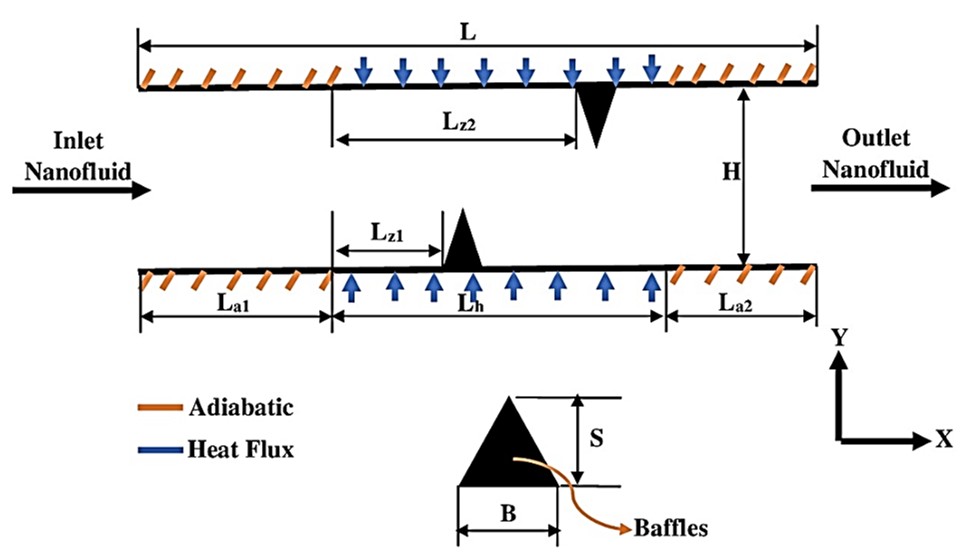
In large-scale applications, fluid flow with baffles is a multifaceted phenomenon because it plays an important role in improving heat transfer and mixing in addition to other fluid dynamics processes. To achieve the required heat transfer, the design of triangular baffle models inside the channel is of great importance. In the present work, the effect of the inclusion of baffles in the upper and lower surface of a two-dimensional channel of a nanofluid flow (CuO+Water) with volumetric fractions (5%) steady-state single-phase turbulence with Reynolds number ranges of (7000-17000) is numerically studied. The channel is divided into three main sections, the first and the last are thermally insulated, and the second is subjected to a constant uniform heat flux of (30 kW/m2). Using the finite volume method of the Ansys Fluent program, all the equations governing the fluid flow inside the channel, including the conservation of mass, momentum, and heat energy, were solved using the turbulent k-ε for high Reynolds values. The numerical results of the current study indicated that the heat transfer rate gradually increases with an increase in the Reynolds number, while the friction factor gradually decreases with an increase in the Reynolds number, moreover, the values of the Nusselt number and the friction factor were affected by the height of the baffles, where the increase in height both increases gradually, it was also found that the height of (12 mm) gave the highest percentage of heat transfer enhancement with a value of (82.69%) compared to the other heights (2, 4, 6, 8 and 10 mm), which gave a ratio of (60.46, 70.01 and 80.65%), respectively. Finally, the pressure, temperature and velocity distribution of the nanofluid differed when the baffles were placed to disturb the passing flow compared to the normal empty channel.
Article Details

This work is licensed under a Creative Commons Attribution-NonCommercial-ShareAlike 4.0 International License.

This work is licensed under a Creative Commons Attribution-NonCommercial-ShareAlike 4.0 International License.
References
Zhu Z, Zhang M. Water vapor adsorption on desiccant materials for rotor desiccant air conditioning systems. Processes. 2023;11(7):2166.
Chen Q, Jones JR, Archer RH. A dehumidification process with cascading desiccant wheels to produce air with dew point below 0 °C. Applied Thermal Engineering. 2019;148:78–86.
Lei YG, He YL, Li R, Gao YF. Effects of baffle inclination angle on flow and heat transfer of a heat exchanger with helical baffles. Chemical Engineering and Processing: Process Intensification. 2008;47(12):2336–2345.
Li Z, Gao Y. Numerical study of turbulent flow and heat transfer in cross-corrugated triangular ducts with delta-shaped baffles. International Journal of Heat and Mass Transfer. 2017;108:658–670.
Sriromreun P. Numerical study on heat transfer enhancement in a rectangular duct with incline shaped baffles. Chemical Engineering Transactions. 2017;57:1243–1248.
Rashidi S, Eskandarian M, Mahian O, Poncet SJ. Combination of nanofluid and inserts for heat transfer enhancement: gaps and challenges. Journal of Thermal Analysis and Calorimetry. 2019;135:437–460.
Alnak DE. Thermohydraulic performance study of different square baffle angles in cross-corrugated channel. Journal of Energy Storage. 2020;28:101295.
Chang SW, Cheng TH. Thermal performance of channel flow with detached and attached pin-fins of hybrid shapes under inlet flow pulsation. International Journal of Heat and Mass Transfer. 2021;164:120554.
Keklikcioglu O, Ozceyhan V. Experimental investigation on heat transfer enhancement of a tube with coiled-wire inserts installed with a separation from the tube wall. International Communications in Heat and Mass Transfer. 2016;78:88–94.
Nanan K, Piriyarungrod N, Thianpong C, Wongcharee K, Eiamsa-ard S. Numerical and experimental investigations of heat transfer enhancement in circular tubes with transverse twisted-baffles. Heat and Mass Transfer. 2016;52:2177–2192.
Ji J, Pan Y, Zhang J, Shi B, Bao L. Numerical study on the effect of baffle structure on the heat transfer performance of elastic tube bundle heat exchanger. Applied Thermal Engineering. 2024;238:122220.
Al-darraji AR, Marzouk SA, Aljabr A, Almehmadi FA, Alqaed S, Kaood A. Enhancement of heat transfer in a vertical shell and tube heat exchanger using air injection and new baffles: experimental and numerical approach. Applied Thermal Engineering. 2024;236:121493.
Bhattacharyya S, Sharma AK, Vishwakarma DK, Goel V, Paul AR. Influence of magnetic baffle and magnetic nanofluid on heat transfer in a wavy minichannel. Sustainable Energy Technologies and Assessments. 2023;56:102954.
Bichkar P, Dandgaval O, Dalvi P, Godase R, Dey T. Study of shell and tube heat exchanger with the effect of types of baffles. Procedia Manufacturing. 2018;20:195–200.
Menni Y, Chamkha AJ, Zidani C, Benyoucef B. Numerical analysis of heat and nanofluid mass transfer in a channel with detached and attached baffle plates. Mathematical Modelling of Engineering Problems. 2019;6(1).
Nithya M, Vel MS, Anitha S, Sivaraj C. Optimizing thermal efficiency: advancements in flat plate heat exchanger performance through baffle integration. International Communications in Heat and Mass Transfer. 2024;158:107885.
Akçay S. Numerical analysis of hydraulic and thermal performance of Al₂O₃-water nanofluid in a zigzag channel with central winglets. Gazi University Journal of Science. 2023;36(1):383–397.
De D, Pal TK, Bandyopadhyay S. Helical baffle design in shell and tube type heat exchanger with CFD analysis. International Journal of Heat and Technology. 2017;35(2):378–383.
Lima-Téllez T, Hinojosa JF, Hernández-López I, Moreno S. Numerical study of the thermal performance of a single-channel cooling PV system using baffles and different nanofluids. Heliyon. 2024;10(15).
Reddy PN, Verma V, Kumar A, Awasthi MK. CFD simulation and thermal performance optimization of channel flow with multiple baffles. Journal of Heat and Mass Transfer Research. 2023;10(2):257–268.
Ali SA, Rasheed SA. Effect of partially filled porous media on laminar flow and heat transfer via forced convection of fluid flow within a channel at different angles: a numerical study. AIP Conference Proceedings. 2025;3169(1).
Ali SA, Barrak ES, Alrikaby NJ, Hameed MR. Numerical study of thermal-hydraulic performance of forced convection heat transfer in dimple surface pipe with different shapes using commercial CFD code. Heat Transfer. 2025;125(2):1–5.
Aljabair S, Mohammed AA, Alesbe I. Natural convection heat transfer in corrugated annuli with H₂O–Al₂O₃ nanofluid. Heliyon. 2020;6(11).
Karamallah AA, Mahmoud NS. Experimental investigation of heat transfer enhancement with nanofluid and twisted tape inserts in a circular tube. Engineering and Technology Journal. 2016;34(3A):664–684.
Elfaghi AM, Abosbaia AA, Alkbir MF, Omran AA. Heat transfer enhancement in pipe using Al₂O₃/water nanofluid. CFD Letters. 2022;14(9):118–124.
Elfaghi AM, Mustaffa M. Numerical simulation of forced convection heat transfer in pipe using different nanoparticles. Journal of Complex Flow. 2021;3(2):33–37.
Abobaker M, Addeep S, Afolabi LO, Elfaghi AM. Effect of mesh type on numerical computation of aerodynamic coefficients of NACA 0012 airfoil. Journal of Advanced Research in Fluid Mechanics and Thermal Sciences. 2021;87(3):31–39.
Hameed MR, Al Sarmad Ahmed A, Hadwan HH, Toman AA, Mahdi MA. CFD-FSI analysis of textured journal bearing working with nano lubricant. Diagnostyka. 2024;25(2).
Togun H, Homod RZ, Aljibori HS, Abed AM, Alias H, Hussein AK, Biswal U, Al-Thamir M, Mahdi JM, Mohammed HI, Ahmadi G. Al₂O₃–Cu hybrid nanofluid flow and heat transfer characteristics in the duct with various triangular rib configurations. Journal of Thermal Analysis and Calorimetry. 2024;149(17):10047–10060.
Shojaee S, Vahabi M, Dinarvand S, Hamedi A, Mirabdolah Lavasani A, Moinfar Z. Twisted-tape inserts of rectangular and triangular sections in turbulent flow of CMC/CuO non-Newtonian nanofluid into an oval tube. International Journal of Numerical Methods for Heat & Fluid Flow. 2024;34(12):4535–4564.
Marzouk SA, Almehmadi FA, Aljabr A, Sharaf MA. Numerical and experimental investigation of heat transfer enhancement in double tube heat exchanger using nail rod inserts. Scientific Reports. 2024;14(1):9637.
Ali SA. Influence of inserted different ribs configuration in 2D horizontal channel on characteristics turbulent fluid flow and forced heat transfer: a numerical investigation. Journal of Research and Applications in Mechanical Engineering. 2025;13(1).
Blazek J. Computational fluid dynamics: principles and applications. Butterworth-Heinemann; 2015.
Rebollo TC, Lewandowski R. Mathematical and numerical foundations of turbulence models and applications. Springer New York; 2014.
Zhang L, Che D. Influence of corrugation profile on the thermal-hydraulic performance of cross-corrugated plates. Numerical Heat Transfer, Part A: Applications. 2011;59(4):267–296.
Anjaneya G, Sunil S, Manjunatha NK, Santhosh A, Patil SA, Prasad CD, Aden AA, Giriswamy BG. Study of impact of nanofluids on performance of microchannel heat exchangers using CFD. International Journal of Thermofluids. 2024;24:100836.
Abumandour RM, El-Reafay AM, Salem KM, Dawood AS. Numerical investigation by cut-cell approach for turbulent flow through an expanded wall channel. Axioms. 2023;12(5):442.
Abumandour RM, El-Reafay AM, Salem KM, Dawood AS. Numerical investigation by cut-cell approach for turbulent flow through an expanded wall channel. Axioms. 2023;12(5):442.
Yuan W, Zhang X, Poirel D. Numerical investigation of aerodynamic response to gust including gust-induced dynamic stall. AIAA Aviation Forum and Ascend. 2024:4475.
