
Research on Performances of Rotor Dehumidification for Ring Main Unit
Article Sidebar
Main Article Content
Abstract
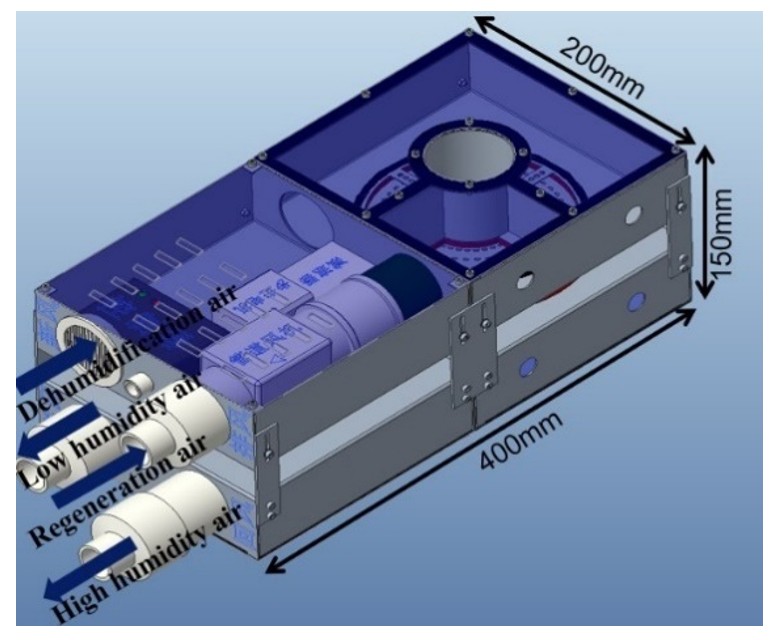
In view of the dehumidification problem of ring main unit, a dehumidification scheme using a small dehumidification rotor is proposed. A small dehumidification rotor device impregnated with polymer adsorbent was designed and manufactured. The experimental device adopts thermal balance calibration, and the error range is less than 3%. In order to further study the performances of the small dehumidifying rotor, the small dehumidifying rotor was tested by changing the regeneration temperature and speed under two air conditions of high temperature and high humidity and low temperature and high humidity. The test results show that it has good dehumidification effect under the two different environmental conditions. After a long time of on-site dehumidification test of the ring main unit, even if the relative humidity outside the ring main unit reaches more than 80%, the relative humidity inside the ring main unit remains below 65%, effectively solving the problem of condensation in the main unit.
Article Details

This work is licensed under a Creative Commons Attribution-NonCommercial-ShareAlike 4.0 International License.

This work is licensed under a Creative Commons Attribution-NonCommercial-ShareAlike 4.0 International License.
References
Zhu Z, Zhang M. Water vapor adsorption on desiccant materials for rotor desiccant air conditioning systems. Processes. 2023;11(7):2166.
Chen Q, Jones JR, Archer RH. A dehumidification process with cascading desiccant wheels to produce air with dew point below 0 °C. Applied Thermal Engineering. 2019;148:78–86.
Yadav L, Sharma A, Pratap R, Mishra SK, Verma AK. Performance evaluation of different desiccant matrix materials coated with silica gel. Heat Transfer Engineering. 2023;44:1–13.
Ge F, Wang C. Exergy analysis of dehumidification systems: a comparison between the condensing dehumidification and the desiccant wheel dehumidification. Energy Conversion and Management. 2020;224:113343.
Liu M, Tu R, Chen X, Wu Z, Zhu J, Yang X. Performance analyses of an advanced heat pump driven fresh air handling system using active and passive desiccant wheels under various weather conditions. International Journal of Refrigeration. 2022;141:1–11.
Lu C, Li X. Research on anti-condensation technology for prefabricated cabin of smart substation. Electrical Engineering. 2020;21(11):66–70.
Luo X, Xia L. Research on dewing prevention technology for electrical equipment. Renewable Energy Resources. 2014;32(4):489–492.
Toyoda E, Matsumoto M, Handa T. Insulation failure in telecommunication cables resulting from water condensation in aerial terminal closures and its prevention using a humidity controlling polymer. IEEE Transactions on Dielectrics and Electrical Insulation. 2005;12(1):175–182.
Patania F, Gagliano A, Nocera F. Thermofluid dynamic analysis of ventilated facades. Energy and Buildings. 2010;42(7):1148–1155.
De Gracia A, Castell A, Navarro L. Numerical modelling of ventilated facades: a review. Renewable and Sustainable Energy Reviews. 2013;22:539–549.
Huang M. Research progress of GIS equipment heating. High Voltage Apparatus. 2020;56(12):24–33.
Wang Z. Thermal analysis of GIS busbar based on coupled magnetic-fluid-temperature fields. Zhejiang Electric Power. 2021;40(1):44–49.
Fong KF, Chow TT, Lee CK, Lin Z, Chan LS. Advancement of solar desiccant cooling system for building use in subtropical Hong Kong. Energy and Buildings. 2010;42(12):2386–2399.
Bareschino P, Diglio G, Pepe F, Angrisani G, Roselli C, Sasso M. Modelling of a rotor desiccant wheel: numerical validation of a variable properties model. Applied Thermal Engineering. 2015;78:640–648.
Ge TS, Qi D, Dai YJ, Wang RZ. Experimental testing on contaminant and moisture removal performance of silica gel desiccant wheel. Energy and Buildings. 2018;176:71–77.
La D, Dai YJ, Li H, Li Y, Kiplagat JK, Wang RZ. Experimental investigation and theoretical analysis of solar heating and humidification system with desiccant rotor. Energy and Buildings. 2011;43(5):1113–1122.
Han JC, Kim NH. Experimental investigation on the performance of small-sized dehumidification rotor for residential use. Journal of the Korea Academia-Industrial Cooperation Society. 2015;16(4):2344–2349.
Angrisani G, Roselli C, Sasso M. Dehumidification and thermal behavior of desiccant wheels: correlations based on experimental and manufacturer data. Heat Transfer Engineering. 2018;39(3):293–303.
Ahn J, Kim J, Kang BH. Performance of a hybrid desiccant cooling system in a residential environment. Heat Transfer Engineering. 2016;37(7–8):633–639.
