
Clamping Force Optimization for Four-Jaw Lathe Chuck Operators
Article Sidebar
Main Article Content
Abstract
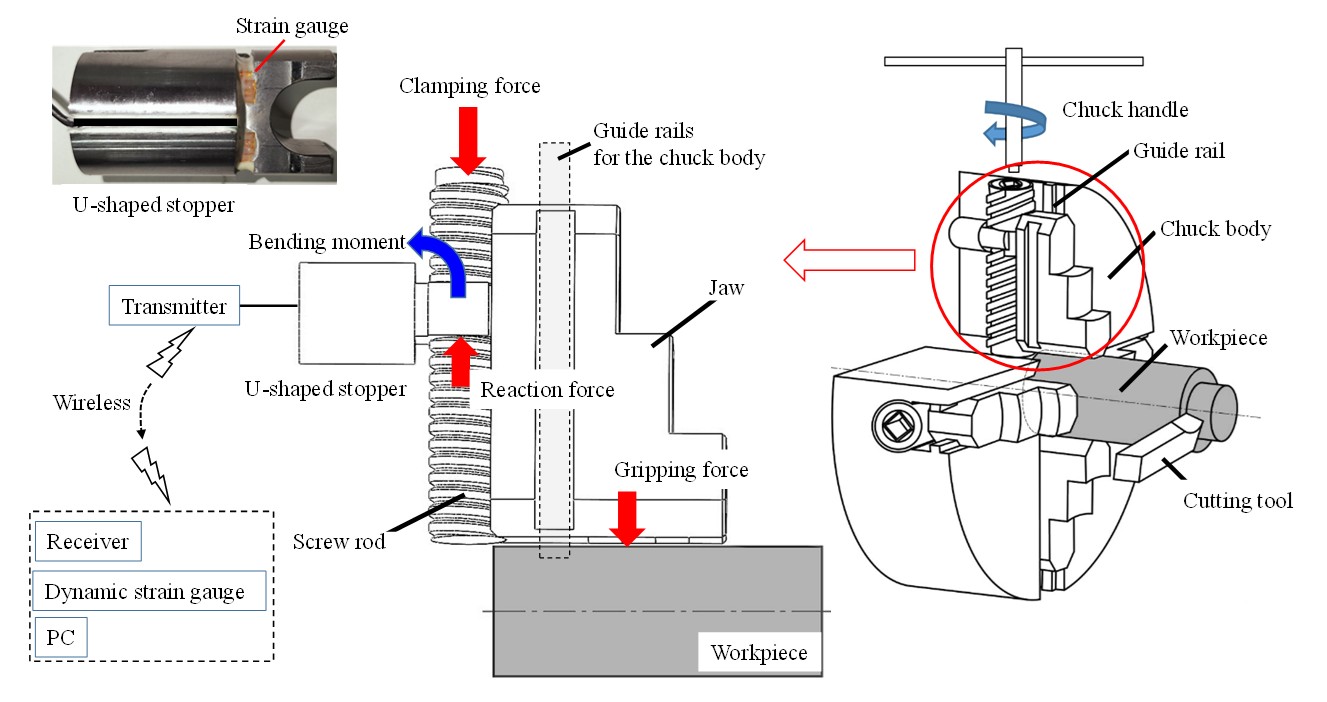
The manufacturing industry faces critical challenges related to shortages of skilled technicians and declining skill levels, compounded by a lack of instructors and limited training time. Effective skill transfer and the development of new skilled operators are essential. In lathe operations, proper clamping of workpieces is crucial for safety and machining accuracy. However, in the absence of clear standards for clamping force, reliance on instructors’ experience is common. This study addressed this issue by developing a clamping force monitoring device for a four-jaw lathe chuck, incorporating theoretical calculations and experimental verification of the required clamping force. Additionally, it investigated the clamping force applied by instructors and quantified the operator’s clamping force using a safety factor. For rough cutting, the safety factor was 1.7 times the reference instructor’s force, and for finish cutting, it was 2.1 times. The optimal clamping force was determined by adjusting the required force with a safety factor and half the observed variation width, resulting in 15.1 kN for rough cutting and 4.7 kN for finish cutting. The study concluded that the clamping force monitoring device optimizes clamping for safe and accurate machining, establishing a clear standard for beginners.
Article Details

This work is licensed under a Creative Commons Attribution-NonCommercial-ShareAlike 4.0 International License.

This work is licensed under a Creative Commons Attribution-NonCommercial-ShareAlike 4.0 International License.
References
Ministry of Economy, Trade and Industry. White paper on monodzukuri 2023 (FY2022 Measures to promote manufacturing technology); 2023.
Unno K. Support and promotion of the skill succession by utilizing expert skilled workers. J Jpn Soc Precis Eng. 2015;80(1):30-33.
Estrems M, Arizmendi M, Cumbicus WE, Lopez A. Measurement of clamping force in a 3 jaw chuck through an instrumented Aluminium ring. Procedia Eng. 2015;132:456-463.
Walter MF, Stahl JE. The connection between cutting and clamping forces in turning. Int J Mach Tools Manuf. 1994;34(7):991-1003.
Shimotsuchibashi W, Ueda K. Development of analytical simulator for prediction of machining error due to elastic deformation of clamped work. J Jpn Soc Precis Eng. 1991;57(3):453-458.
Kadowaki Y. Gripping pressure distribution in three-jaw scroll chucks and its evaluation method. Trans Jpn Soc Mech C. 1983;49(441):827-834.
Doi M, Masuko M. Considerations of chucking force in chuck work. B JSME. 1986;29(250):1344-1349. https://doi.org/10.1299/jsme1958.29.1344
Doi M, Masuko M, Takeuchi S. Considerations of chucking force in chuck work: 2nd report chucking behaviors of power chuck. Trans Jpn Soc Mech C. 1985;55(510);455-460.
Shinno H, Sohara T, ItoY. Fluctuation of chucking force in cutting. Trans Jpn Soc Mech C. 1989;55(509):182-187.
Feng PF, Yu DW, Wu ZJ, Uhlmann E. Jaw-chuck stiffness and its influence on dynamic clamping force during high-speed turning. Int J Mach Tools Manuf. 2008;48(11):1268-1275.
Chiba M, Sasagawa H, Sugimoto N. Development safety simulator for turning. J JSEE. 2016;64(6):93-98.
Yoshikawa T, Ito R, Yamasaki T, Tsujinaka T, Goto A, Hamada H. About stance of tightening at chucking by the takumi on lathe working. Memoirs of Niihama National College of Technology. 2013;49:7-12.
Sirisuwan P, Yuminaga H, Yoshikawa T, Hamada H, EMG activity of arms muscles and body movement during chucking in lathe between expert and non-expert. Digital Human Modeling; 2015 July 21; Los Angeles: Springer; 2015. p.216-226. https://doi.org/10.1007/978-3-319-21070-4_22
Hashimoto N, Kato H, Aoyado J, Higuchi S, Okawa K. Training of workpiece centering operation on lathe by the simulator. J Jpn Soc Precis Eng. 2013;79(8):779-783.
Taki S, Yonezawa S. Motion analysis of machining work using a digital position display device. Int J Autom Technol. 2022;16(5):625-633.
Polytechnic University, the Institute of Research and Development. Machining practical textbook. 4th ed. Employment Research Corporation; 2023.
Ishida M. The basics and practical skills of lathe machining used on the job. 4th ed. Shuwa System Co., Ltd.; 2020.
Sawa T. Visually pass the skills proficiency test practical exam “Standard lathe work grade 2” Procedures and explanations. Nikkan Kogyo Shimbun Co., Ltd.; 2009.
Kitagawa Corporation. How to set the gripping force of the chuck [Internet]. Hiroshima; [cited 2022 Aug 10]. Available from: https://prod.kiw.co.jp/mtools/item/data/PDF/gripforceset_jp.pdf.
Takahashi S, Kawai S. Introduction to strain gauges. Taiseisha Co., Ltd.; 2019.
Japan Vocational Ability Development Association. Skills test question public site (B07) the grade 2 machining (lathe) skills test task [Internet]. Tokyo; [cited 2024 May 18]. Available from: https://www.kentei.javada.or.jp/index.html.
