
Feasibility Assessment of PV and Energy Storage Systems for Nearly Zero Energy Office Buildings Using Generalized Reduced Gradient Method: A Case Study of Mae Moh Training Center EGAT
Article Sidebar
Main Article Content
Abstract
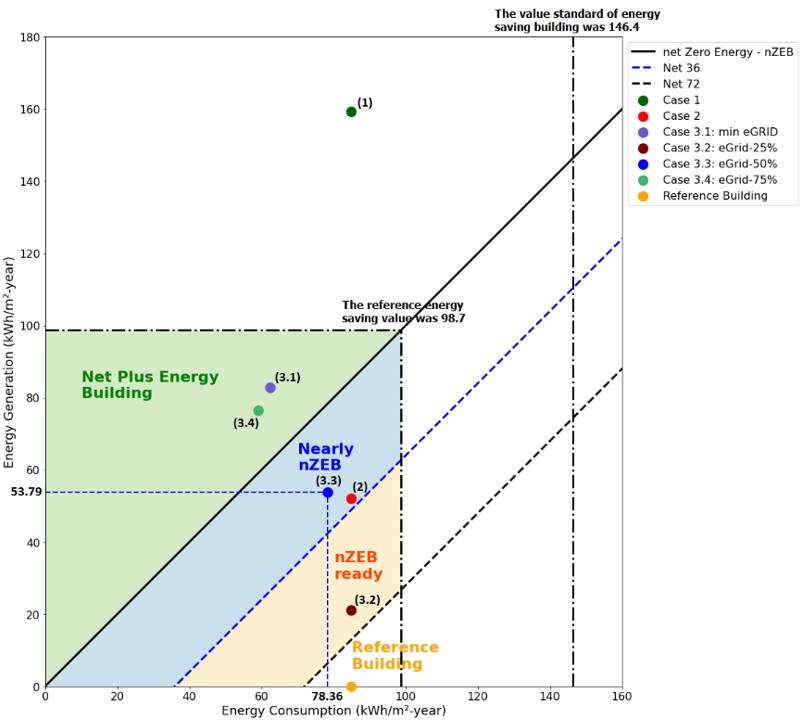
This study evaluates the feasibility of implementing photovoltaic (PV) and energy storage systems to achieve Nearly Zero Energy Buildings (nZEBs) status for a cluster of buildings at the Mae Moh Training Center, Thailand. Using the Generalized Reduced Gradient method, three scenarios were analyzed: full-area installation, individual building optimization, and group optimization with energy storage. The full-area installation proved inefficient with only 24% PV utilization. Individual building optimization offered the shortest payback period of 3.17 years and 42% electricity reduction. Group optimization with energy storage emerged as the most comprehensive solution, achieving 75% PV utilization and 50% grid electricity reduction with an 8.67-year payback period for the optimal configuration of a 136 kW PV system and 100 kWh storage system. This approach best aligns with nZEB principles, offering balanced energy management and operational flexibility. The study demonstrates the potential of integrated PV and storage systems in achieving nZEB status.
Article Details

This work is licensed under a Creative Commons Attribution-NonCommercial-ShareAlike 4.0 International License.

This work is licensed under a Creative Commons Attribution-NonCommercial-ShareAlike 4.0 International License.
References
Ministry of Energy. The Energy Efficiency Plan (EEP) 2018-2037 [Internet]. 2020 [cited 2024 Aug 15]. Available from: http://berc.dede.go.th/wp-content/uploads/2023/03/20201021_EEP_2018_Final-1.pdf.
Skoplaki E, Palyvos J. Operating temperature of photovoltaic modules: A survey of pertinent correlations. Renew Energy. 2009;34:23–29.
Milan C, Bojesen C, Nielsen MP. A cost optimization model for 100% renewable residential energy supply systems. Energy. 2012;48:118–127.
González-Mahecha RE, Lucena AF, Szklo A, Ferreira P, Vaz AF. Optimization model for evaluating on-site renewable technologies with storage in zero/nearly zero energy buildings. Energy Build. 2018;172:505–516.
Riverola A, Vossier A, Chemisana D. Fundamentals of solar cells. Nanomater Sol Cell Appl. 2019;3–33.
Rosa FDM, Antonio G, Silvia R, Giuseppe PV. Experimental and numerical approach for the evaluation of PV-system performance on energy and environmental behavior of nearly zero energy buildings: Case study in Mediterranean climate. Renew Energy. 2024;227:120609.
Fabrizio A, Rosa FDM, Antonio G, Giuseppe PV. Resilience to the climate change of nearly zero energy-building designed according to the EPBD recast: Monitoring, calibrated energy models and perspective simulations of a Mediterranean nZEB living lab. Energy & Buildings. 2022;262:112004.
Suwanasang N, Tongsopit S. An Assessment of the Technical and Economic Potential of Rooftop Solar Systems on Chulalongkorn University’s Buildings. Journal of Energy Research. 2015;12(2):59-74.
Sirikaew S, Chokkuea W, Saengprajak A, Seehatip C. Evaluation of Electricity Generation Potential from Solar Rooftop Using the Mathematical Model: Case Study of Academics Resource Center Building. Mahasarakham University. Srinakharinwirot University Journal of Sciences and Technology, 2019;11(21):179-192.
Chansela W, Inkarojrit V. Feasibility assessment of solar rooftop systems for gymnasium: case study of Chulalongkorn University. Journal of Environmental Design. 2020;7(2):2-25.
Leiria D, Johra H, Marszal-Pomianowska A, Pomianowski M Z, Kvols Heiselberg P. Using data from smart energy meters to gain knowledge about households connected to the district heating network: A Danish case. Smart Energy. 2021;3:100035.
al Khafaf N, Rezaei A A, Amani A M, Jalili M, McGrath B, Meegahapola L, Vahidnia A. Impact of battery storage on residential energy consumption: An Australian case study based on smart meter data. Renewable Energy. 2022;182:390-400.
Energy Research and Development Nakornping Institute (ERDI-CMU). Near Zero Energy Building: A Case Study of Mae Moh Training Center EGAT Phase 2; 2021.
Energy Research and Development Nakornping Institute (ERDI-CMU). Near Zero Energy Building: A Case Study of Mae Moh Training Center EGAT Phase 3; 2023.
Asanakham A, Kantiya I, Kiatsiriroat T. Performance Prediction of Poly-Crystalline Solar Cell Module under Real Practice. Engineering Journal Chiang Mai University. 2015;22(3):87-93.
Abadie J. Generalization of the Wolfe reduced gradient method to the case of nonlinear constraints. Optimization. 1969;37-47.
Lasdon LS, Waren AD, Jain A, Ratner M. Design and Testing of a Generalized Reduced Gradient Code for Nonlinear Programming. ACM Trans. Math. Softw. 1978;4(1):34–50.
Gabriele GA, Ragsdell KM. The Generalized Reduced Gradient Method: A Reliable Tool for Optimal Design. Journal of Engineering for Industry. 1977;99(2):394-400.
Yeniay Ö. A comparative study on optimization methods for the constrained nonlinear programming problems. Mathematical Problems in Engineering; 2005.
González-Mahecha RE, Lucena A P, Szklo A, Ferreira P, Vaz AIF. Optimization model for evaluating on-site renewable technologies with storage in zero/nearly zero energy buildings. Energy and Buildings. 2018;172:505-516.
