
CNN-Based Cannabis Leaf Disease Recognition Model Development for Agricultural Sector Utilization
Article Sidebar
Main Article Content
Abstract
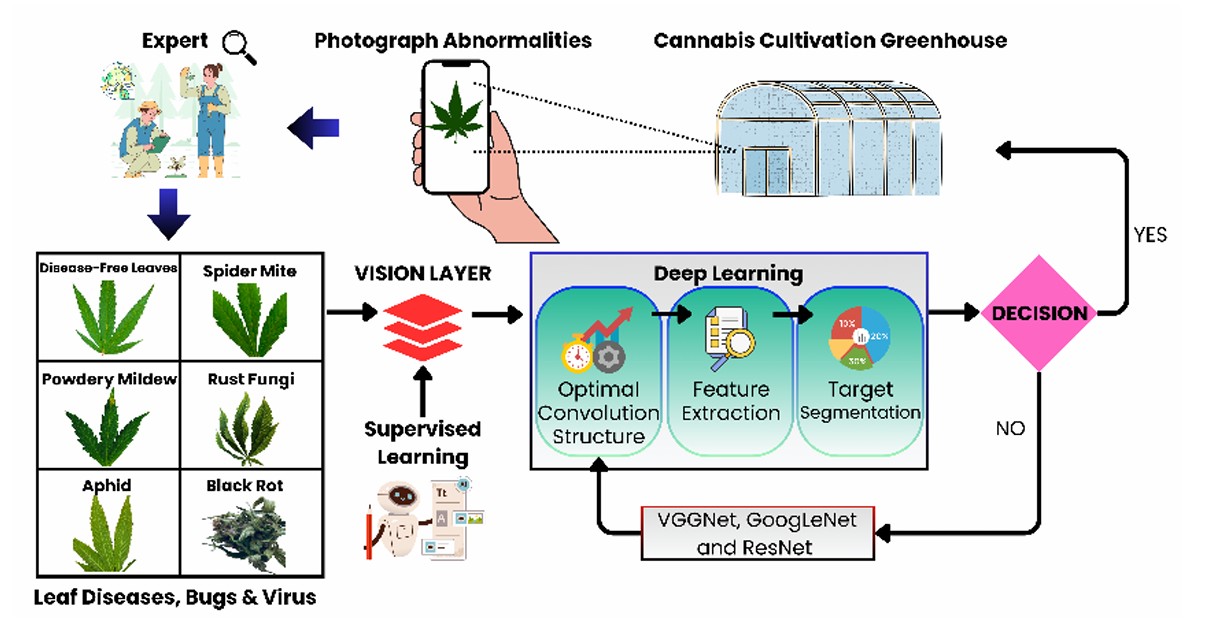
This research aims to develop a convolutional neural network (CNN) model for detecting plant diseases in cannabis leaves. This critical issue affects both quality and yield in the agricultural industry. The dataset comprises 4,155 images of cannabis leaves, collected from farms across Thailand under controlled environmental conditions. The images were captured inside greenhouses with translucent roofing to regulate natural lighting. Cameras were mounted on tripods and positioned top-down to ensure consistent angles and coverage of both healthy and diseased leaves. The dataset includes images categorized into five disease classes spider mite, downy mildew, rust, aphids, and black rot. Each image was meticulously labeled before being used for model training and evaluation. This research evaluates the performance of three major CNN architectures ResNet, GoogLeNet, and VGGNet using performance metrics such as F1-score and Accuracy. Experimental results demonstrate that ResNet achieved the highest accuracy, with an F1-score of 96.55% and a Accuracy of 96.56% after 50 training epochs. GoogLeNet offered a balance between accuracy and computational efficiency, making it suitable for time-sensitive applications. VGGNet, while slightly less accurate, is appropriate for deployment in environments with limited computational resources. The findings affirm the effectiveness of CNN models in detecting diseases in cannabis leaves. This approach can mitigate crop loss, enhance productivity, and strengthen the resilience of the cannabis industry both nationally and globally. Furthermore, the methodology can be extended to other economically important crops, contributing to the advancement of sustainable, modern agriculture.
Article Details

This work is licensed under a Creative Commons Attribution-NonCommercial-NoDerivatives 4.0 International License.
Articles published in Journal of Industrial Technology Ubon Ratchathani Rajabhat University both hard copy and electronically are belonged to the Journal.
References
R. K. Sari, “Analysis of the benefits and risks of cannabis legalization policy in Thailand after cannabis legalization in 2022–2024,” J. Asia Pac. Stud., vol. 8, no. 1, pp. 21–31, 2024.
A. Chitsena, “Benefits and threats of hemp legalization for the agricultural sector in Thailand." Accessed: Jan. 03, 2025. [Online]. Available: https://archive.cm.mahidol.ac.th/handle/ 123456789/3519
S. R. Sommano et al., “Growing ganja permission: a real gate-way for Thailand’s promising industrial crop?,” J. Cannabis Res., vol. 4, no. 1, pp. 10, Dec. 2022, doi: 10.1186/s42238-022-00121-4.
E. Quarshie, “Implication of Regulated Cannabis Legalisation on Wellbeing and Economic Growth,” Ph.D. dissertation, Univ. of the Witwatersrand, Johannesburg, South Africa, 2025. [Online]. Available: https://wiredspace.wits.ac.za/items/f7cf3993-5760-41e2-841f-ebdec16bed79
S. Marrinan et al., “An early economic analysis of medical cannabis for the treatment of chronic pain,” Expert Rev. Pharmacoecon. Outcomes Res., vol. 25, no. 1, pp. 39–52, Jan. 2025, doi: 10.1080/14737167.2024.2412248.
G. M. Stack et al., “Genetic Mapping, Identification, and Characterization of a Candidate Susceptibility Gene for Powdery Mildew in Cannabis sativa,” Mol. Plant-Microbe Interactions, vol. 37, no. 1, pp. 51–61, Jan. 2024, doi: 10.1094/MPMI-04-23-0043-R.
K. Sriprateep et al., “Hybrid Adaptive Multiple Intelligence System (HybridAMIS) for classifying cannabis leaf diseases using deep learning ensembles,” Smart Agric. Technol., vol. 9, pp. 100535, 2024.
J. Lu, L. Tan, and H. Jiang, “Review on convolutional neural network (CNN) applied to plant leaf disease classification,” Agriculture, vol. 11, no. 8, pp. 707, 2021.
G. Latif, S. E. Abdelhamid, R. E. Mallouhy, J. Alghazo, and Z. A. Kazimi, “Deep learning utilization in agriculture: Detection of rice plant diseases using an improved CNN model,” Plants, vol. 11, no. 17, pp. 2230, 2022.
B. Tugrul, E. Elfatimi, and R. Eryigit, “Convolutional neural networks in detection of plant leaf diseases: A review,” Agriculture, vol. 12, no. 8, pp. 1192, 2022.
N. Shelar, S. Shinde, S. Sawant, S. Dhumal, and K. Fakir, “Plant disease detection using CNN,” in ITM Web of Conferences, EDP Sciences, Navi Mumbai, India, 2022, pp. 1–6, doi: 10.1051/itmconf/20224403049.
S. M. Hassan and A. K. Maji, “Plant disease identification using a novel convolutional neural network,” IEEE Access, vol. 10, pp. 5390–5401, 2022.
J. A. Pandian, V. D. Kumar, O. Geman, M. Hnatiuc, M. Arif, and K. Kanchanadevi, “Plant disease detection using deep convolutional neural network,” Appl. Sci., vol. 12, no. 14, pp. 6982, 2022.
G. Shrestha, Deepsikha, M. Das, and N. Dey, “Plant Disease Detection Using CNN,” 2020 IEEE Applied Signal Processing Conference (ASPCON), Kolkata, India, 2020, pp. 109–113, doi: 10.1109/ASPCON49795.2020.9276722.
Islam, Md Tariqul, “Plant disease detection using CNN model and image processing,” Int J Eng. Res. Technol, vol. 9, no. 10, pp. 291–297, 2020.
L. Borawar and R. Kaur, “ResNet: Solving Vanishing Gradient in Deep Networks,” in Proceedings of International Conference on Recent Trends in Computing, vol. 600, R. P. Mahapatra, S. K. Peddoju, S. Roy, and P. Parwekar, Eds., in Lecture Notes in Networks and Systems, vol. 600. , Singapore: Springer Nature Singapore, 2023, pp. 235–247. doi: 10.1007/978-981-19-8825-7_21.
X. Zhang, N. Han, and J. Zhang, “Comparative analysis of VGG, ResNet, and GoogLeNet architectures evaluating performance, computational efficiency, and convergence rates,” Appl. Comput. Eng., vol. 44, pp. 172–181, Mar. 2024, doi: 10.54254/2755-2721/44/20230676.
I. U. W. Mulyono, E. H. Rachmawanto, C. A. Sari, and M. K. Sarker, “A high accuracy of deep learning based CNN architecture: classic, VGGNet, and RestNet50 for Covid-19 image classification,” TELKOMNIKA Telecommun. Comput. Electron. Control, vol. 22, no. 5, Art. no. 5, Jul. 2024, doi: 10.12928/telkomnika.v22i5.26017.
H. Zheng, “A Review of Evaluation Metrics in Machine Learning Algorithms,” in Lecture notes in networks and systems, Vanderbijlpark, South Africa, 2023, pp. 15–25. doi: 10.1007/978-3031-35314-7_2.
A. Shiva Kumar, K. Gopi, and T. Uma Devi, "Applying deep convolutional neural networks to predict plant diseases in the PlantVillage dataset: A focus on robustness and accuracy," Journal of Engineering Sciences, vol. 15, no. 1, pp. 128-142, 2024.
