
Indoor Cooling Load Reduction Using the Concrete Vent Tile Assisted with PV-Powered Pan
Article Sidebar
Main Article Content
Abstract
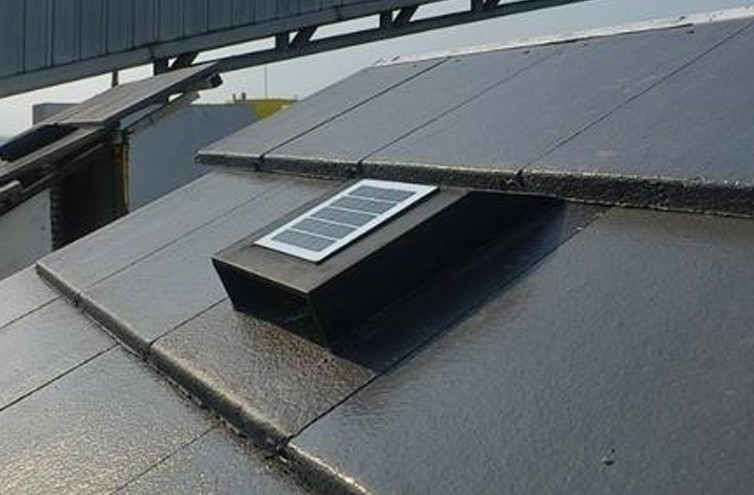
This paper proposes the concrete vent tile assisted with PV-powered fan (CVT-PV) to reduce accumulated heat in the interior of the test house that also function as a fresh air circulation equipment for daytime. The CVT-PV composed of a flat concrete tile with a circular vent, and a DC fan (1.5 W) connected with a PV panel (5 Wp). Two test houses were used for the experiment, one house served as a reference house and the other house as a house with CVT-PV. Each house is a volume by about 1.2 m3. The roof configuration of both houses is a shed roof with 25 deg of tile angle. The airflow pattern in this experiment is the cross ventilation. Experimental results showed that the CVT-PV could provide the maximum air ventilation rate 20 m3/h approximately, amounted of number of air change to the maximum nearly 16 air change per hour. Due to the CVT-PV ventilating efficiency combined with the circulated the number of air change, expressed in terms of the indoor temperature and relative humidity, are better than the reference house during 0.5ºC to 6.1ºC and 0.5 to 6.5%, respectively, and also the cooling load reduced by about 43.37%. With this reason, the properties of humid air of a house with CVT-PV are in the Thailand ventilation comfort chart, which approached to comfortable zone than the reference house.
Article Details

This work is licensed under a Creative Commons Attribution-NonCommercial-NoDerivatives 4.0 International License.
Articles published in Journal of Industrial Technology Ubon Ratchathani Rajabhat University both hard copy and electronically are belonged to the Journal.
References
W. Ratchatha, J. Pukdum, T. Phengpom and W. Puangsombut, “Development of a Concrete Vent Tile Assisted with PV-Powered Fan,” in The International Conference on Multidisciplinary Research Trends in the Greater Mekong Sub-Region (ICGMS 2024), Royal Nakhara Hotel and Convention Centre, Nong Khai, Thailand, July 24-26, pp. 71-78.
J. Khedari, N. Yamtraipat, N. Pratintong and J. Hirunlabh, “Thailand Ventilation Comfort Chart,” Energy and Buildings, vol. 32, no. 3, pp. 245-249, Sep. 2000.
J. Khedari, A. Sangprajak and J. Hirunlabh, “Thailand Climatic Zone,” Renewable Energy, vol. 25, no. 2, pp. 267-280, Feb. 2002.
V. Amatayakul, J. Pukdum, D. Nonthiworawong and W. Puangsombut, “Thermal Performance of Thermal Insulation: Installing the Thermal Insulation under the Metal Sheet Roof,” The Journal of Industrial Technology Suan Sunandha Rajabhat University, vol. 11, no. 1, pp. 63-72, Jan.-Jun. 2023.
S. Chaiyapinunt and N. Khamporn, “Heat Transmission through a Glass Window with a Curved Venetian Blind Installed,” Solar Energy, vol. 110, pp. 71-82, 2014.
R. Wongmahasiri and S. Watechagit, “Energy Conservation in Single House due to the Effect of Paint Color: Case Bangkok,” Asian Creative Architecture, Art and Design, vol. 18, no. 1, pp. 154-164, Jan.- Jun. 2014.
K. Juengpimonyanon, D. Nonthiworawong and T. Ananacha, “Attic Heat Gain Reduction Using a Concrete Tile Ventilator,” The Journal of Industrial Technology Suan Sunandha Rajabhat University, vol. 8, no. 2, pp. 58-69, Jul.-Dec. 2020.
W. Puangsombut, J. Pukdum and D. Nonthiworawong, “Thermal Performance of Concrete Tile Ventilator Equipped with PV-Powered Fan,” The Journal of Industrial Technology Suan Sunandha Rajabhat University, vol. 9, no. 2, pp. 12-22, Jul.-Dec. 2021.
Y. O. Devres, “Psychrometric Properties of Humid Air: Calculation Procedures,” Applied Energy, vol. 48, no. 1, pp. 1-18, 1994.
J. Ekburanawat, “Development of Indoor Comfort Zone Control System,” Journal of Industrial Technology Ubon Ratchathani Rajabhat University, vol. 13, no. 2, pp. 27-40, Jul.-Dec. 2023, (in Thai).
J. Taweekun and A. Tantiwichien, “Thermal Comfort Zone for Thai People,” Scientific Research an Academic Publisher, vol. 5, no. 5, pp. 252-529, 2013.
N. Yamtraipat, J. Khedari, J. Hirunlabh and J. Kunchornrat, “Assessment of Thailand indoor set-point impact on energy consumption and environment,” Energy Policy, vol. 34, no. 7, pp. 765-770, May 2006.
J. Hirunlabh, W. Puangsombut, J. Waewsak and J. Khedari, “PV attic ventilation: A simple tool for reducing cooling load and providing comfort,” International Journal of Ambient Energy, vol. 23, no. 3, pp. 159-168, 2002.
