
Design and Fabrication of a low-Cost Semi-Automatic Cotton Spinning Machine for Household Production
Article Sidebar
Main Article Content
Abstract
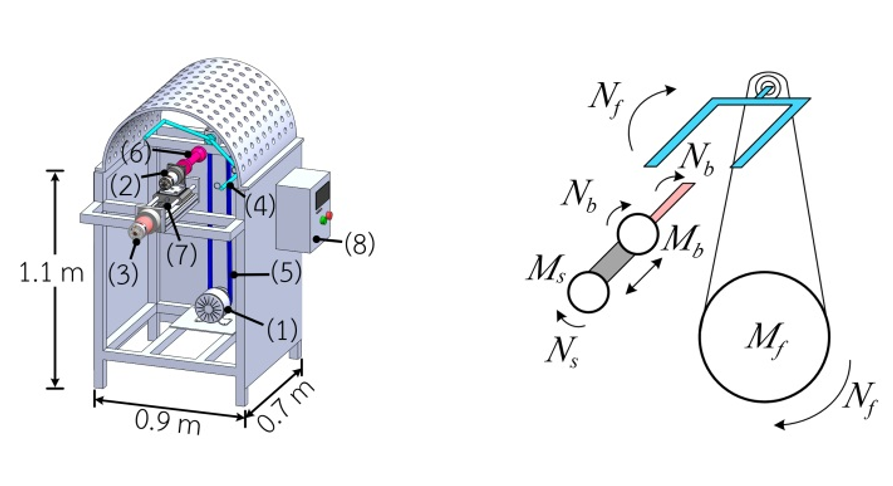
This research aims to design and fabricate a semi-automatic cotton spinning machine for household production and to investigate the optimum revolution speed of motors that affect the qualities of cotton yarn. The machine was developed from a traditional cotton spinner in order to improve productivity rates and decrease working hours and the number of workers by replacing a manual flyer with DC motors including a crank arm motor, a cotton-picking motor, and a spindle motor. All worked together functionally with the semi-automatic mode. The speeds of motors could be adjusted to correspond with the workers' requirements. Based on the tests, the longest cotton yarn and highest perfection value occurred when sets of the speeds of a flyer, a bobbin, and a screw traveler were 300, 280, and 18 rpm and 400, 370, and 18 rpm, respectively. The maximum spinning efficiency was 98.2% when the speed of a flyer was 300 rpm. Moreover, the working ratio was also increased when a flyer's speed was increased. Finally, the developed machine was demonstrated at two selected communities. Tests were conducted and compared with a conventional machine. It found that productivity rates were higher and working hours were longer. The qualities of cotton yarn for example length, strength, and number of knots were acceptable.
Article Details

This work is licensed under a Creative Commons Attribution-NonCommercial-NoDerivatives 4.0 International License.
Articles published in Journal of Industrial Technology Ubon Ratchathani Rajabhat University both hard copy and electronically are belonged to the Journal.
References
S. Wichaidit, S. Kongmanon, and P. Buatama, “Value addition of local woven wisdoms toward creative tourism,” Journal of Modern Learning Development, vol. 7, no. 3, pp. 347–364, 2022.
S. A. Hosseini Ravandi and M. Valizadeh, “Properties of fibers and fabrics that contribute to human comfort,” in Improving Comfort in Clothing, Woodhead Publishing, 2011, pp. 61–78.
E. A. Posselt, Cotton Manufacturing Part 1-Dealing With The Fibre, Ginning, Mixing, Picking, Scutching And Carding. Obscure Press, 2010.
S. Rahman and A. J. Uddin, “Unusable cotton spinning mill waste: A viable source of raw material in paper making,” Heliyon, vol. 8, no. 8, Art. no. e10055, August 2022.
N. Dai et al., “Prediction of cotton yarn quality based on attention-GRU,” Applied Sciences, vol. 13, no. 18, Art. no. 10003, 2023.
R. Raja and K. Suryaprakasa Rao, “Performance evaluation through simulation modeling in a cotton spinning system,” Simulation Modelling Practice and Theory, vol. 15, no. 9, pp. 1163–1172, October 2007.
M. R. Islam, S. Ahmed, M. A. Siddik, and S. M. Ashique, “Analysis of cotton yarn properties spun on aerodynamic compact and open-end rotor spinning,” Textile Science and Technology, vol. 7, no. 1, pp. 22–40, 2021.
A. Panpoom et al., “Reaearch and development of cotton spinner equipment for minor garment manufacturer groups,” in Sakamon The 18 th TSAE National Conference, Bangkok, Thailand, 2017, pp. 161–164. (in Thai)
