
Development of a Dementia Screening Application Prototype
Article Sidebar
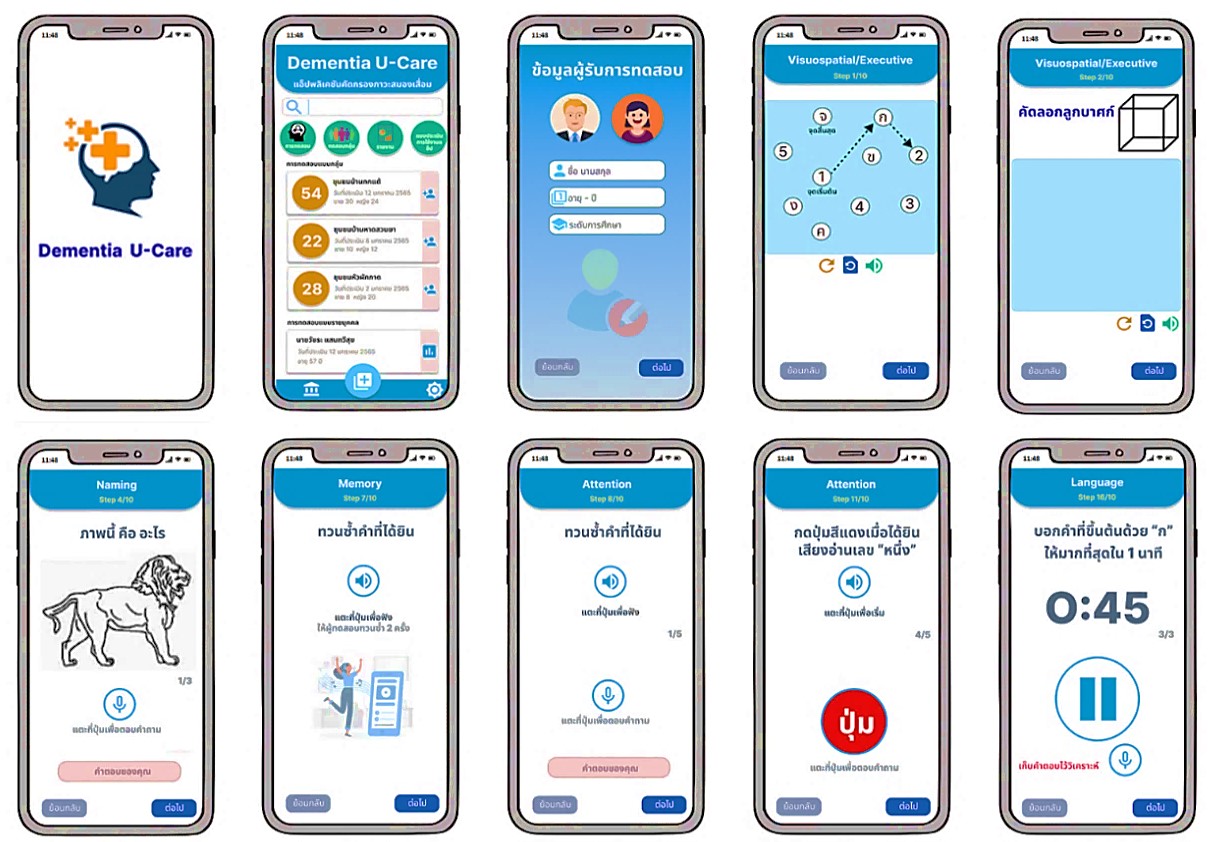
Main Article Content
Abstract
This article aims to study the process of working and user requirements of the MoCA test, which is the dementia screening test. The objective is to design and develop a mobile application prototype for dementia screening for the elderly. The design thinking process has been employed in this research to enable the creation of applications according to the user's requirements that consists of 5 steps: empathize, define, ideate, prototype, and test. The mobile application for collecting MoCA test results is more convenient than the traditional paper form because it reduces the time and workflow. Moreover, it is convenient to retrieve information and provide simplified score processing by employing various technologies; image processing and deep learning, speech recognition, and processing, touches and gestures, number analysis, and timing. The testing of the dementia screening application still requires specialist control and diagnostics to enable test subjects to comply with the protocols of the MoCA tool for maintaining accuracy. The results of the satisfaction assessment of the dementia screening application users were at an excellent level, with an 80.98 average (out of 100.00) based on the system usability scale (SUS) as an evaluation tool.
Article Details

This work is licensed under a Creative Commons Attribution-NonCommercial-NoDerivatives 4.0 International License.
Articles published in Journal of Industrial Technology Ubon Ratchathani Rajabhat University both hard copy and electronically are belonged to the Journal.
References
A. Natthamonworakul, “Strategy for Thai Aging Society: Establishment of the ASEAN Center for Active Aging and Innovation (ACAI) and the Ministry of Public Health's Policy on Aging 2022,” Journal of The Department of Medical Services, vol. 46, no. 4, pp. 5-9, 2021. (In Thai)
P. Anundilokrit, “Dementia,” Regional Health Promotion Center 9 Journal. Vol. 15, no. 37, pp. 392-398, 2021. (In Thai)
S. Hemrungrojn, S. Tangwongchai and T. Charoenboon, “Use of the Montreal Cognitive Assessment Thai version (MoCA) to Discriminate Amnestic Mild Cognitive Impairment from Alzheimer’s Disease and Healthy Controls: Machine Learning Results,” Dementia and Geriatric Cognitive Disorders, vol. 50, no. 2, pp. 183-194, 2021.
S. Zgonec, “Mobile Apps Supporting People with Dementia and Their Carers: Literature Review and Research Agenda,” IFAC-PapersOnLine, vol. 54, no. 13, pp. 663-68, 2021.
C. Yamagata, J. F. Coppola, M. Kowtko and S. Joyce, “Mobile App Development and Usability Research to Help Dementia and Alzheimer Patients,” In Proc. 2013 IEEE Long Island Systems, Applications and Technology Conference (LISAT), May. 2013, pp. 1-6.
D. Kwaunkwai, S. Suebpongsiri and N. Susri, “Questioning in Cases of Missing Persons with Dementia,” Journal of Criminology and Forensic Science, vol. 7, no. 2, pp. 151-162, 2021.
Ministry of Public Health, Handbook for the Development of Brain Potential of People with Impaired Brain Function in the Early Stages, Bangkok, Thailand: CyberPrint Group, 2016. (in Thai)
L. Setiyani and E. Tjandra, “UI/UX Design Model for Student Complaint Handling Application Using Design Thinking Method (Case Study: STMIK Rosma Karawang),” International Journal of Science, Technology & Management, vol. 3, no. 3, pp. 690-702, 2022.
C. Adhitya, R. Andreswari and P. F. Alam, “Analysis and Design of UI and UX Web-Based Application in Maiproyek Startup Using User Centered Design Method in Information System Program of Telkom University,” In Proc. IOP Conference Series: Materials Science and Engineering, Yogyakarta, Indonesia, Feb. 13-14, 2021.
J. Pacheco, S. Garbatov and M. Goulão, “Improving Collaboration Efficiency Between UX/UI Designers and Developers in a Low-Code Platform,” In 2021 ACM/IEEE International Conference on Model Driven Engineering Languages and Systems Companion (MODELS-C), Oct. 2021, pp. 138-147.
W. S. L. Nasution and P. Nusa, “UI/UX Design Web-Based Learning Application Using Design Thinking Method,” ARRUS Journal of Engineering and Technology, vol. 1, no. 1, pp. 18-27, 2021.
S. Kumprasert, et al., “Development of Data Management Program for Refilling Extemporaneous Preparation in Pediatric Patients at Outpatient Department of Maharaj Nakhon Chiangmai Hospital,” Thai Journal of Pharmacy Practice, vol. 14, no. 2, pp. 461-72, 2022.
J. Sauro. “5 Ways to Interpret a SUS Score.” MeasuringU. Accessed: Dec. 31, 2022. [Online]. Available: https://measuringu.com/interpret-sus-score
B. Ye, T. V. How, C. H. Chu and A. Mihailidi, “Dementia Care Apps for People with Dementia and Informal Caregivers: A Systematic Review Protocol,” Gerontology. vol. 67, no. 5, pp. 633-38, 2021.
K. Cheungsuvadee, P. Kumpa, P. Weerananthawet and P. Vorraboot, “Development of Screening Elderly Patients to Appoint Cataract Surgery Application,” Journal of Industrial Technology Ubon Ratchathani Rajabhat University. vol. 10, no. 2, pp. 113-24, 2020. (In Thai)
