
Applying Analytic Network Process for Optimal Lean Tool Selection: an Empirical Case Study
Article Sidebar
Main Article Content
Abstract
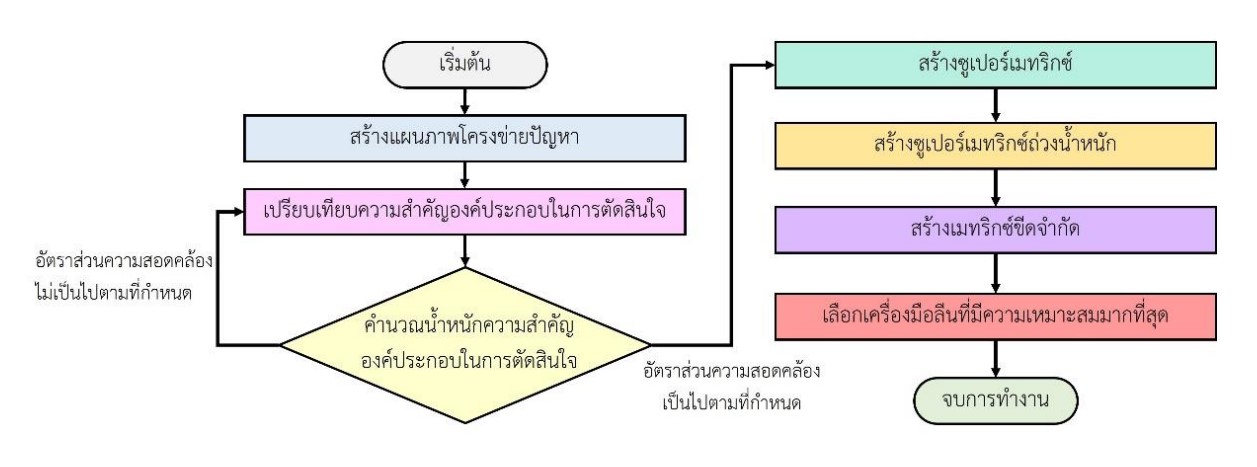
The purpose of this research was to select an optimal lean tool by analytic network process (ANP) based on decision-making elements, namely eight decision criteria and seven different alternative lean tools. These decision-making elements have influences from other decision-making elements in external clusters, and receive impacts from decision-making elements in the same groups. The proposed method was applied with an empirical case study, which is a small and medium-sized enterprise in the electronic component manufacturing industry in Thailand. From the research result, it was found that ANP can be used to solve the problem of optimal lean tool selection effectively and rank the lean tools based on weights of decision-making elements in alternative cluster of limit matrix. Decision makers can compare decision-making elements in pairs and analyze relationships between the decision criteria and lean tools simultaneously. By applying the proposed method with the case study company, it found that the visual control was the most optimal in improving works based on the lean concept, and can increase productivity 12 percent as compared to the productivity before the improvement. Meanwhile, the other lean tools were less important based on their weights in descending order. The benefits of this study are to guide entrepreneurs in solving lean tool selection problems in order to reduce wastes during works and increase productivity continuously.
Article Details

This work is licensed under a Creative Commons Attribution-NonCommercial-NoDerivatives 4.0 International License.
Articles published in Journal of Industrial Technology Ubon Ratchathani Rajabhat University both hard copy and electronically are belonged to the Journal.
References
S. Vinodh, A. Thiagarajan and G. Mulanjur, “Lean concept selection using modified fuzzy TOPSIS: a case study,” International Journal of Services and Operations Management, vol. 18, no. 3, pp. 342-357, Jun. 2014.
S. Vinodh, K. R. Shivraman and S. Viswesh, “AHP‐based lean concept selection in a manufacturing organization,” Journal of Manufacturing Technology Management, vol. 23, no. 1, pp. 124–136, Dec. 2011.
S. Jing, Z. Niu and P.-C. Chang, “The application of VIKOR for the tool selection in lean management,” Journal of Intelligent Manufacturing, vol. 30, no. 8, pp. 2901–2912, Sep. 2019.
L. N. Pattanaik, T. K. Baug and C. Koteswarapavan, “A hybrid ELECTRE based prioritization of conjoint tools for lean and sustainable manufacturing,” Production Engineering, vol. 13, no. 6, pp. 665–673, Oct. 2019.
C. Bai, A. Satir, and J. Sarkis, “Investing in lean manufacturing practices: an environmental and operational perspective,” International Journal of Production Research, vol. 57, no. 4, pp. 1037–1051, Jul. 2018.
S. M. Baskaran and A. R. Lakshmanan, “A framework model for lean tools selection for improving material flow using fuzzy TOPSIS,” International Journal of Productivity and Quality Management, vol. 27, no. 4, pp. 196-228, Jun. 2019.
T. L. Saaty, “Fundamentals of the analytic network process — Dependence and feedback in decision-making with a single network,” Journal of Systems Science and Systems Engineering, vol. 13, no. 2, pp. 129–157, Apr. 2004.
Department of International Trade Promotion, “Factsheet electronic commodities.” Ministry of Commerce. Accessed: Aug. 19, 2022. [Online]. https://www.ditp.go.th/contents_attach/78
/789569.pdf (in Thai)
N. Koohathongsumrit and P. Luangpaiboon, “An integrated FAHP–ZODP approach for strategic marketing information system project selection,” Managerial and Decision Economics, vol. 43, no. 6, pp. 1792-1809, Nov. 2022.
N. Koohathongsumrit, “Optimization route selecting by multi-criteria decision making analysis,” RMUTP Research Journal, vol. 11, no. 1, pp. 137-150. Jun. 2017. (in Thai)
N. Koohathongsumrit and W. Meethom, “Route selection in multimodal transportation networks: a hybrid multiple criteria decision-making approach,” Journal of Industrial and Production Engineering, vol. 38, no. 3, pp. 171–185, Feb. 2021.
N. Koohathongsumrit and W. Chankham, “A hybrid approach of fuzzy risk assessment-based incenter of centroid and MCDM methods for multimodal transportation route selection,” Cogent Engineering, vol. 9, no. 1, Jul. 2022, doi: https://doi.org/10.1080/23311916.2022.2091672.
S. Kheybari, F. M. Rezaie and H. Farazmand, “Analytic network process: An overview of applications,” Applied Mathematics and Computation, vol. 367, p. 124780, Feb. 2020, doi: https://doi.org/10.1016/j.amc.2019.124780.
