
Design of local exhaust ventilation for soldering at Bangkok Vocational Training Center, Bangkok Noi District
Article Sidebar
Main Article Content
Abstract
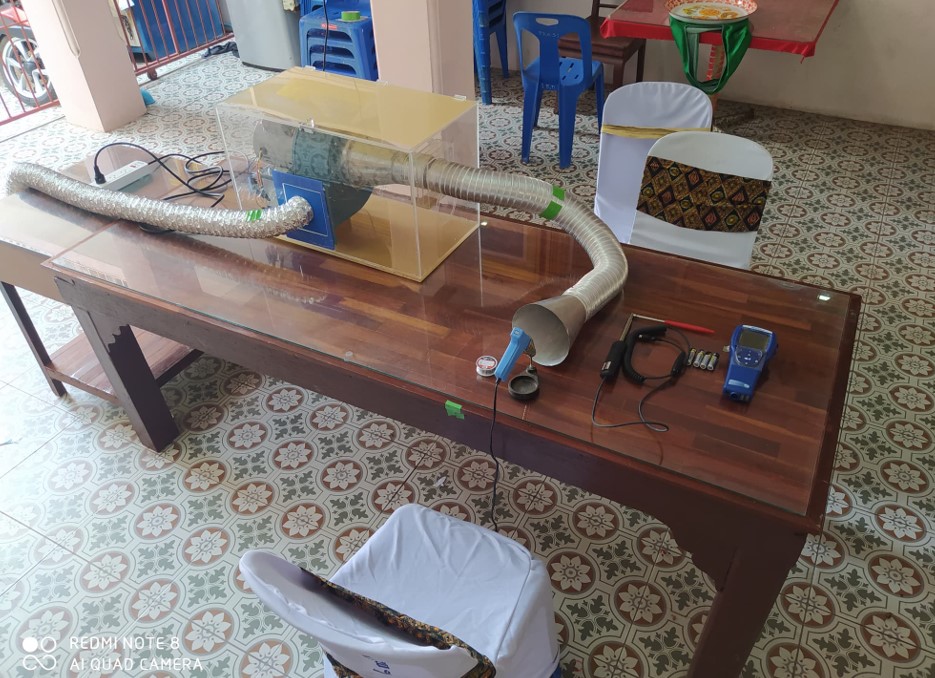
The objectives of this research were 1) to develop local ventilation equipment for use during soldering of electronic devices. 2) To test the effectiveness of local exhaust ventilation in reducing the amount of pollutants during soldering of electronic devices of learners and instructors at Bangkok Vocational Training Center, Bangkok Noi District. The statistics obtained are average, percentage. Has designed a dedicated ventilation system for soldering electronic parts a total of 2 times. After building, has been tested for efficiency of the local exhaust ventilation compared to the calculated design list. At the 1st time, there was a problem of sparking at the fan and making noise while in use. Therefore, the second local exhaust ventilation was developed, and the efficiency has been tested. It was found that the air velocity and the static pressure values are different from the values calculated before the design. When testing the pollution reduction effectiveness of local exhaust ventilation Before and after activation of personal local exhaust ventilation during soldering of electronic devices, it was found that carbon monoxide decreased by 100 percent, lead fumes decreased by 83.96 percent, and carbon dioxide decreased by 65.72%. The results of testing the effectiveness of ventilation equipment only in terms of sound pressure level found that the fan had an effect on the sound pressure level. After improvement, the sound pressure level, Leq 5 min was 55.70 dB(A) on average.
Article Details

This work is licensed under a Creative Commons Attribution-NonCommercial-NoDerivatives 4.0 International License.
Articles published in Journal of Industrial Technology Ubon Ratchathani Rajabhat University both hard copy and electronically are belonged to the Journal.
References
Sentry Air System, “Solder fume health hazard.” Sentry Air System. Accessed: Dec. 25, 2021. [Online]. Available: https://www.sentryair.com/brochures/TheHazardsofSolderFume.pdf
S. F. Dehghan, Y. Mehrifar and A. Ardalan, “The Relationship between Exposure to Lead-Containing Welding Fumes and the Levels of Reproductive Hormones,” Annals of Global Health, vol. 85, no. 1, pp. 1-6, Oct. 2019.
J. Nettleton, “Short and intermittent exposure to rosin-based solder flux fume: When exposure may need further assessment and control Hazard.” Health and Safety Executive. Accessed: Dec. 20, 2021. [Online]. Available: https://www.hse.gov.uk/foi/internalops/sims/manuf/3_02_26.htm
The National Institute for Occupational Safety and Health, “Rosin core solder, pyrolysis products (as formaldehyde).” The National Institute for Occupational Safety and Health. Accessed: Dec. 10, 2021. [Online]. Available: https://www.cdc.gov/niosh/npg/npgd0547.html
The National Institute for Occupational Safety and Health, “Rosin core solder.” The National Institute for Occupational Safety and Health. Accessed: Dec. 10, 2021. [Online]. Available: https://www.cdc.gov/niosh/pel88/solder.html
American Conference of Governmental Industrial Hygienists, Industrial Ventilation: A manual of recommended Practice, 25th ed. Washington, D.C., USA: Kemper Wood Center, 2004.
Center for Disease control and Prevention, “NIOSH manual of analytical method (NMAM) fourth Edition.” Center for Disease control and Prevention. Accessed: Dec. 10, 2021. [Online]. Available: https://www.cdc.gov/niosh/docs/2003-154/pdfs/7301.pdf
The National Institute for Occupational Safety and Health, NIOSH pocket guide to chemical hazard, Ohio, USA: NIOSH Publications, 2007.
S. Zare, Y. Sahranavard, H. Ali Hakimi, M. Bateni, M. Karami and R. Hemmatjo, “Designing, constructing and installing a local exhaust ventilation system to minimize welders' exposure to welding fumes,” Archives of Hygiene Science, vol. 6, no. 4, pp. 356–362, Oct. 2017.
A. Zarei, M. Jahangiri, A. Koohpaei, A. Zolfaghari, A. Barkhordari and M. Mortezavi Mehrizi, “Design, construction and evaluation of local exhaust ventilation system for the control of total dust and crystalline silica in a tile manufacturing factory,” Journal of Health Sciences and Surveillance System, vol. 6, no. 4, pp. 165-172, Oct. 2018.
M. H. Kohneshahri, M. Mohammadyan, H. A. Khani, M. Pourhossein and B. Dastakzan, “Designing a local exhaust ventilation system to control toluene diisocyanate and dust in woodworking industries,” International Journal of Occupational Hygiene, vol. 8, no. 4, pp. 223-229. Apr. 2016.
K. Chen, H. Zhang and W. Zhang, “Measures to alleviate fume hood noise,” American Laboratory, vol. 50, no. 3, pp. 1-4. Apr. 2018.
