ผลกระทบของการปรับปรุงเส้นใยแกลบข้าวที่มีต่อคุณสมบัติของแผ่นขัดจากเส้นใยแกลบข้าวผสมพอลิยูรีเทน
Article Sidebar
Main Article Content
บทคัดย่อ
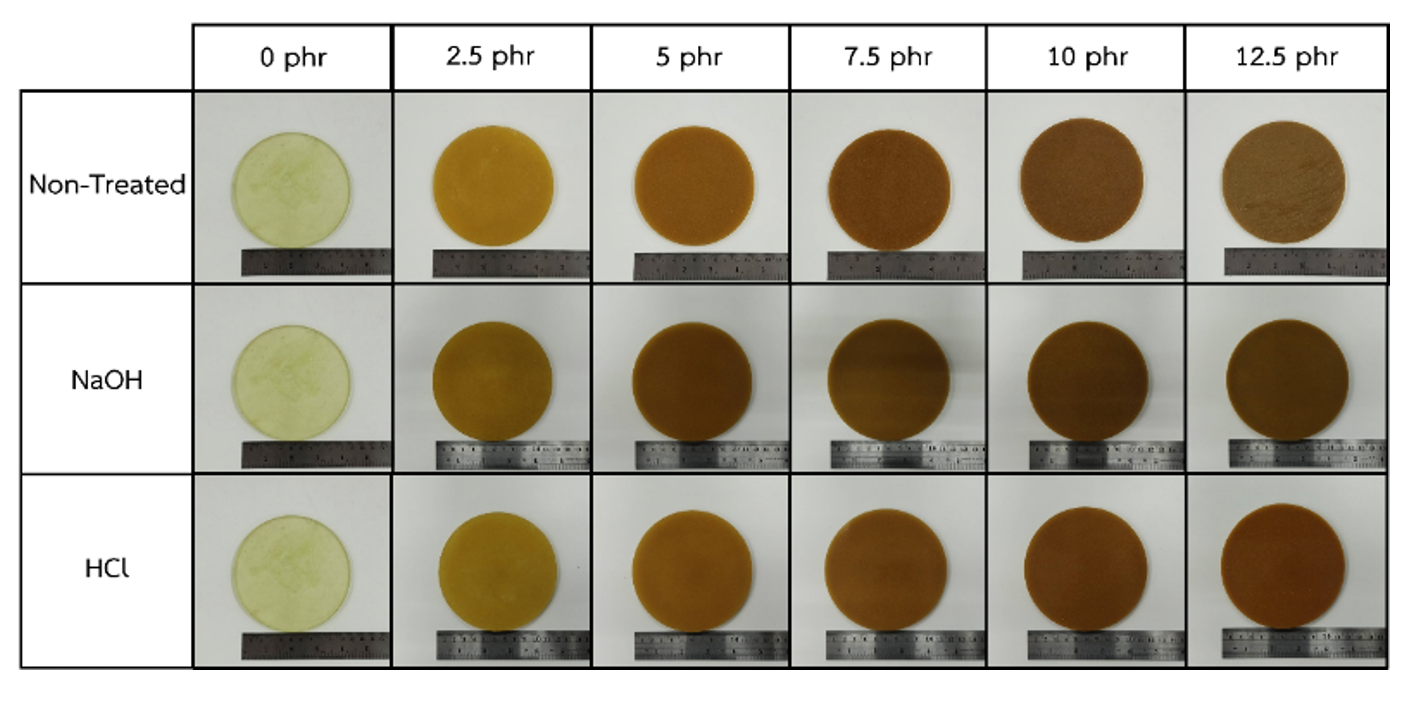
งานวิจัยนี้มีวัตถุประสงค์เพื่อศึกษาผลกระทบของการปรับปรุงเส้นใยแกลบข้าวผสมพอลิยูรีเทนด้วยกรดไฮโดรคลอริกและโซเดียมไฮดรอกไซด์ โดยแกลบข้าวขนาด 80 mesh จะถูกนาไปผสมกับพอลิยูรีเทนในอัตราส่วน 0 2.5 5 7.5 10 และ 12.5 phr เพื่อขึ้นรูปเป็นแผ่นขัดขนาดเส้นผ่านศูนย์กลาง 120 มม. หนา 5 มม. จากนั้นนาไปวัดค่าความแข็งของแผ่นขัดแล้วจึงนาไปทดสอบค่าความต้านทานการขัดถูด้วยชิ้นงานทรงกระบอกขนาดเส้นผ่านศูนย์กลาง 15 มม. สูง 16 มม. และตัดแบ่งแผ่นขัดให้มีน้าหนัก 10 กรัม เพื่อทดสอบความสามารถในการดูดซึมน้า จากผลการวิจัยพบว่า พอลิยูรีเทนผสมแกลบข้าวชนิดต่าง ๆ สามารถขึ้นรูปเป็นแผ่นขัดได้ โดยแผ่นขัดจากแกลบข้าวที่ผ่านกระบวนการปรับปรุงด้วยกรดไฮโดรคลอริกและจากแกลบข้าวที่ไม่ผ่านกระบวนการปรับปรุงมีค่าความแข็งไม่ต่างกันอย่างมีนัยสาคัญ ในขณะที่แผ่นขัดจากแกลบข้าวที่ผ่านกระบวนการปรับปรุงด้วยกรดไฮโดรคลอริกมีค่าความต้านทานการขัดถูสูงและดูดซึมน้าน้อยกว่าแผ่นขัดจากแกลบข้าวที่ไม่ผ่านกระบวนการปรับปรุง ตรงข้ามกับแผ่นขัดจากแกลบข้าวที่ผ่านกระบวนการปรับปรุงด้วยโซเดียมไฮดรอกไซด์พบว่า แผ่นขัดมีค่าความแข็งลดลงในทุกอัตราส่วน ถึงแม้ว่าค่าความต้านทานการขัดถูเพิ่มขึ้นแต่การดูดซึมน้าก็เพิ่มขึ้นด้วย ดังนั้นกระบวนการปรับปรุงแกลบข้าวด้วยกรดไฮโดรคลอริกส่งผลให้แผ่นขัดมีค่าความต้านทานการขัดถูดีขึ้นดูดซึมน้าได้น้อยลง และไม่ส่งผลต่อค่าความแข็ง
Article Details

อนุญาตภายใต้เงื่อนไข Creative Commons Attribution-NonCommercial-NoDerivatives 4.0 International License.
บทความที่ได้รับการตีพิมพ์ในวารสารฯ ท้ังในรูปแบบของรูปเล่มและอิเล็กทรอนิกส์เป็นลิขสิทธิ์ของวารสารฯ
เอกสารอ้างอิง
P. Suriyothin “LED: a Bright and Colourful Light Source … that Needs to Be Verified,” Academic Journal of Architecture. Chulalongkorn University, vol. 60, pp. 11-24, 2011.
B. Zhang, H. Lei, and Y. Chen, “Preparation of Ag2O modified silica abrasives and their chemical mechanical polishing performances on sapphire,” Friction, vol. 5, no. 4, 2017.
S. Dai, H. Lei, and J. Fu, “Preparation of SiC/SiO2 Hard Core–Soft Shell Abrasive and Its CMP Behavior on Sapphire Substrate,” Journal of Electronic Materials, vol. 49, no. 2, pp. 13011307, 2020. doi: 10.1007/s11664-019-07683-9.
H. Lei, L. Q. Huang, and Q. Gu, “Synthesis of Zn-doped colloidal SiO2 abrasives and their applications in sapphire chemical mechanical polishing slurry,” Journal of Materials Science: Materials in Electronics, vol. 28, no. 2, 2017, doi: 10.1007/s10854-016-5650-7
M. Bahr, Y. Sampurno, R. Han, and A. Philipossian, “Slurry injection schemes on the extent of slurry mixing and availability during chemical mechanical planarization,” Micromachines, vol. 8, no. 6, 2017, doi: 10.3390/mi8060170.
S. Chansatarpornkul, P. Khajornrungruang, and K. Suzuki, “Study on organic fibers in the polishing pad for sapphire chemical mechanical polishing,” in JSPE Autumn Conference, Sep. 4-6, 2019, pp.18-19.
N. Bun-athuek, S. Boripatkosol, A. Rattanapan, P. Kajornrungruang, K. Suzuki, and T. Somthong, “Natural fiber-based polishing pad for chemical mechanical polishing of sapphire substrate,” Journal of Science and Technology: for Local Development, vol. 1, pp. 99-116, 2022.
S. Janepittaya, “Where are Thai rice exports in the world market in an era when 'India-Vietnam' are still strong,” Bangkokbiznews Accessed: Jul. 24, 2023. [Online]. Available: https://www.bangkokbiznews.com/ business/1080192
I. B. Ugheoke and O. Mamat, “A critical assessment and new research directions of rice husk silica processing methods and properties,” Maejo International Journal of Science and Technology, vol. 6, no. 3, 2012.
M. Ketsuwan, N. Bun-athuek, N. Sukhawipat, S. Boripatkosol, and C. Parung, “Study on mechanical properties of rice husk fiber-based polishing pad for chemical mechanical polishing of sapphire substrate,” in 1st International Conference on Robotics, Engineering, Science, and Technology,
Pattaya, Thailand, Feb. 16, 2024.
U. Boonsom, S. Boripatkosol, A. Rattanapan, N. Bun-athuek, and P. Boonsong, “Utilization of rice husk fiber and water hyacinth fiber forming polishing pad for sapphire chemical mechanical polishing (CMP),” KKU Research Journal: Graduate Studies,Vol. 22, No. 4, 2022.
N. Stephen, J. O. Akindapo and D. K. Garba, “Development of a military helmet using coconut fiber reinforced polymer matrix composite,” European Journal of Engineering and Technology, Vol. 3, No. 7, pp. 55-65, 2015.
K. Yongmalwong and I. Jangchud, “Improving Abrasion Resistance of Natural Rubber by Blending with Linear Low Density Polyethylene (LLDPE): Effects of Compatibilizers,” in The 9th KU KPS National Conference, Nakhon Pathom, Thailand, Dec. 6-7, 2012.
J. A. Halip, S. H. Lee, P. M. Tahir, L. T. Chuan, M. A. Selimin, and H. A. Saffian, “Chemical Treatments of Rice Husk for Polymer Composites,” Biointerface Research in Applied Chemistry, Vol. 11, Issue 4, pp. 12425-12433, 2021. doi.org/10.33263/BRIAC114. 1242512433
K. A. Chanda, A. Hazra, M. P. Kumar, S. Neogi, and S. Neogi, “Chemical Treatments of Rice Husk Filler and Jute Fiber for the Use in Green Composites,” Fibers and Polymers, 16(4), 902-910, 2015. doi: 10.1007/s12221-015-0902-3
J. T. Librea, F. D. Dacanay, Z. Z. Martin, and L. L. Diaz, “Effect of Water and Acid Pre-treatment on the Physicochemical Properties of Rice Husk for Silica Extraction,” in Materials Science and Engineering Conference Series, Apr. 19–20, 2019, doi:10.1088/1757-899X/540/1/ 012007
O. A. Battista, “Hydrolysis and Crystallization of Cellulose,” Industrial & Engineering Chemistry, Vol. 42, No. 3, pp. 502-507, 1950.
