
Automated Prioritization for Monitoring and Tracking Service Requests using Named Entity Recognition Technique
Article Sidebar
Main Article Content
Abstract
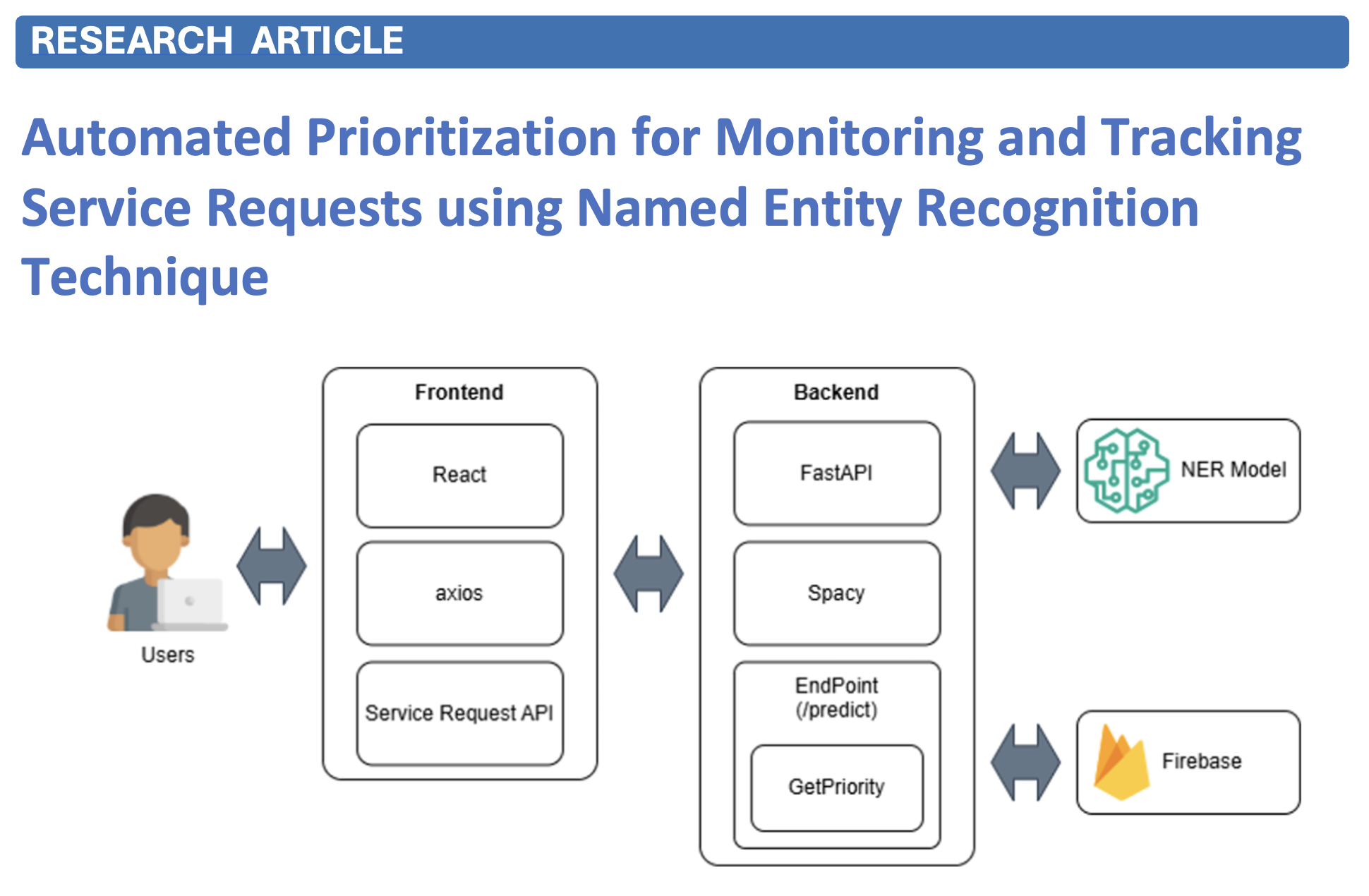
Service request prioritization in IT service management presents significant challenges in terms of accuracy and efficiency, particularly in Thai-language environments where automated support tools remain limited. This study develops and evaluates a web-based application designed to optimize the management and tracking of organizational service requests. By incorporating automated prioritization through Named Entity Recognition (NER), the system aims to improve operational efficiency and reduce the time staff spend on maintenance-related tasks. In addition to real-time tracking, the application serves as a centralized repository for service request data, enabling in-depth analysis and supporting strategic planning. This capability facilitates more informed decision-making in organizational service management. A key feature of the proposed system is its ability to automatically prioritize incoming service requests based on extracted information. The core component is an NER model fine-tuned using 500 service request samples. Four transformer-based language models, namely BERT-Base-Thai, BERT-Base-Multilingual, WangchanBERTa-Base, and XLM-RoBERTa-Base, were evaluated and compared. The evaluation employed multiple performance metrics, including evaluation loss, precision, recall, F1-score, and accuracy, to determine the most suitable model for the task. Experimental results indicate that BERT-Base-Multilingual achieved the best performance, obtaining an evaluation loss of 0.0272, precision of 0.9888, recall of 0.9946, F1-score of 0.9917, and accuracy of 0.9923. System performance testing further demonstrated that automatic priority assignment required less than 3.5 seconds per request, while service resolution was completed within 48 hours, resulting in an overall user satisfaction score of 4.16 out of 5. The findings confirm the effectiveness of the proposed NER model in accurately identifying multiple entity categories and demonstrate that the developed system successfully enhances service request management while reducing request-tracking time through automated log analysis.
Article Details

This work is licensed under a Creative Commons Attribution-NonCommercial-NoDerivatives 4.0 International License.
All authors need to complete copyright transfer to Journal of Applied Informatics and Technology prior to publication. For more details click this link: https://ph01.tci-thaijo.org/index.php/jait/copyrightlicense
References
Axelos (2019). ITIL Foundation: ITIL 4 Edition. TSO (The Stationery Office).
Chandwani, A., Shrivastava, K., Sadashiv, S., Saha, I., and Mishra, P. (2023). Virtual assistant for appointment booking. In 2023 IEEE 8th International Conference for Convergence in Technology (I2CT), pages 1–5. DOI: 10.1109/I2CT57861.2023.10126199.
Dande, F., Li, X., Shofoluwe, M., and McLeod, A. (2024). Artificial intelligence integration in IT service management: An ITIL configuration management process review. In Proceedings of the 1st World Congress on Industrial Engineering and Operations Management, pages 464–474, Detroit, USA. DOI: 10.46254/WC01.20240164.
Dzemydien.e, D., Turskien.e, S., and Šileikien.e, I. (2024). An approach of ICT incident management based on ITIL 4 methodology recommendations. Baltic Journal of Modern Computing, 12(3):286–303. DOI: 10.22364/bjmc.2024.12.3.05.
Hugging Face (2025). Transformers documentation. Accessed: 2025-05-23.
Jurafsky, D. and Martin, J. H. (2008). Speech and Language Processing. Pearson Prentice Hall, 2 edition.
Kuntichod, W., Lee, W., and Prayote, A. (2024). Unseen named entity recognition for Thai language. In 2024 21st International SoC Design Conference (ISOCC), pages 258–259. DOI: 10.1109/ISOCC62682.2024.10762678.
Laosen, N., Laosen, K., and Paklao, T. (2024). Named entity recognition for Thai historical data. In 2024 21st International Joint Conference on Computer Science and Software Engineering (JCSSE), pages 528–533. DOI: 10.1109/JCSSE61278.2024.10613644.
Liu, Z., Jiang, K., Liu, Z., and Qin, T. (2024). A cybersecurity named entity recognition model based on active learning and self-learning. In 2024 36th Chinese Control and Decision Conference (CCDC), pages 4505–4510. DOI: 10.1109/10.1109/CCDC62350.2024.10587887.
Mao, H., Zhang, T., and Tang, Q. (2021). Research framework for determining how artificial intelligence enables information technology service management for business model resilience. Sustainability, 13(20):11496. DOI: 10.3390/su132011496.
Mesquita, D. and Altinok, D. (2025). Mastering spaCy: Build Structured NLP Solutions with Custom Components and Models Powered by spacy-llm. Packt Publishing, 2 edition.
Nakayama, H. (2018). seqeval: A Python framework for sequence labeling evaluation. OpenAI (2024). ChatGPT. Large Language Model.
Patil, N., Patil, A., and Pawar, B. V. (2020). Named entity recognition using conditional random fields. Procedia Computer Science, 167:1181–1188. DOI: 10.1016/j.procs.2020.03.431.
Petcharat, T. and Puengwattanapong, P. (2018). Incident management system for IT service. Life Sciences and Environment Journal, 19(1):58–66. https://ph01.tci-thaijo.org/index.php/psru/article/view/74756.
Phatthiyaphaibun, W., Chaovavanich, K., Polpanumas, C., Suriyawongkul, A., Lowphansirikul, L., Chormai, P., Limkonchotiwat, P., Suntorntip, T., and Udomcharoenchaikit, C. (2023). PyThaiNLP: Thai natural language processing in Python. In Proceedings of the
rd Workshop for Natural Language Processing Open Source Software (NLP-OSS 2023), pages 25–36. DOI: 10.18653/v1/2023.nlposs-1.4.
PyThaiNLP (2021). PyThaiNLP documentation. Rajamangala University of Technology Tawan-Ok (2022). Rajamangala university of technology tawanok. Retrieved 28 March 2025, https://www.rmutto.ac.th/.
Shorten, C., Khoshgoftaar, T. M., and Furht, B. (2021). Text data augmentation for deep learning. Journal of Big Data, 8(1):101. DOI: 10.1186/s40537-021-00492-0.
Sornlertlamvanich, V. and Yuenyong, S. (2022). Thai named entity recognition using BiLSTM-CNN-CRF enhanced by TCC. IEEE Access, 10:53043–53052. DOI: 10.1109/ACCESS.2022.3175201.
Tian, Y. (2024). A model for named entity recognition in colorectal tumor pathological text. In 2024 9th International Conference on Intelligent Computing and Signal Processing (ICSP), pages 780–784. DOI: 10.1109/ICSP62122.2024.10743829.
Tommy, L., Kirana, C., and Riska, L. (2020). The combination of natural language processing and entity extraction for academic chatbot. In 2020 8th International Conference on Cyber and IT Service Management (CITSM), pages 1–6. DOI: 10.1109/CITSM50537.2020.9268851.
Tunstall, L., von Werra, L., and Wolf, T. (2022). Natural Language Processing with Transformers. O’Reilly Media.
Vasiliev, Y. (2020). Natural Language Processing with Python and spaCy: A Practical Introduction. No Starch Press, San Francisco.
Zhang, S., Li, G., Shi, X., Liu, L., and Chen, M. (2024). Chinese named entity recognition with integrated boundary features and location information. In 2024 IEEE 7th Information Technology, Networking, Electronic and Automation Control Conference (ITNEC), pages 565–570. DOI: 10.1109/10.1109/ITNEC60942.2024.10732932.
