
Detecting Fish Movement Behavior based on Constant Temperature and pH using the IoT and Realtime Object Detection Model
Article Sidebar
Main Article Content
Abstract
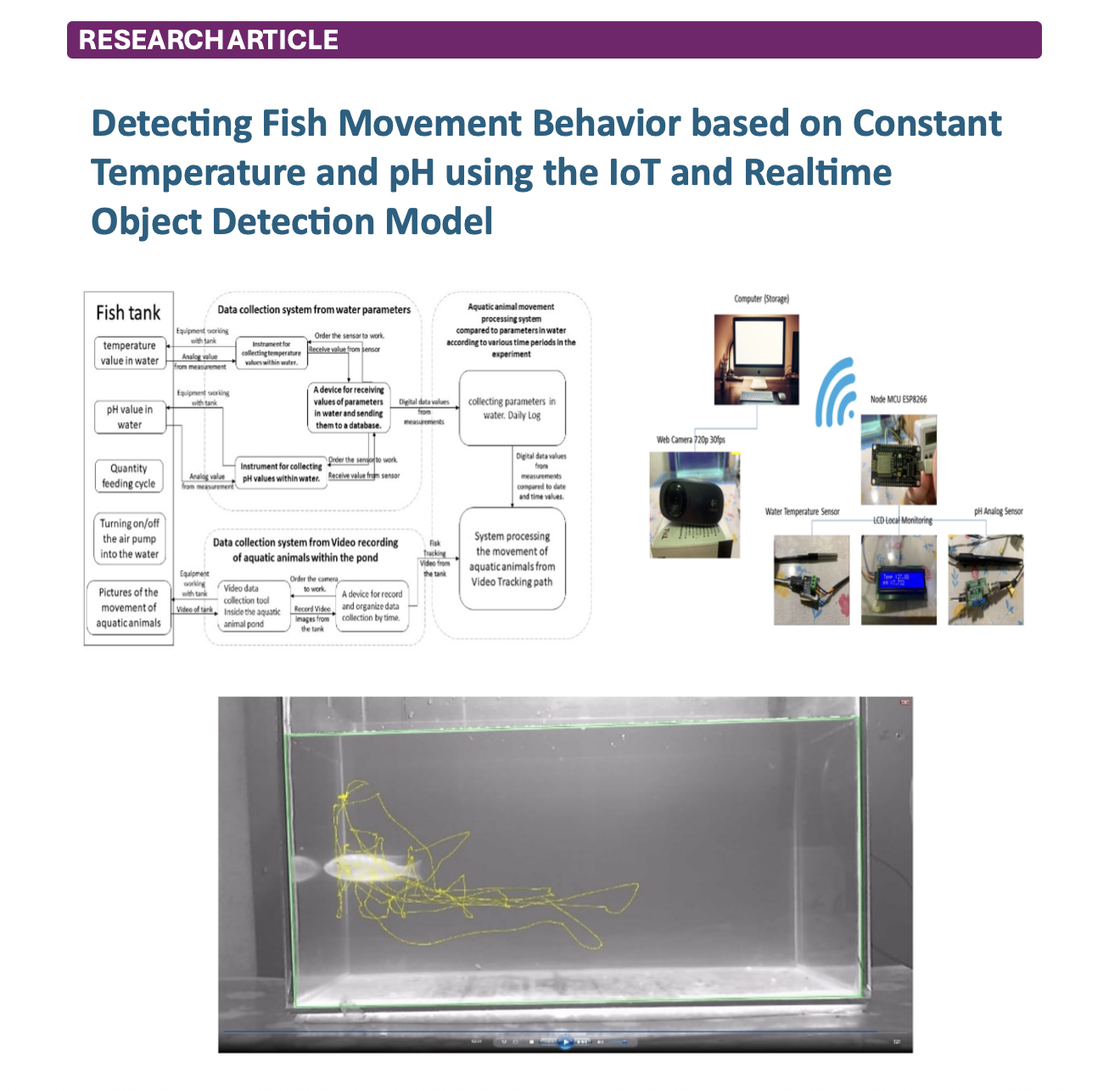
This paper introduces a novel approach to water quality monitoring utilizing fish behavior as an indicator of aquatic environmental conditions. The proposed system integrates advanced technologies, including computer vision, sensors, and data analytics, to track and analyze the movement patterns of fish in real-time. Deployed sensors measure key water quality parameters such as temperature, pH, dissolved oxygen, and turbidity, while cameras capture fish activities within the monitored water bodies, then the livelihood of the fish will be affected. With problems that arise, solutions can be prepared by analyzing key components. Two components consist of a system that can automatically set fish feeding and the second component is water property measurement and level monitoring using the sensor module and electrical equipment with automatic video recording equipment installed, in observing the behavior and livelihood of aquatic animals. It has a communication connection in the form of the Internet of Things (IoT). We have developed a system that allows devices to measure temperature and pH in water and to display via the Internet for use in online data tracking and automatic installation of video recording equipment. By correlating observed fish behaviors with concurrently recorded water quality data, the system establishes meaningful relationships that enable the continuous assessment of the aquatic environment. From the results, it was known that the best conditions for the fish to survive. The project can be used as a prototype for creating an automatic fish tank that can adjust various parameters within the water if it is not appropriate for the well-being of aquatic animals. This innovative approach contributes to the advancement of environmental monitoring systems, fostering a deeper understanding of the dynamic interplay between aquatic ecosystems and water quality parameters.
Article Details

This work is licensed under a Creative Commons Attribution-NonCommercial-NoDerivatives 4.0 International License.
All authors need to complete copyright transfer to Journal of Applied Informatics and Technology prior to publication. For more details click this link: https://ph01.tci-thaijo.org/index.php/jait/copyrightlicense




References
Chen, K.-H. (2023). Group-of-picture mode acceleration for efficient object detection in video streams. IEEE Access, 11, 71668–71682. https://doi.org/10.1109/access.2023.3294558
Diwan, T., Anirudh, G., & Tembhurne, J. V. (2022). Object detection using YOLO: Challenges, architectural successors, datasets and applications. Multimedia Tools and Applications, 82 (6), 9243–9275. https://doi.org/10.1007/s11042-022-13644-y
dos Santos, J. A., Soares, C. M., & Bialetzki, A. (2020). Effects of ph on the incubation and early development of fish species with different reproductive strategies. Aquatic Toxicology, 219, 105382. https://doi.org/10.1016/j.aquatox.2019.105382
Ismail, S., Dawoud, D. W., Ismail, N., Marsh, R., & Alshami, A. S. (2022). IoT-based water management systems: Survey and future research direction. IEEE Access, 10, 35942–35952. https://doi.org/10.1109/access.2022.3163742
Jabbar, W. A., Mei Ting, T., I. Hamidun, M. F., Che Kamarudin, A. H., Wu, W., Sultan, J., Alsewari, A. A., & Ali, M. A. (2024). Development of lorawan-based iot system for water quality monitoring in rural areas. Expert Systems with Applications, 242, 122862. https://doi.org/10.1016/j.eswa.2023.122862
Khan, M. I., Mukherjee, K., Shoukat, R., & Dong, H. (2017). A review on pH sensitive materials for sensors and detection methods. Microsystem Technologies, 23 (10), 4391–4404. https://doi.org/10.1007/s00542-017-3495-5
Kori, S., Ayatti, S., Lalbeg, V., & Angadi, A. (2018). Smart live monitoring of aquarium—An IoT application. Information and Communication Technology for Intelligent Systems, 1–9. https://doi.org/10.1007/978-981-13-1747-7_1
Liu, Y., Li, B., Zhou, X., Li, D., & Duan, Q. (2024). FishTrack: Multi-object tracking method for fish using spatiotemporal information fusion. Expert Systems with Applications, 238, 122194. https://doi.org/10.1016/j.eswa.2023.122194
Lopes, A. F., Faria, A. M., & Dupont, S. (2020). Elevated temperature, but not decreased pH, impairs reproduction in a temperate fish. Scientific Reports, 10 (1). https://doi.org/10.1038/s41598-020-77906-1
Manjakkal, L., Mitra, S., Petillot, Y. R., Shutler, J., Scott, E. M., Willander, M., & Dahiya, R. (2021). Connected sensors, innovative sensor deployment, and intelligent data analysis for online water quality monitoring. IEEE Internet of Things Journal, 8 (18), 13805–13824. https://doi.org/10.1109/jiot.2021.3081772
Manzar, S. A., Verma, S., & Gupta, S. H. (2022). Analysis and optimization of downlink energy in NB-IoT. Sustainable Computing: Informatics and Systems, 35, 100757. https://doi.org/10.1016/j.suscom.2022.100757
Matarneh, S., AlQaraleh, L., Alkhrissat, T., & Abdel-Jaber, M. (2024). Assessing water production from air conditioning systems as an unconventional supply source: A focus on water quality and social acceptance perspectives. Case Studies in Chemical and Environmental Engineering, 9, 100585. https://doi.org/10.1016/j.cscee.2023.100585
Nanyanzi, D. R., Ocen, G. G., Omara, T., Bwire, F., Matovu, D., & Semwogerere, T. (2021). Design and assembly of a domestic water temperature, pH and turbidity monitoring system. BMC Research Notes, 14 (1), 161. https://doi.org/10.1186/s13104-021-05578-9
Nyanti, L., Soo, C.-L., Danial-Nakhaie, M.-S., Ling, T.-Y., Sim, S.-F., Grinang, J., Ganyai, T., & Lee, K.-S.-P. (2020). Effects of water temperature and ph on total suspended solids tolerance of malaysian native and exotic fish species. AACL Bioflux, 11 (3), 565–575. https://www.cabidigitallibrary.org/doi/pdf/10.5555/20183236723
Pasha Mohd Daud, A. K., Sulaiman, N. A., Mohamad Yusof, Y. W., & Kassim, M. (2020). An IoT-based smart aquarium monitoring system. 2020 IEEE 10th Symposium on Computer Applications amp; Industrial Electronics (ISCAIE), 277–282. https://doi.org/10.1109/iscaie47305.2020.9108823
Qiao, M., Zhou, G., Liu, Q. L., & Zhang, L. (2021). Salient object detection: An accurate and efficient method for complex shape objects. IEEE Access, 9, 169220–169230. https://doi.org/10.1109/access.2021.3138782
Redmon, J., Divvala, S., Girshick, R., & Farhadi, A. (2016). You only look once: Unified, real-time object detection. https://arxiv.org/abs/1506.02640
Saad, A., Benyamina, A. E. H., & Gamatie, A. (2020). Water management in agriculture: A survey on current challenges and technological solutions. IEEE Access, 8, 38082–38097. https://doi.org/10.1109/access.2020.2974977
Schindelin, J., Arganda-Carreras, I., Frise, E., Kaynig, V., Longair, M., Pietzsch, T., Preibisch, S., Rueden, C., Saalfeld, S., Schmid, B., Tinevez, J.-Y., White, D. J., Hartenstein, V., Eliceiri, K., Tomancak, P., & Cardona, A. (2012). Fiji: An open-source platform for biological-image analysis. Nature Methods, 9 (7), 676–682. https://doi.org/10.1038/nmeth.2019
Shreesha, S., Pai, M. M. M., Verma, U., & Pai, R. M. (2023). Fish tracking and continual behavioral pattern clustering using novel Sillago Sihama Vid (SSVid). IEEE Access, 11, 29400–29416. https://doi.org/10.1109/access.2023.3247143
Winkler, J., Badri-Hoeher, S., & Barkouch, F. (2023). Activity segmentation and fish tracking from sonar videos by combining artifacts filtering and a Kalman approach. IEEE Access, 11, 96522–96529. https://doi.org/10.1109/access.2023.3294710
Zhao, X., Yan, S., & Gao, Q. (2019). An algorithm for tracking multiple fish based on biological water quality monitoring. IEEE Access, 7, 15018–15026. https://doi.org/10.1109/access.2019.2895072
