Design And Development of Biodegradable Sawdust Nursery Trays
Article Sidebar
Main Article Content
Abstract
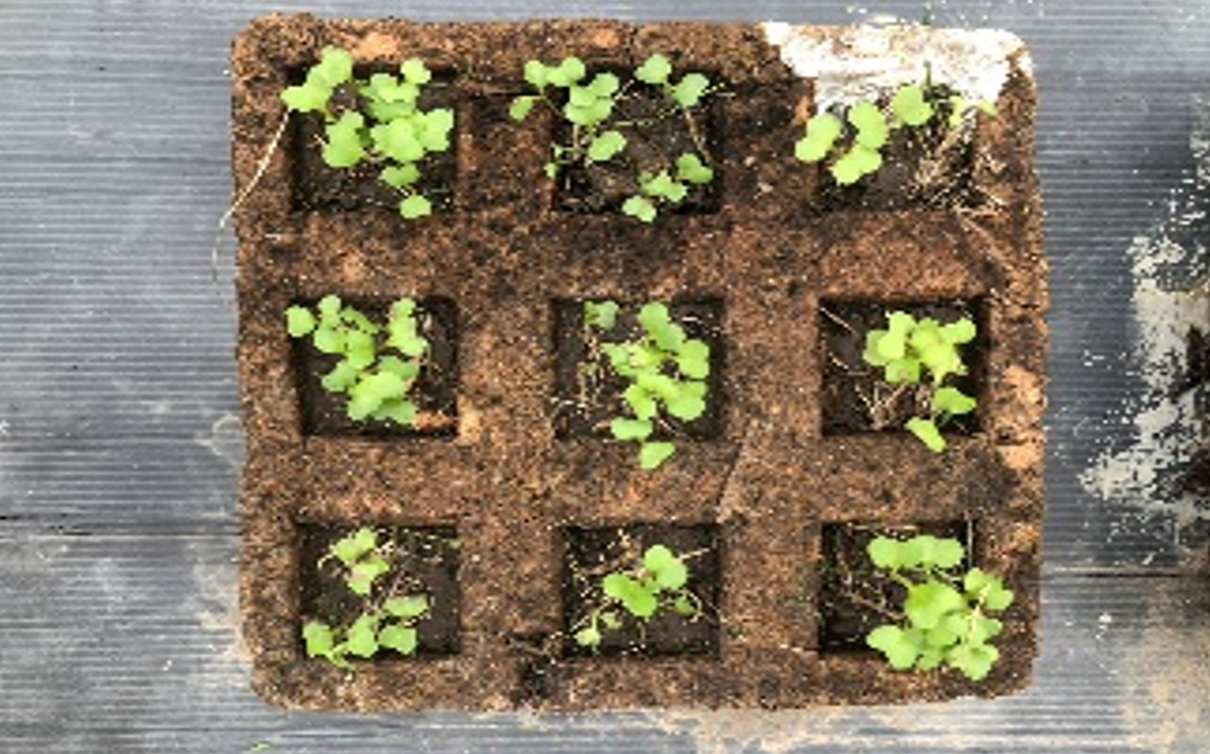
The objectives of this research are 1) to study the process of forming seedling trays from sawdust using wet starch glue as a binding material 2) to design seedling trays suitable for use 3) to produce seedling trays. Seedlings must be in accordance with community industrial product standards. A total of 6 experimental methods were used in different mixing ratios by weight. Formed using a hydraulic press. Study the physical characteristics of the seedling trays after being removed from the mold. Study properties and test for deterioration The method of collecting data was from a sample of 12 farmers who produced seedlings in Hankha District, Chainat Province, and in-depth interviews with a sample of 5 entrepreneurs using a specific random sampling method. Using statistics to analyze the data, it was found that 1) the molding process for experimental set A06, which had a mixture ratio of wet starch glue : sawdust 60 : 40, was the most moldable. Can be formed into full leaves. 2) Entrepreneurs have a need for nursery trays of standard rectangular shape and size and when considering the chemical characteristics of the raw materials It has an appropriate pH value for plant growth. 3) Physical characteristics and properties according to community industrial product standards were found to be durable, harmonious, not cracked, have a smooth, uniform brown surface, and have a size of 5 cm at the top and 5 cm at the bottom. 4 centimeters, height 5 centimeters, thickness 0.5 centimeters, weight 246.66 grams and has a humidity value of 25.94 ±1.43, a water absorption value of 66.79±5.56%, a swelling value of 7.38±0.85%, a porosity value of 6.46±1.66%. Able to absorb water well It has the slowest deterioration.
Article Details

This work is licensed under a Creative Commons Attribution-NonCommercial-NoDerivatives 4.0 International License.
Articles published in Journal of Industrial Technology Ubon Ratchathani Rajabhat University both hard copy and electronically are belonged to the Journal.
References
K. Jutamas, “The Production of Biodegradable Flowerpot from Sludge of Rubber Factory with Waste from Mushroom Culture and Palm Bunches,” ASEAN Journal of Scientific and Technological Reports, vol. 24, no. 1, pp. 84-93, Jan. - Apr. 2021.
T. Yamane, Statistics an Introductory Analysis. New York: Harper & Row, 1973.
C. Pathama, S. Kunruedee, W. Rungtiva, and S. Klanarong, “Properties of Film from Cassava Starch Modified by Acid Hydrolysis in Water and Ethanol,” in Proceedings of 50th Kasetsart University Annual Conference: Agro-Industry, Jan. 31- Feb. 2, 2012, pp. 379-387.
C. Kanjanaporn and S. Ubonwan, “Creation and Optimization of Planting Trays from Elephant Dung,” Industrial Technology Journal, vol. 6, no. 2, pp. 53-64, Jul. - Dec. 2021.
P. Tuanjai, C. Wanvipa, and S. Kattinat, “Environment-Friendly Plant Pot Production from Palm Oil Sludge and Mushroom Cultured Waste,” Journal of Technology Srivijaya Research Rajamangala University, vol. 10, no. 3, pp. 497-511, Sep. - Nov. 2018.
C. Wanvipa, P. Tuanjai, and C. Weerasak, “Production of Coaster from Used Cubes Mushroom Research,” Report Faculty of Fisheries Science and Technology Rajamangala University of Technology Srivijaya, pp. 16-20, 2019.
N. Tanpaiboonkul, T. Budnumpetch, K. Sukaranandara, and P. Phothilangka, “Biodegradable Pots from Water Hyacinth Using Cassava Starch and Cassava Pulp as Binder,” Journal of Science and Technology Huachiew Chaloem Phrakiat, vol. 8, no. 1, pp. 56-69, Jan. - Jun. 2023.
S. Sirisak and Y. Charatchai, “Study the Optimal Mixing Ratio and the Physical Quality of The Bio-Composite Pot from Coconut Residue,” Khon Kaen Agriculture Journal, vol. 47, no. Suppl. 1, pp. 1485-1490, Jan. 2019.
S. Pinprapa and N. Sirinaree, “Biodegradable Nursery Pot from Beverage Labelling Waste and Coconut Bagasse,” in Proceedings of 4th. KU SRC Annual Conference Kasetsart University, vol. 4, Aug. 2020, pp. 36-45.
