
Multifunctional Furniture Design to Increase Usable Space for Small Residential
Article Sidebar
Main Article Content
Abstract
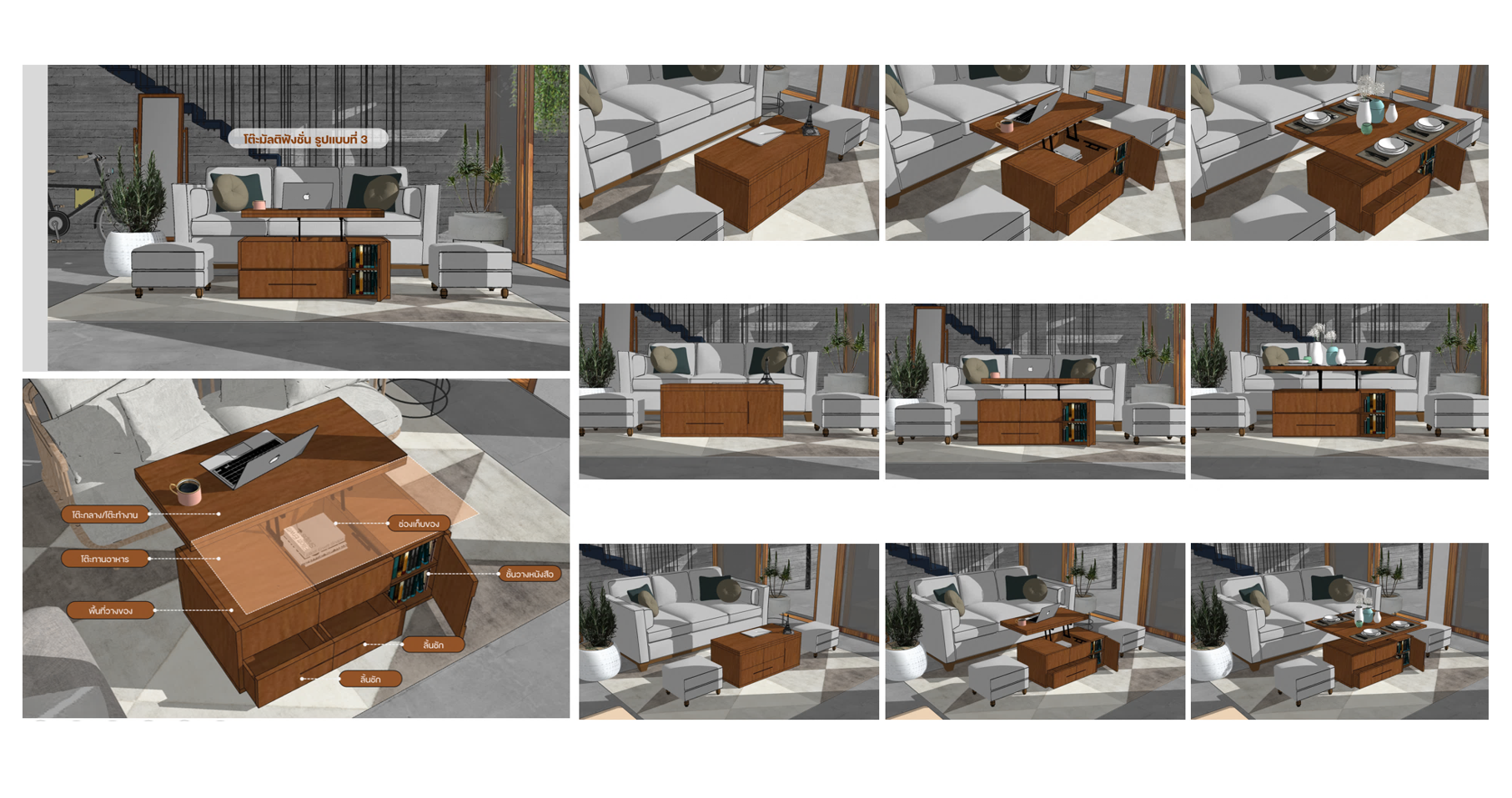
The objectives of this research are: 1) to study the needs of consumers in relation to small living spaces, 2) to design multifunctional furniture suitable for use and to evaluate consumer satisfaction, and 3) to produce prototypes and test them to meet the Thai Industrial Standards (TIS) 107-2563. This study employed surveys and interviews to assess consumer needs and utilized experimental methods in the production and testing of prototypes. The study revealed that the most common issue faced by consumers is limited usable space, which is insufficient for their needs, and that the living room is the most utilized area. Multifunctional furniture designs include a coffee table that combines a dining table and a desk. According to experts, multifunctional furniture suitable for small living spaces should not exceed 50x80 centimeters in size and should be 41 centimeters high, with robust construction, slightly rounded edges, and versatility in function. Consumer satisfaction with the furniture design showed that Design 1, which measures 45x80 centimeters and is 41 centimeters high, emphasizes functionality with features such as storage drawers and a bookshelf, along with a work desk approximately 74 centimeters high. Utilizing a multi-purpose foldable steel frame with modern wooden legs to make the living space appear larger. This research can save approximately 79.31% of usable space, add value by about 23.68%, and provide valuable knowledge that can be applied to similar businesses, contributing to the economic development of the industrial sector.
Article Details

This work is licensed under a Creative Commons Attribution-NonCommercial-NoDerivatives 4.0 International License.
Articles published in Journal of Industrial Technology Ubon Ratchathani Rajabhat University both hard copy and electronically are belonged to the Journal.
References
B. Pimthong, "The design and development of a teak wood foldable chair for 28-40 SQM residences to promote woodwork and furniture of small -and- micro- community enterprise: a case study of Baan Donmun group in Phrae province," Arch Journal Issue, vol. 34, no. 1, pp. 74-76, Jun. 2022.
R. V. Krejcie and D. W. Morgan, "Determining sample size for research activities," Educational and Psychological Measurement, vol. 30, no. 3, pp. 607-610, Oct. 1970.
T. Siriwong, and S. Rermlawan, "Marketing mix affecting furniture purchase decisions of customers in Muand district, Chachoengsao province," Journal of Management Science Research, Surindra Rajabhat University, vol. 8, no. 1, p. 114-126, Apr. 2024.
N. Sakunnee and A. Saengchanthai, "Furniture design from wood chips with wood grain interlocking techniques," in The 1st Kamphaeng Phet Rajabhat University Student National Conference, Kamphaeng Phet, Thailand, Feb. 22, 2021, pp. 486.
R. Rittisak, "A study of small housing to meet the income and lifestyle of new generation people," M.S. thesis, Department of Architecture, Thammasat University, Pathumthani, Thailand, 2023.
