Air Quality Monitoring Station Using the Internet of Things with LoRa Technology and Extending the Transmission Distance Through Repeaters
Article Sidebar
Main Article Content
Abstract
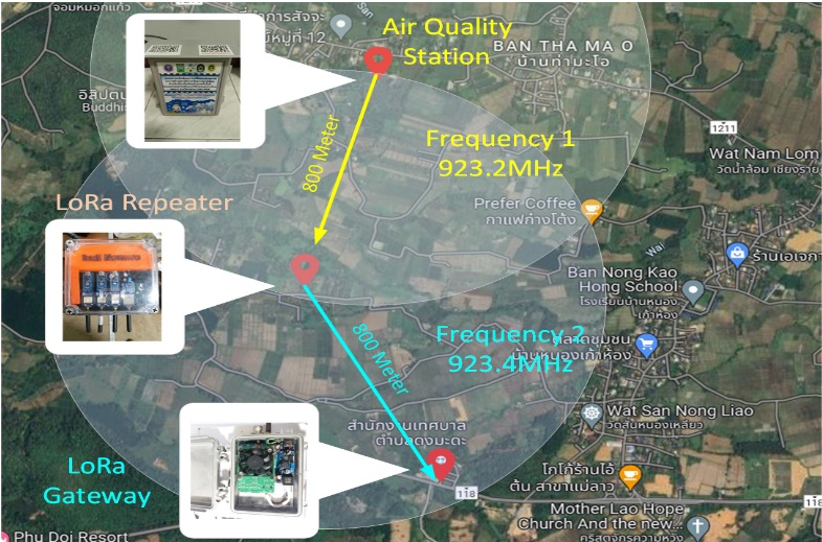
Nowadays, the LoRa technology for the Internet of Things (IoT) is designed to fulfil the requirements of long-range data transmission, capable of covering distances of up to 1 kilometer in unobstructed environments. However, when desiring to cover a greater distance, certain constraints come into play that the system is incapable of accommodating. Therefore, the present study encompasses the development of a repeater system utilizing LoRa technology with the aim of extending the transmission range for the purpose of transmitting data from air quality monitoring stations. The repeater system functions within two distinct frequency bands, specifically 923.2 MHz and 923.4 MHz. Based on the results, the signal strength observed between the air quality monitoring station and the repeater exhibited a range spanning from -84 dBm to -92 dBm. The study looked at the indicator level value of the signal strength that the device received from the transmitter in the context of the LoRa repeater device and the LoRa network. The experimental findings revealed that the average signal level ranged between -69 dBm and -112 dBm. Additionally, the results indicated that the average signal delay was measured at 5,000 ms.
Article Details

This work is licensed under a Creative Commons Attribution-NonCommercial-NoDerivatives 4.0 International License.
Articles published in Journal of Industrial Technology Ubon Ratchathani Rajabhat University both hard copy and electronically are belonged to the Journal.
References
Department of Disease Control, “Guidelines for Monitoring Risky Areas from Air Pollution. Integrated Environmental and Health Plan Ministry of Public Health.” Accessed: Jan. 20, 2023. [Online]. Available: http://www.oic.go.th/FILEWEB/CABINFOCENTER17/DRAWER002/GENERAL/DATA0000/00000199.PDF. (in Thai)
Y. Cheng, X. Li, Z. Li, S. Jiang and X. Jiang, “Air Cloud: a cloud-based air-quality monitoring system for everyone,” in Proceedings of the 12th ACM Conference on Embedded Network Sensor Systems, Memphis, TN, USA, Nov. 3–6, 2014, pp. 256–265.
J. Shah and B. Mishra, “IoT enabled environmental monitoring system for smart cities,” in International Conference on Internet of Things and Applications (IOTA), Pune, India, Jan. 22–24, 2016, pp. 383–388.
B. Ando, S. Baglio, A. Pistorio, G. M. Tina and C. Ventura, “Sentinella: Smart monitoring of photovoltaic systems at panel level,” IEEE Transactions on Instrumentation and Measurement, vol. 64, no. 8, pp. 2188–2199, 2015.
G. Mois, S. Folea and T. Sanislav, “Analysis of three IoT-based wireless sensors for environmental monitoring,” IEEE Transactions on Instrumentation and Measurement, vol. 66, no. 8, pp. 2056–2064, 2017.
LoRa Alliance, “LoRaWAN® for Smart Utilities.” Accessed: Jan. 18, 2023. [Online]. Available: https://lora-alliance.org/lorawan-for-developers/
K. H. Ke, Q. W. Liang, G. J. Zeng, J. H. Lin and H. C. Lee, “Demo Abstract: A LoRa Wireless Mesh Networking Module for Campus-Scale Monitoring,” in Proceedings of the 16th ACM/IEEE International Conference on Information Processing in Sensor Networks (IPSN), Pittsburgh, PA, USA, Apr. 18–21, 2017, pp. 259–260.
A. Augustin, J. Yi, T. Clausen, and W. M. Townsley, “A study of LoRa: Long range and low power networks for the Internet of Things,” Sensors, vol. 16, no. 9, pp. 1466–1476, 2016.
S. Chaimool and T. Kanadee, “Application of LoRaWAN network system for power monitoring and storage in smart buildings,” Journal of King Mongkut's University of Technology North Bangkok, vol. 34, no. 3, pp. 1–13, 2024. (in Thai)
A. Kostadinov and K. Kolev, “LoRa smart city applications,” in Proceedings of the 29th International Conference on Systems Signals and Image Processing (IWSSIP), Skopje, North Macedonia, Jun. 1–3, 2022, pp. 112–119.
M. Rizzi, P. Ferrari, A. Flammini and E. Sisinni, “Evaluation of the IoT LoRaWAN Solution for Distributed Measurement Applications,” IEEE Transactions on Instrumentation and Measurement, vol. 66, no. 12, pp. 3340–3349, 2017.
H. T. Friis, “A note on a simple transmission formula,” Proceedings of the IRE and Waves and Electrons, vol. 34, no. 5, pp. 254–256, 1946.
T. Udomchaipitak, N. Boonnam and S. Puttinaovara, “An Experimental Study of RSSI for LoRa Technology in Different Bandwidths,” in Proceedings of the 37th International Technical Conference on Circuits/Systems Computers and Communications, Phuket, Thailand, Jul. 5–8, 2022, pp. 156–160.
A. A. Tesfay, E. P. Simon, I. Nevat and L. Clavier, “Power domain NOMA without SIC in downlink CSS-based LoRa networks,” in Proceedings of the 23rd International Conference DCCN, Moscow, Russia, Sep. 14–18, 2020, pp. 3–13.
A. Alessandro, G. Fabrice, R. Stephane and S. Stefano, “Packet Delivery Ratio Guarantees for Differentiated Lorawan Services,” in Proceedings of the 2022 IEEE Global Communications Conference, Rio de Janeiro, Brazil, Dec. 4–8, 2022, pp. 172–176.
The Things Network, “Spreading factors.” Accessed: Aug. 4, 2023. [Online]. Available: https://www.thethingsnetwork.org/docs/lorawan/spreading-factors/
