Development of Remote Monitoring of Pulse Oximetry and Heart Rate System Notification Via Line Application
Article Sidebar
Main Article Content
Abstract
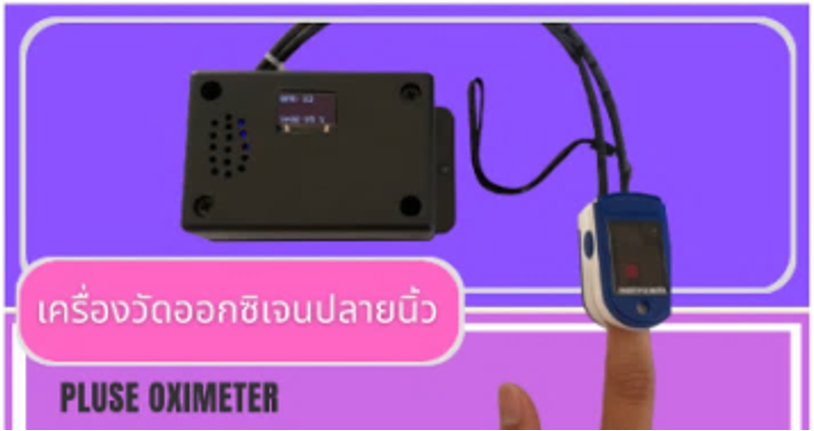
This research developed a pulse oximeter and heart rate monitor with a remote monitoring system. Users and caregivers can monitor current and past oxygen levels and heart rate through the application web page. The system records blood oxygen levels and heart rates according to a configurable schedule. If the amount of oxygen in the blood or heart rates are detected, the system sends alerts to the LINE application, enabling timely intervention by caregivers. The development of the pulse oximeter and heart rate monitor in this research utilizes a microcontroller, NodeMCU, for operational control. Data from the heart rate and blood oxygen sensors are transmitted over the Internet and stored using Google Sheets online services for continuous monitoring and remote tracking. Voice notifications recorded on a MicroSD card are also included. The results showed that system can measure blood oxygen saturation and heart rate, and record the measurement results in Google Sheets according to the set schedule. A meter management system is available through the web application. Performance testing compared to the pulse oximetry, there was a difference 1.41% for heart rate measurement test and 0.41% for blood oxygen compatibility test.
Article Details

This work is licensed under a Creative Commons Attribution-NonCommercial-NoDerivatives 4.0 International License.
Articles published in Journal of Industrial Technology Ubon Ratchathani Rajabhat University both hard copy and electronically are belonged to the Journal.
References
B. Yang and J. Moss, “Evolution of the Pulse Ox,” CHEST, vol. 164, no. 1, pp. 24-26, Jul. 2023, doi: 10.1016/j.chest.2022.12.042.
J. Puapermpoolsiri, J. Chimnoy, and J. Chotsaengthong, “Low-Cost Automatically Continuous Positive Airway Pressure Machine,” in The 14th Conference on Application Research and Development (ECTI-CARD 2022), A. Wutthiphong, Ed. Lopburi, Thailand, Feb. 17-19, 2022, pp. 148-153.
World Health Organization, “World Health.WHO/AFRO: Response to COVID-19utbreak.” Accessed: May 4, 2022. [Online]. Available: https://www.who.int/emergencies/diseases/novel-coronavirus-2019/advice-for-public?adgroupsurvey={adgroupsurvey}&gclid=CjwKCAiAkp6tBhB5EiwANTCx1PmcsSePrK1ZtGrEdcHwYArQ73YoEPeMhomGgE4zEqHSiAIFuq-zrhoCpJEQAvD_BwE
S. Chatmongkolchart, “Pulse oximetry.” Songkla University. Accessed: May 19, 2023. [Online]. Available: http://medinfo2.psu.ac.th/anesth/education/pulseoximeter.html
R. Ranokphanuwat, “Cloud-Based Service System for Automatic Plant Monitoring and Watering based on Soil Moisture,” Journal of Information Science and Technology, vol. 8, no. 2, pp. 65-73, 2018.
R. Chaipradermsak and N. Porntheerapat, “The effectiveness of innovative cover of oxygen saturation probe in infants,” Nursing Journal, vol. 44, no. 2, pp. 94-102, Dec. 2017.
E. Boonchieng, “CMU develops pulse oximeter with low cost, high accuracy, inaccuracy not more than 2%.” Chiang Mai University. Accessed: Oct. 3, 2023. [Online]. Available: https://www.cmu.ac.th/th/article/a3e5f8c8-a7ee-473f-a372-26aeecec32a4
N. Tadpitakkul, Innovation in Response to COVID-19. Bangkok, Thailand: National Science and Technology Development Agency (NSTDA), 2020. (in Thai)
