Application of Solar Energy to Control the Temperature in Greenhouses with Internet of Things Misting and Operation Methods
Article Sidebar
Main Article Content
Abstract
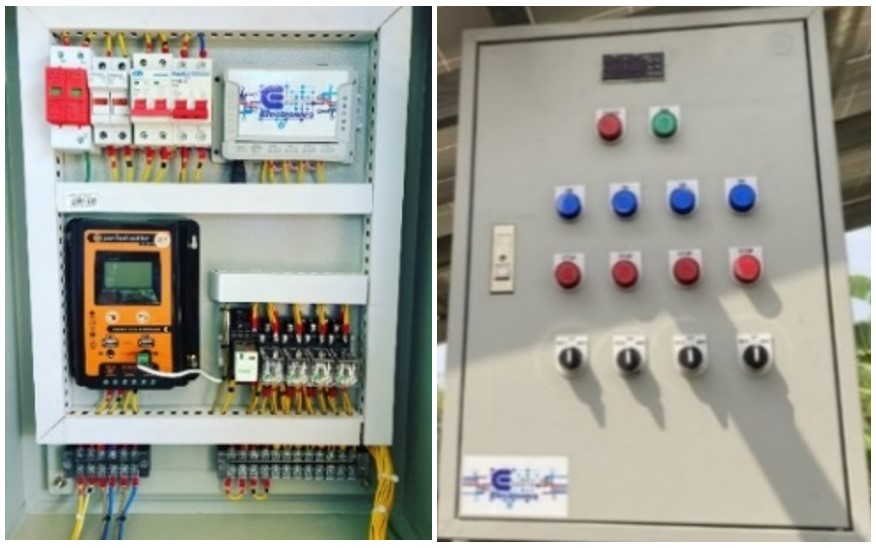
This article is a presentation. Application of Solar Energy to Control the Temperature in Greenhouses with Internet of Things Misting and Operation Methods. Objective. 1. To design, build and use solar energy as an energy source, and 2. To control the temperature in greenhouses by misting and Internet of Things operation methods. The system structure consists of 1. Solar energy power system 2. The control system consists of Temperature Controller STC – 3008. Receives an analog signal from the DHT21 sensor. The test set the temperature to 35 degrees Celsius. Under operating conditions when the temperature is greater than 1 degree Celsius. The misting system then operates and stops when the temperature drops below the adjusted value of 1 degree Celsius. Solar energy design results from. The total daily energy demand was 1,780 watts – hours. Solar energy produces average of 320 watts – hours of power in one day. With a solar energy system designed to create an Stand Alone with batteries. It used a battery with a capacity of 200 amperes, voltage in the system was 24 volts. power in the system is equal to 4,800 watts – hours. Enough for the system that actually works equal to 30 minutes per day. During the system operation, the temperature in the house averaged 38.1 degrees Celsius and the average error value was 3.2 degrees Celsius. The error value is still within acceptable range and can be activated with the eWeLink app that controls the sprinkler system for watering.
Article Details

This work is licensed under a Creative Commons Attribution-NonCommercial-NoDerivatives 4.0 International License.
Articles published in Journal of Industrial Technology Ubon Ratchathani Rajabhat University both hard copy and electronically are belonged to the Journal.
References
K. Pongtana and C. Sakul, “Hydroponics house with automatic control system using solar energy,” UTK Research Journal, vol. 13, no. 2, pp. 65-77, Jul. – Dec. 2019. (in Thai)
J. Manwicha, “Smart Farms Technology,” Hatyai Academic Journal, vol. 14, no. 2, pp. 201-210, Jul. – Dec. 2016. (in Thai)
J. Muangprathub et al., “IoT and agriculture data analysis for the smart farm,” Computers and Electronics in Agriculture, vol. 156, pp. 467-474, Jan. 2019.
E. S. Mohamed et al., “Smart farming for improving agricultural management,” The Egyptian Journal of Remote Sensing and Space Sciences, vol. 24, no. 3, pp. 971-981, Dec. 2021.
N. Lefore, A. Closas and P. Schmitter, “A framework to deliver inclusive and environmentally sustainable solar irrigation for smallholder agriculture,” Energy Policy, vol. 154, Jul. 2021, Art. no. 112313.
T. Rudchapo and M. Punon, “The Development of Flat Plate Solar Hot Water System Combined with Induction Water Heating System : SIWH,” Journal of Industrial Technology Ubon Ratchathani Rajabhat University, vol. 9, no. 2, pp. 73-84, Jul. – Dec. 2019. (in Thai)
N. Ruecha, T. Kanta and C. Tapok, “Guidelines for utilizing solar energy to support policies (Green office) in Kamphaeng Phet Rajabhat University, Mae Sot area. The Golden Teak,” Science and Technology Journal, vol. 9, no. 1, pp. 65-83, Jan. – Jun. 2022. (in Thai)
R. J. Mustafa, M. R. Gomaa, M. Al-Dhaifallah and H. Rezk, “Environmental Impacts on the Performance of Solar Photovoltaic Systems,” Sustainability, vol. 12, no. 2, 2020, Art. no. 608.
P. C. Ene, C. C. Okoh, P. A. Okoro, S. V. Egoigwe and K. C. Chike, “Application of smart DC-Grid for efficient use of the solar photovoltaic system in driving separately excited DC motor: Dynamic performance and techno-economic assessments,” Cleaner Engineering and Technology, vol. 4, Oct. 2021, Art. no. 100136.
R. Himmina and A. Calng, “Energy Backup for Building,” B.D. thesis, Dept. Elect. Eng., Prince of Songkla University, Songkla, Thailand, 2021. (in Thai)
M. I. Hlal, V. K. Ramachandaramurthy, A. Sarhan, A. Pouryekta and U. Subramaniam, “Optimum battery depth of discharge for off-grid solar PV/battery system,” Journal of Energy Storage, vol. 26, Dec. 2019, Art. no. 100999.
N. Hamrouni, M. Jraidi and A. Chérif, “Solar radiation and ambient temperature effects on the performances of a PV pumping system,” Revue des Energies Renouvelables, vol. 11, no. 1, pp. 95-106, Mar. 2008.
T. Namhormchan and A. Seripatananon, “PLC-Based Automatic Control System of Temperature and Relative Humidity in Soilless Culture Greenhouse with an Evaporative Cooling System and Fogging System,” EAU Heritage Journal Science and Technology, vol. 8, no. 1, pp. 98-111, Jan. – Apr. 2014. (in Thai)
