
การพัฒนาแบบจำลองการจำแนกโรคในใบกัญชาด้วยโครงข่ายประสาทเทียมแบบคอนโวลูชันสำหรับอุตสาหกรรมการเกษตร
Article Sidebar
Main Article Content
บทคัดย่อ
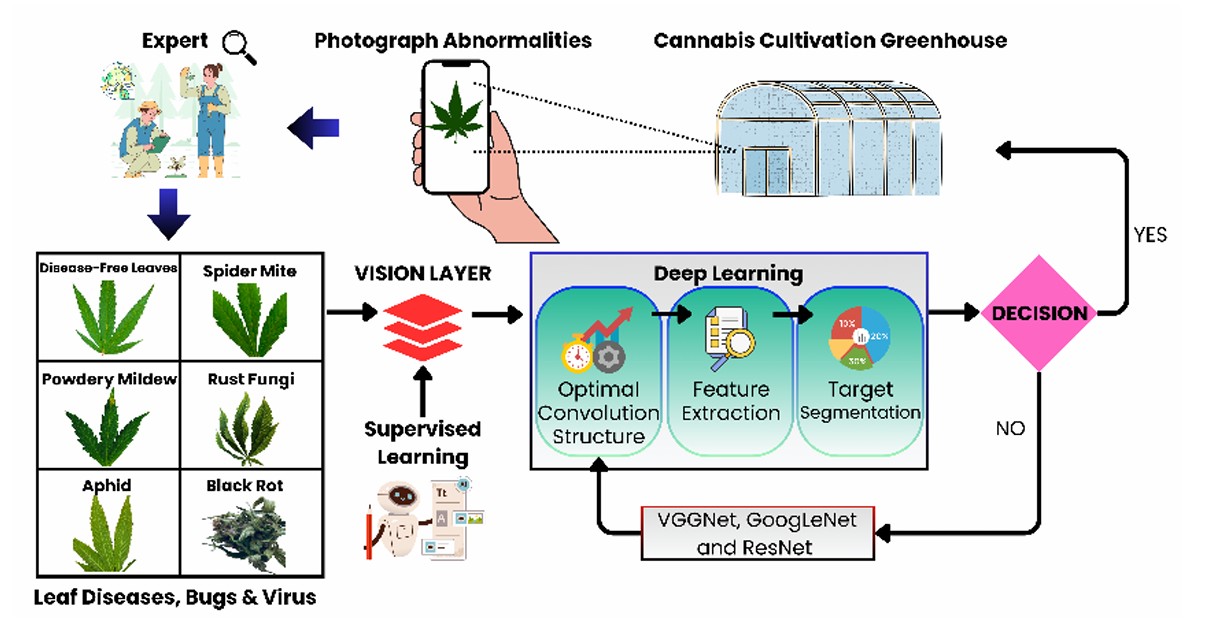
งานวิจัยนี้มีวัตถุประสงค์เพื่อพัฒนาแบบจำลองโครงข่ายประสาทเทียมแบบคอนโวลูชันสำหรับการตรวจจับโรคพืชในใบกัญชา ซึ่งเป็นปัญหาสำคัญที่ส่งผลกระทบต่อคุณภาพและปริมาณผลผลิตในอุตสาหกรรมการเกษตร โดยชุดข้อมูลภาพใบกัญชาที่ใช้ในการวิจัยมีจำนวนทั้งหมด 4,155 ภาพ ซึ่งถูกรวบรวมจากฟาร์มในประเทศไทยผ่านกระบวนการถ่ายภาพที่ควบคุมสภาพแวดล้อม การถ่ายภาพดำเนินการในโรงเรือนที่มีหลังคากันแสงแบบโปร่งแสง เพื่อควบคุมแสงธรรมชาติ กล้องถูกยึดกับขาตั้ง และถ่ายภาพจากมุมมองด้านบน เพื่อให้ครอบคลุมลักษณะใบปกติและใบที่มีความผิดปกติจากโรค ได้แก่ โรคไรแดง โรคราน้ำค้าง โรคราสนิม โรคเพลี้ยอ่อน และโรคเน่าดำ ชุดข้อมูลนี้ถูกจัดการและทำการติดป้ายกำกับอย่างละเอียด ก่อนนำไปพัฒนาและทดสอบแบบจำลองโครงข่ายประสาทเทียมแบบคอนโวลูชัน การศึกษานี้เปรียบเทียบประสิทธิภาพของสถาปัตยกรรมโครงข่ายหลัก ได้แก่ เรสเน็ต กูเกิลเน็ต และวีจีจีเน็ต โดยพิจารณาตัวชี้วัด ได้แก่ ค่าเอฟวันและค่าความแม่นยำเฉลี่ย จากการทดลองพบว่า เรสเน็ตมีความแม่นยำสูงสุด โดยค่าความแม่นยำแบบค่าเอฟวันอยู่ที่ 96.55% และค่าความแม่นยำเฉลี่ยอยู่ที่ 93.67% หลังจากการเรียนรู้ 50 รอบ กูเกิลเน็ตแสดงความสมดุลระหว่างความแม่นยำและเวลาประมวลผล เหมาะสำหรับงานที่ต้องการลดเวลาการประมวลผล ขณะที่วีจีจีเน็ตแม้จะมีความแม่นยำน้อยกว่า แต่เหมาะสำหรับกรณีที่มีข้อจำกัดด้านทรัพยากรคอมพิวเตอร์ ผลการวิจัยนี้ยืนยันศักยภาพของแบบจำลองโครงข่ายประสาทเทียมแบบคอนโวลูชันในการตรวจจับโรคพืชในใบกัญชา ซึ่งสามารถลดความเสียหาย เพิ่มผลผลิต และสนับสนุนความมั่นคงของอุตสาหกรรมกัญชาทั้งในระดับประเทศและระดับสากล นอกจากนี้ยังสามารถนำแนวทางดังกล่าวไปปรับใช้กับพืชเศรษฐกิจชนิดอื่น เพื่อส่งเสริมการเกษตรสมัยใหม่อย่างยั่งยืน
Article Details

อนุญาตภายใต้เงื่อนไข Creative Commons Attribution-NonCommercial-NoDerivatives 4.0 International License.
บทความที่ได้รับการตีพิมพ์ในวารสารฯ ท้ังในรูปแบบของรูปเล่มและอิเล็กทรอนิกส์เป็นลิขสิทธิ์ของวารสารฯ
เอกสารอ้างอิง
R. K. Sari, “Analysis of the benefits and risks of cannabis legalization policy in Thailand after cannabis legalization in 2022–2024,” J. Asia Pac. Stud., vol. 8, no. 1, pp. 21–31, 2024.
A. Chitsena, “Benefits and threats of hemp legalization for the agricultural sector in Thailand." Accessed: Jan. 03, 2025. [Online]. Available: https://archive.cm.mahidol.ac.th/handle/ 123456789/3519
S. R. Sommano et al., “Growing ganja permission: a real gate-way for Thailand’s promising industrial crop?,” J. Cannabis Res., vol. 4, no. 1, pp. 10, Dec. 2022, doi: 10.1186/s42238-022-00121-4.
E. Quarshie, “Implication of Regulated Cannabis Legalisation on Wellbeing and Economic Growth,” Ph.D. dissertation, Univ. of the Witwatersrand, Johannesburg, South Africa, 2025. [Online]. Available: https://wiredspace.wits.ac.za/items/f7cf3993-5760-41e2-841f-ebdec16bed79
S. Marrinan et al., “An early economic analysis of medical cannabis for the treatment of chronic pain,” Expert Rev. Pharmacoecon. Outcomes Res., vol. 25, no. 1, pp. 39–52, Jan. 2025, doi: 10.1080/14737167.2024.2412248.
G. M. Stack et al., “Genetic Mapping, Identification, and Characterization of a Candidate Susceptibility Gene for Powdery Mildew in Cannabis sativa,” Mol. Plant-Microbe Interactions, vol. 37, no. 1, pp. 51–61, Jan. 2024, doi: 10.1094/MPMI-04-23-0043-R.
K. Sriprateep et al., “Hybrid Adaptive Multiple Intelligence System (HybridAMIS) for classifying cannabis leaf diseases using deep learning ensembles,” Smart Agric. Technol., vol. 9, pp. 100535, 2024.
J. Lu, L. Tan, and H. Jiang, “Review on convolutional neural network (CNN) applied to plant leaf disease classification,” Agriculture, vol. 11, no. 8, pp. 707, 2021.
G. Latif, S. E. Abdelhamid, R. E. Mallouhy, J. Alghazo, and Z. A. Kazimi, “Deep learning utilization in agriculture: Detection of rice plant diseases using an improved CNN model,” Plants, vol. 11, no. 17, pp. 2230, 2022.
B. Tugrul, E. Elfatimi, and R. Eryigit, “Convolutional neural networks in detection of plant leaf diseases: A review,” Agriculture, vol. 12, no. 8, pp. 1192, 2022.
N. Shelar, S. Shinde, S. Sawant, S. Dhumal, and K. Fakir, “Plant disease detection using CNN,” in ITM Web of Conferences, EDP Sciences, Navi Mumbai, India, 2022, pp. 1–6, doi: 10.1051/itmconf/20224403049.
S. M. Hassan and A. K. Maji, “Plant disease identification using a novel convolutional neural network,” IEEE Access, vol. 10, pp. 5390–5401, 2022.
J. A. Pandian, V. D. Kumar, O. Geman, M. Hnatiuc, M. Arif, and K. Kanchanadevi, “Plant disease detection using deep convolutional neural network,” Appl. Sci., vol. 12, no. 14, pp. 6982, 2022.
G. Shrestha, Deepsikha, M. Das, and N. Dey, “Plant Disease Detection Using CNN,” 2020 IEEE Applied Signal Processing Conference (ASPCON), Kolkata, India, 2020, pp. 109–113, doi: 10.1109/ASPCON49795.2020.9276722.
Islam, Md Tariqul, “Plant disease detection using CNN model and image processing,” Int J Eng. Res. Technol, vol. 9, no. 10, pp. 291–297, 2020.
L. Borawar and R. Kaur, “ResNet: Solving Vanishing Gradient in Deep Networks,” in Proceedings of International Conference on Recent Trends in Computing, vol. 600, R. P. Mahapatra, S. K. Peddoju, S. Roy, and P. Parwekar, Eds., in Lecture Notes in Networks and Systems, vol. 600. , Singapore: Springer Nature Singapore, 2023, pp. 235–247. doi: 10.1007/978-981-19-8825-7_21.
X. Zhang, N. Han, and J. Zhang, “Comparative analysis of VGG, ResNet, and GoogLeNet architectures evaluating performance, computational efficiency, and convergence rates,” Appl. Comput. Eng., vol. 44, pp. 172–181, Mar. 2024, doi: 10.54254/2755-2721/44/20230676.
I. U. W. Mulyono, E. H. Rachmawanto, C. A. Sari, and M. K. Sarker, “A high accuracy of deep learning based CNN architecture: classic, VGGNet, and RestNet50 for Covid-19 image classification,” TELKOMNIKA Telecommun. Comput. Electron. Control, vol. 22, no. 5, Art. no. 5, Jul. 2024, doi: 10.12928/telkomnika.v22i5.26017.
H. Zheng, “A Review of Evaluation Metrics in Machine Learning Algorithms,” in Lecture notes in networks and systems, Vanderbijlpark, South Africa, 2023, pp. 15–25. doi: 10.1007/978-3031-35314-7_2.
A. Shiva Kumar, K. Gopi, and T. Uma Devi, "Applying deep convolutional neural networks to predict plant diseases in the PlantVillage dataset: A focus on robustness and accuracy," Journal of Engineering Sciences, vol. 15, no. 1, pp. 128-142, 2024.
