
การลดภาระการทำความเย็นภายในห้องโดยใช้กระเบื้องคอนกรีตระบายอากาศที่ติดตั้งพัดลมเซลล์แสงอาทิตย์
Article Sidebar
Main Article Content
บทคัดย่อ
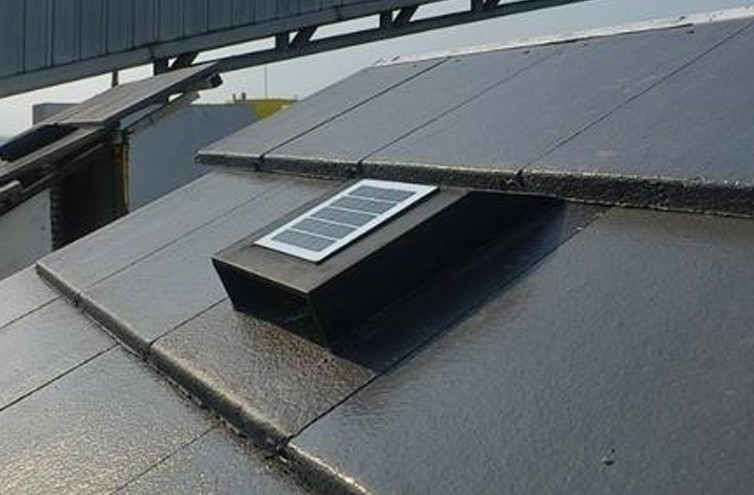
บทความนี้นำเสนอกระเบื้องคอนกรีตระบายอากาศที่ติดตั้งพัดลมเซลล์แสงอาทิตย์เพื่อลดความร้อนสะสมภายในห้องของบ้านทดสอบและทำหน้าที่เป็นอุปกรณ์หมุนเวียนอากาศในช่วงเวลากลางวัน กระเบื้องคอนกรีตระบายอากาศที่ติดตั้งพัดลมเซลล์แสงอาทิตย์ประกอบด้วยคอนกรีตแผ่นเรียบที่มีช่องระบายอากาศแบบวงกลมและพัดลมกระแสตรงขนาด 1.5 W ต่อตรงกับแผงเซลล์แสงอาทิตย์ขนาด 5 Wp บ้านทดสอบสองหลังถูกใช้สำหรับการทดลองนี้ บ้านหลังแรกถูกใช้สำหรับอ้างอิงและบ้านหลังที่สองติดตั้งกระเบื้องคอนกรีตระบายอากาศที่ติดตั้งพัดลมเซลล์แสงอาทิตย์ บ้านแต่ละหลังมีปริมาตรห้องทดสอบประมาณ 1.2 m3 รูปแบบหลังคาเป็นแบบเพิงแหงน มีมุมสำหรับมุงกระเบื้อง 25 องศา รูปแบบการไหลของอากาศเป็นการไหลแบบตัดขวาง ผลการทดลองแสดงให้เห็นว่ากระเบื้องคอนกรีตระบายอากาศที่ติดตั้งพัดลมเซลล์แสงอาทิตย์ทำให้เกิดอัตราการระบายอากาศสูงสุดประมาณ 20 m3/h คิดเป็นอัตราการเปลี่ยนอากาศของห้องสูงสุดเกือบ 16 เท่าของปริมาตรห้องต่อชั่วโมง เนื่องจากประสิทธิภาพการระบายอากาศของบ้านที่ติดตั้งกระเบื้องคอนกรีตระบายอากาศที่ติดตั้งพัดลมเซลล์แสงอาทิตย์เมื่อรวมกับการหมุนเวียนของอัตราการเปลี่ยนอากาศที่แสดงในมุมมองของอุณหภูมิภายในอาคารและความชื้นสัมพัทธ์จึงดีกว่าบ้านอ้างอิงในช่วง 0.5ºC ถึง 6.1ºC และร้อยละ 0.5 ถึง 6.5 ตามลำดับ ทำให้ภาระการทำความเย็นภายในห้องลดลง 43.37% เมื่อเทียบกับบ้านอ้างอิง ด้วยเหตุนี้คุณสมบัติของอากาศชื้นของบ้านที่ติดตั้งกระเบื้องคอนกรีตระบายอากาศที่ติดตั้งพัดลมเซลล์แสงอาทิตย์จึงอยู่ในแผนภูมิความสบายในการระบายอากาศของประเทศไทย ซึ่งเข้าใกล้โซนสบายมากกว่าบ้านอ้างอิง
Article Details

อนุญาตภายใต้เงื่อนไข Creative Commons Attribution-NonCommercial-NoDerivatives 4.0 International License.
บทความที่ได้รับการตีพิมพ์ในวารสารฯ ท้ังในรูปแบบของรูปเล่มและอิเล็กทรอนิกส์เป็นลิขสิทธิ์ของวารสารฯ
เอกสารอ้างอิง
W. Ratchatha, J. Pukdum, T. Phengpom and W. Puangsombut, “Development of a Concrete Vent Tile Assisted with PV-Powered Fan,” in The International Conference on Multidisciplinary Research Trends in the Greater Mekong Sub-Region (ICGMS 2024), Royal Nakhara Hotel and Convention Centre, Nong Khai, Thailand, July 24-26, pp. 71-78.
J. Khedari, N. Yamtraipat, N. Pratintong and J. Hirunlabh, “Thailand Ventilation Comfort Chart,” Energy and Buildings, vol. 32, no. 3, pp. 245-249, Sep. 2000.
J. Khedari, A. Sangprajak and J. Hirunlabh, “Thailand Climatic Zone,” Renewable Energy, vol. 25, no. 2, pp. 267-280, Feb. 2002.
V. Amatayakul, J. Pukdum, D. Nonthiworawong and W. Puangsombut, “Thermal Performance of Thermal Insulation: Installing the Thermal Insulation under the Metal Sheet Roof,” The Journal of Industrial Technology Suan Sunandha Rajabhat University, vol. 11, no. 1, pp. 63-72, Jan.-Jun. 2023.
S. Chaiyapinunt and N. Khamporn, “Heat Transmission through a Glass Window with a Curved Venetian Blind Installed,” Solar Energy, vol. 110, pp. 71-82, 2014.
R. Wongmahasiri and S. Watechagit, “Energy Conservation in Single House due to the Effect of Paint Color: Case Bangkok,” Asian Creative Architecture, Art and Design, vol. 18, no. 1, pp. 154-164, Jan.- Jun. 2014.
K. Juengpimonyanon, D. Nonthiworawong and T. Ananacha, “Attic Heat Gain Reduction Using a Concrete Tile Ventilator,” The Journal of Industrial Technology Suan Sunandha Rajabhat University, vol. 8, no. 2, pp. 58-69, Jul.-Dec. 2020.
W. Puangsombut, J. Pukdum and D. Nonthiworawong, “Thermal Performance of Concrete Tile Ventilator Equipped with PV-Powered Fan,” The Journal of Industrial Technology Suan Sunandha Rajabhat University, vol. 9, no. 2, pp. 12-22, Jul.-Dec. 2021.
Y. O. Devres, “Psychrometric Properties of Humid Air: Calculation Procedures,” Applied Energy, vol. 48, no. 1, pp. 1-18, 1994.
J. Ekburanawat, “Development of Indoor Comfort Zone Control System,” Journal of Industrial Technology Ubon Ratchathani Rajabhat University, vol. 13, no. 2, pp. 27-40, Jul.-Dec. 2023, (in Thai).
J. Taweekun and A. Tantiwichien, “Thermal Comfort Zone for Thai People,” Scientific Research an Academic Publisher, vol. 5, no. 5, pp. 252-529, 2013.
N. Yamtraipat, J. Khedari, J. Hirunlabh and J. Kunchornrat, “Assessment of Thailand indoor set-point impact on energy consumption and environment,” Energy Policy, vol. 34, no. 7, pp. 765-770, May 2006.
J. Hirunlabh, W. Puangsombut, J. Waewsak and J. Khedari, “PV attic ventilation: A simple tool for reducing cooling load and providing comfort,” International Journal of Ambient Energy, vol. 23, no. 3, pp. 159-168, 2002.
