อัตราภาระบรรทุกสารอินทรีย์ที่เหมาะสมของระบบผลิตก๊าซชีวภาพจากน้ำเสีย ในกระบวนการล้างหนอนแมลงวันลายที่เลี้ยงด้วยกากถั่วเหลือง
Article Sidebar
Main Article Content
บทคัดย่อ
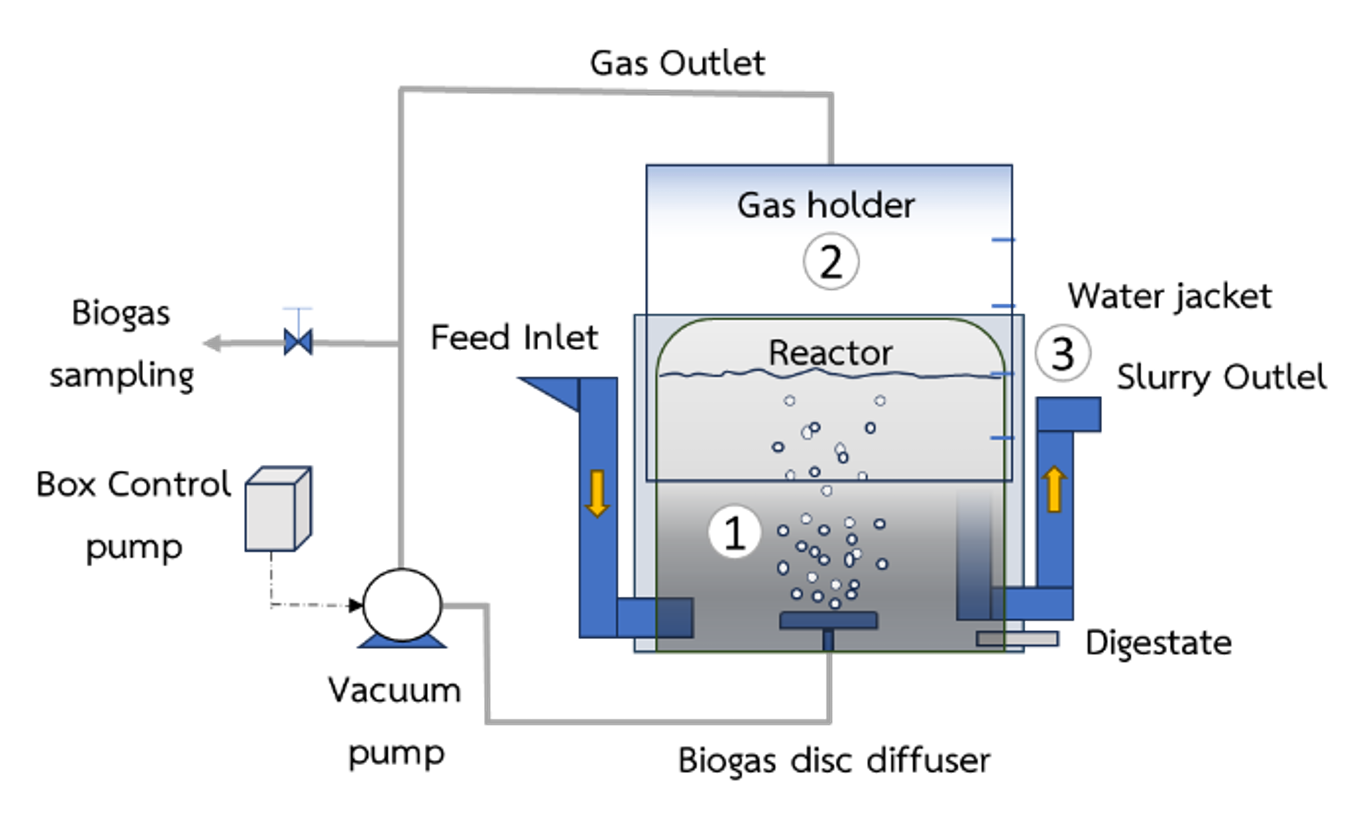
งานวิจัยนี้มีวัตถุประสงค์เพื่อศึกษาหาอัตราภาระบรรทุกสารอินทรีย์ที่เหมาะสมสำหรับการบำบัดน้ำเสียจากกระบวนการล้างหนอนแมลงวันลายที่เลี้ยงด้วยกากถั่วเหลืองร่วมกับหัวเชื้อสารข้นเหลวจากระบบผลิตก๊าซชีวภาพในฟาร์มสุกรโดยระบบผลิตก๊าซชีวภาพแบบฝาครอบลอยร่วมกับการกวนผสมด้วยก๊าซชีวภาพ ซึ่งกำหนดอัตราภาระบรรทุกสารอินทรีย์เข้าสู่ระบบที่ 1.00 2.00 และ 3.00 กก.ซีโอดี/ลบม./วัน ตามลำดับ ระยะเวลาเก็บกักน้ำเสียในระบบ 20 วัน ทดลองในสภาวะอุณหภูมิแวดล้อมทั่วไปและวัดค่าปริมาณก๊าซชีวภาพและสัดส่วนมีเทนระหว่างการทดลอง ผลการทดสอบพบว่าอัตราภาระบรรทุกสารอินทรีย์ทั้ง 3 ระดับ สามารถผลิตก๊าซชีวภาพสะสมเฉลี่ยอยู่ที่ 1,214.17 1,716.04 และ 1,714.48 ลิตร ตามลำดับ และสัดส่วนก๊าซมีเทนเฉลี่ยร้อยละ 66.64 69.02 และ 67.22 ตามลำดับ ซึ่งการทดลองที่อัตราการเติม 2.00 กก.ซีโอดี/ลบม./วัน เป็นอัตราการเติมในระดับที่เหมาะสมที่สุด ทำให้เกิดการย่อยสลายสารอินทรีย์ได้มีประสิทธิภาพในการกำจัดปริมาณซีโอดีสูงถึงร้อยละ 66.29 นอกจากนี้ยังสามารถกำจัดของแข็งทั้งหมดอยู่ที่ร้อยละ 65.95 และกำจัดของแข็งระเหยง่ายได้ร้อยละ 81.15 ซึ่งเป็นสภาวะที่มีความเหมาะสมมีประสิทธิภาพในการบำบัดสารอินทรีย์สูงที่สุด สามารถนำไปศึกษาต่อในระบบก๊าซชีวภาพที่มีขนาดใหญ่ขึ้น และสามารถลดผลกระทบของน้ำเสียรวมทั้งมลพิษทางน้ำที่มีผลต่อสิ่งแวดล้อม
Article Details

อนุญาตภายใต้เงื่อนไข Creative Commons Attribution-NonCommercial-NoDerivatives 4.0 International License.
บทความที่ได้รับการตีพิมพ์ในวารสารฯ ท้ังในรูปแบบของรูปเล่มและอิเล็กทรอนิกส์เป็นลิขสิทธิ์ของวารสารฯ
เอกสารอ้างอิง
X. Chu, M. Li, G. Wang, K. Wang, R. Shang, Z. Wang, and L. Li, “Evaluation of the Low Inclusion of Full-Fatted Hermetia illucens Larvae Meal for Layer Chickens: Growth Performance, Nutrient Digestibility, and Gut Health,” Frontiers in Veterinary Science, vol. 7, pp. 1–7, Nov. 2020, doi: 10.3389/fvets.2020.585843.
Department of Internal Trade (DIT), “Oil crops and animal feed materials,” (in Thai), Department of Internal Trade, 2020. Accessed: Jan. 10, 2023. [Online]. Available: https://agri.dit.go.th/index.php/home.
Kung Krabaen Bay Royal Development Study Center, “Black Soldier Fly larvae (BSFL) for protein from animal feed,” (in Thai), Kung Krabaen Bay Royal Development Study Center, Chanthaburi, Thailand, 2022. Accessed: Jan. 6, 2023. [Online]. Available: https://www4.fisheries.go.th/doffile/fkey/ref556.
P. Kritthiraput, K. Sasujit, P. Pintana, C. Sawatdeenarunat, and R. Nirunsin, “Biogas Production of Wastewater From Black Soldier Fly Larvae Washing Process,” (in Thai), M.S. thesis, Dept. Renew. Ener. Eng., Maejo Univ., Chiang Mai, Thailand, 2023.
P. Bulak, K. Proc, M. Pawłowska, A. Kasprzycka, W. Berus, and A. Bieganowski, “Biogas generation from insects breeding post production wastes,” Journal of Cleaner Production, vol. 244, pp. 1-8, Jan. 2020, doi: 10.1016/j.jclepro.2019.118777.
Y. Yu, “Research on soybean protein wastewater treatment by the integrated two-phase anaerobic reactor,” Saudi Journal of Biological Sciences, vol. 22, pp. 526-531, Sep. 2015, doi: 10.1016/j.sjbs.2015.01.006.
C. Rico, J. L. Rico, I. Tejero, N. Munoz, and B. Gomez, “Anaerobic digestion of the liquid fraction of dairy manure in Pilot plant for biogas production: Residual methane yield of digestate,” Journal of Waste Management, vol. 31, pp. 2167–2173, Sep.-Oct. 2011, doi: 10.1016/j.wasman.2011.04.018.
P. Sutarut, S. Chobboon, N. Vitjitsombroon, and A. Dechana, “The Development of Biogas Generating Tank from Organic Waste,” (in Thai), Songkhla Rajabhat Univ. Songkhla, Thailand, Sep. 2017, [Online]. Available: http://oservice.skru.ac.th/ebook/lesson.asp?title_code=1457
B. Ruffino, S. Fiore, C. Roati, G. Campo, D. Novarino, and M. Zanetti, “Scale effect of anaerobic digestion tests in fed-batch and semi-continuous mode for the technical and economic feasibility of a full scale digester,” Bioresource Technology, vol. 182, pp. 302-313, Apr. 2015, doi: 10.1016/j.biortech.2015.02.021.
U. Bergamo, G. Viccione, S. Coppola, A. Landi, A. Meda, and C. Gualtieri, “Analysis of Anaerobic Digester Mixing: Comparison of Long Shafted Paddle Mixing vs Gas Mixing,” Water Science and Technology, vol. 81, no. 7, pp. 1406–1419, May 2020, doi: 10.2166/wst.2020.248.
Standard methods for the examination of water and wastewater, 22nd ed., American Public Health Association (APHA), American Water Works Association (AWWA) and Water Environment Federation (WEF), Washington, DC, 2012.
S. Vinardell, S. Astals, K. Koch, J. Mata-Alvarez, and J. Dosta, “Co-digestion of sewage sludge and food waste in a wastewater treatment plant based on mainstream anaerobic membrane bioreactor technology: A techno-economic evaluation,” Bioresource Technology, vol. 330, pp. 1-11, Jun. 2021, doi: 10.1016/j.biortech.2021.124978.
K. Latha, R. Velraj, P. Shanmugam, and S. Sivanesan, “Mixing strategies of high solids anaerobic co-digestion using food waste with sewage sludge for enhanced biogas production,” Journal of Cleaner Production, vol. 210, pp. 388-400, Feb. 2019, doi: 10.1016/j.jclepro.2018.10.219.
M. J. Kim and S. H. Kim, “Conditions of lag-phase reduction during anaerobic digestion of protein for high-efficiency biogas production,” Biomass and Bioenergy, vol. 143, Dec. 2020, doi: 10.1016/j.biombioe.2020.105813.
S. Pongsak, T. Porndonand, C. Piasai, N. Boontian, and M. Padri, “Organic loading Rate for Maximum Biogas Production from Dairy Cattle Manure Wastewater at Suranaree University of Technology,” (in Thai), KKU Research Journal, vol. 20, no. 3, pp. 74-85, Jul-Sep. 2020, [Online]. Available: https://ph02.tci-thaijo.org/index.php/gskku/article/view/192936.
Y. Fransiscus and T. L. Simangunsong, “Anaerobic Digestion of Industrial Tempeh Wastewater with Sludge from Cow Manure Biogas Digester as Inoculum: Effect of F/M Ratio on the Methane Production,” International Journal of Advances in Science Engineering and Information Technology, vol. 11, no. 3, pp. 1007-1013, Jun. 2021, doi: 10.18517/ijaseit.11.3.11846.
M. T. Zinare, A. Dutta, and S. A. Jabasingh, “Start-up of a pilot scale anaerobic reactor for the biogas production from the pineapple processing industries of Belgium,” Renewable Energy, vol. 134, pp. 241-246, Apr. 2019, doi: 10.1016/j.renene.2018.11.058.
S. Pilli, A. K. Pandey, A. Katiyar, K. Pandey, and R. D. Tyagi, “Chapter 2 Pre-treatment Technologies to Enhance Anaerobic Digestion,” in Sustainable Sewage sludge Management Resource. Efficiency: IntechOpen, vol. 23, Jul. 2020, doi: 10.5772/intechopen.93236.
S. Ali, B. Hua, J. J. Huang, R. L. Droste, Q Zhou, W. Zhao, and L. Chen, “Effect of different initial low pH conditions on biogas production, composition, and shift in the aceticlastic methanogenic population,” Bioresource Technology, vol. 289, Oct. 2019, doi: 10.1016/j.biortech.2019.121579.
P. Latifi, M. Karrabi, and S. Danesh, “Anaerobic co-digestion of poultry slaughterhouse wastes with sewage sludge in batch-mode bioreactors (effect of inoculum-substrate ratio and total solids),” Renewable and Sustainable Energy Reviews, vol. 107, pp. 288–296, Jun. 2019, doi: 10.1016/j.rser.2019.03.015.
S. Saipa, T. Cheunbarn, N. Homduang, J. Chanathaworn, and R. Nirunsin, “The Study of the Mixing Duration Time and Recirculation Rate Effect to Biogas Production from Sweet Corn Waste by Dry Fermentation Process,” (in Thai), Chiang Rai Rajabhat University Journal, vol. 18, no. 87, pp. 87-105.
X. Chen, Z. Weizhu, L. Gongsong, S Qi, I. Muhammad, W. Yiqi, R. Luotong, and C. Chen, “Anaerobic biodegradation of soybean-process wastewater: Operation strategy and sludge bed characteristics of a high-performance Spiral Symmetric Stream Anaerobic Bioreactor,” Water Research, vol. 197, Jun. 2021, doi: 10.1016/j.watres.2021.117095.
