
การศึกษาหาสภาวะที่เหมาะสมต่อการขึ้นรูปแผ่นลามิเนตจากเศษขี้เลื่อยไม้ไผ่ผสมพลาสติกโดยใช้โพลีสไตรีนเรซินเป็นเมทริกซ์
Article Sidebar
Main Article Content
บทคัดย่อ
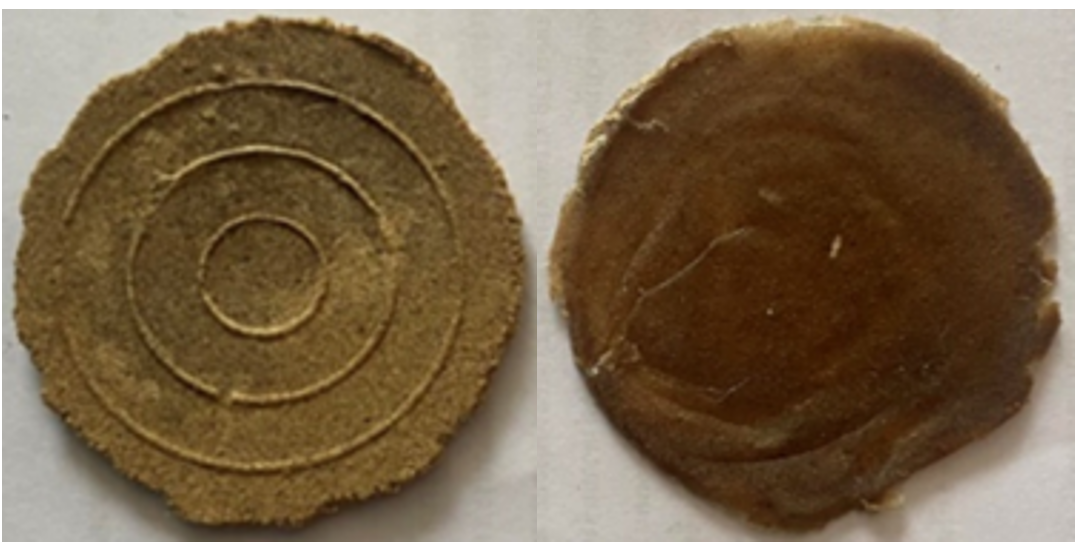
เศษขี้เลื่อยไม้ไผ่จะถูกนำมาเป็นวัสดุเสริมแรงในงานทางด้านวัสดุคอมโพสิตสำหรับนำไปประยุกต์ใช้งานแผ่นลามิเนตตกแต่งเฟอร์นิเจอร์ งานวิจัยนี้มีวัตถุประสงค์ในการสังเคราะห์แผ่นลามิเนตจากเศษขี้เลื่อยไม้ไผ่ผสมพลาสติกโดยใช้โพลีสไตรีนเรซินเป็นเมทริกซ์ โดยกระบวนการในการเตรียมจะทำการปรับสัดส่วนโดยน้ำหนักของเศษขี้เลื่อยไม้ไผ่ผสมลงในสารละลายโพลีสไตรีนเรซินเป็นเมทริกซ์ที่เตรียมได้จากกระบวนการรีไซเคิลเชิงเคมีที่อาศัยการเติมตัวทำละลายอินทรีย์พร้อมกับกระบวนการที่ใช้แรงกลในการกวนสารละลายจากนั้นใช้เครื่องอัดไฮดรอลิกขึ้นรูปแผ่นลามิเนตด้วยเทคนิคการอัดแบบเย็น ผลิตภัณฑ์แผ่นลามิเนตจะทำการวัดคุณสมบัติทางกายภาพตามมาตรฐานเอเอสทีเอ็ม ได้แก่ ความหนา เปอร์เซ็นต์ความชื้น เปอร์เซ็นต์การดูดซึมน้ำ รวมถึงการทดสอบมุมสัมผัสของพื้นผิว ตามลำดับ จากผลการทดลองพบว่า อัตราส่วนระหว่างเศษขี้เลื่อยไม้ไผ่ต่อสารละลายโพลีสไตรีนเรซินเป็น ร้อยละโดยน้ำหนัก 16 ต่อ 20 มีคุณสมบัติทางกายภาพของแผ่นที่เหมาะสม คือ มีค่าความหนาโดยเฉลี่ยที่ 0.53 มิลลิเมตร ความชื้นอยู่ที่ร้อยละ 10.0 การดูดซึมน้ำอยู่ที่ร้อยละ 1.45 และค่าเฉลี่ยมุมสัมผัสของพื้นผิวอยู่ในช่วง 90 ถึง 150 องศา ตามลำดับ แสดงให้เห็นว่าแผ่นลามิเนตมีสมบัติความไม่ชอบน้ำส่งผลทำให้มีความสามารถในการกันน้ำได้อย่างมีประสิทธิภาพ
Article Details

อนุญาตภายใต้เงื่อนไข Creative Commons Attribution-NonCommercial-NoDerivatives 4.0 International License.
บทความที่ได้รับการตีพิมพ์ในวารสารฯ ท้ังในรูปแบบของรูปเล่มและอิเล็กทรอนิกส์เป็นลิขสิทธิ์ของวารสารฯ
เอกสารอ้างอิง
S. Sukeetham, S. Jarusombuti, and T. Veenin, "Particleboard products from bamboo wastes of chopstick factory," Thai Journal of Forestry, vol. 38, no. 2, pp. 192-201, 2019.
S. Pongthornpruek and P. Kaiyuttinun, “The use of bamboo residues from chopstick production for mushroom cultivation material,” in The 5th Rajamangala University of Technology National Conference, Bangkok, Thailand, 2015, pp. 20–26.
S. Wunsri, W. Duawsiri, and N. Thipmonta, "Study of energy fuel briquettes production from sawdust of rubber wood and animal dung," UTK Research Journal, vol. 12, no. 2, pp. 17-25, 2018.
P. Zuo, Z. Liu, H. Zhang, A. Sivanathan, D. Dai, and M. Fan, "Thermal transformation of bamboo sawdust for its advanced cementitious composites," Construction and Building Materials, vol. 383, pp. 131395, 2023.
F. Rusch, A. D. Wastowski, T. S. de Lira, K. C. C. S. Ramos Moreira, and D. de Moraes Lúcio, "Description of the component properties of species of bamboo: a review," Biomass, vol. 13, pp. 2487-2495, 2023.
K. Okubo, T. Fujii, and N. Yamashita, "Development of bamboo-based polymer composites and their mechanical properties," Composites Part A: Applied Science and Manufacturing, vol. 35, no. 3, pp. 377-383, 2004.
S. Abdulkareem and A. J. N. Adeniyi, "Production of particle boards using polystyrene and bamboo wastes," Nigerian Journal of Technology, vol. 36, no. 3, pp. 788-793, 2017.
J. Obradovic, F. Petibon, and P. Fardim, "Preparation and characterization of cellulose-shellac biocomposites," BioResources, vol. 12, pp. 1943-1959, 2017.
A. T. Adeniran, "Properties of particleboard made from recycled polystyrene and Cocos nucifera stem particles," Open Journal of Agricultural Research, vol. 1, pp. 1–7, 2021. [Online]. Available: https://doi.org/10.31586/ojar.2021.010101
T. Karliati et al., "Performance of particleboard made of agroforestry residues bonded with thermosetting adhesive derived from waste Styrofoam," Polymers, vol. 16, p. 543, 2024, [Online]. Available: http://doi.org/10.3390/polym16040543
E. Ferede, "Evaluation of Mechanical and Water Absorption Properties of Alkaline-Treated Sawdust-Reinforced Polypropylene Composite," Journal of Engineering, vol. 2020, Article ID 3706176, 8 pages, 2020. [Online]. Available: https://doi.org/10.1155/2020/3706176.
P. Thipchai, W. Punyodom, K. Jantanasakulwong, S. Thanakkasaranee, S. Hinmo, K. Pratinthong, G. Kasi, and P. Rachtanapun, "Preparation and Characterization of Cellulose Nanocrystals from Bamboos and Their Application in Cassava Starch-Based Film," Polymers, vol. 15, no. 12, article 2622, 2023. [Online]. Available: https://doi.org/10.3390/polym15122622
R. M. Allaf, E. Albarahmieh, and M. Futian, "Preparation of sawdust-filled recycled-PET composites via solid-state compounding," Processes, vol. 8, no. 1, pp. 100, 2020.
K. S. Rahman, M. N. Islam, S. B. Ratul, N. H. Dana, S. M. Musa, and M. O. Hannan, "Properties of flat-pressed wood plastic composites as a function of particle size and mixing ratio," Journal of Wood Science, vol. 64, pp. 279–286, 2018.
Thai Industrial Standards Institute (TISI), "Thai industrial standard no.876-2004: particleboard product," Bangkok: TISI, 2004.
P. Weeranukul, P. Choosit, W. Deepanya, and K. Suweero, “Using polyethylene terephthalate plastic waste as mixture to produce high strength milk carton waste artificial wood,” Rajamangala University of Technology Phra Nakhon, Bangkok, Thailand, 2018.
P. Yenjai, S. Jarusombuti, and T. Veenin, "Particleboard manufacturing from waste of cajuput (Melaleuca cajuputi Powell)," VRU Research and Development Journal Science and Technology, vol. 11, no. 2, pp. 131-140, 2016.
G. Nemli, Y. Örs, and H. Kalaycıoğlu, "The choosing of suitable decorative surface coating material types for interior end use applications of particleboard," Construction and Building Materials, vol. 19, no. 4, pp. 307-312, 2005.
N. Faibut and V. Amornkitbamrung, "Effect of surface roughness on wettability of diamond-like carbon thin films," KKU Research Journal, vol. 13, no. 2, pp. 31-41, 2013.
G. Hong et al., "Mussel-inspired polydopamine as a green, efficient, and stable platform to functionalize bamboo fiber with amino-terminated alkyl for high performance poly(butylene succinate) composites," Polymers, vol. 10, no. 4, p. 461, 2018.
W. D. Liu, T. S. Xie, and R. H. Qiu, “Bamboo fibers grafted with a soybean-oil-based monomer for its unsaturated polyester composites,” Cellulose, vol. 23, no. 4, pp. 2501-2513, Aug. 2016, doi: 10.1007/s10570-016-0969-z.
X. P. Zhang, F. Wang, and L. M. Keer, "Influence of surface modification on the microstructure and thermo-mechanical properties of bamboo fibers," Materials, vol. 8, no. 10, pp. 6597-6608, 2015, doi: 10.3390/ma8105327.
