
Optimizing Fruit Nutrition Data Presentation for Improved User Experience in the RSPG-Burapha Ecosystem
Article Sidebar
Main Article Content
Abstract
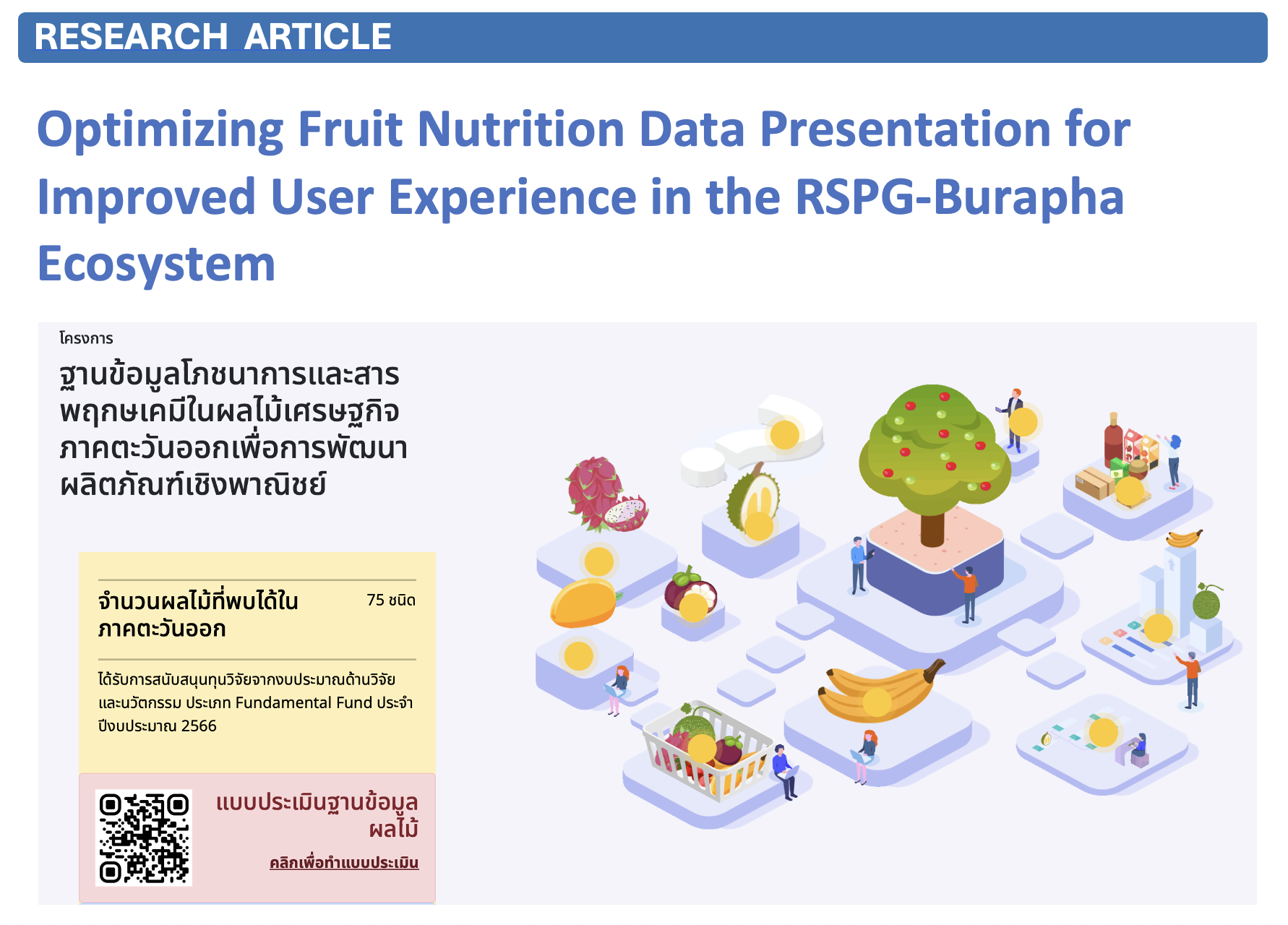
Nutrition facts enable consumers to clearly understand the nutritional content of each type of fruit, empowering them to make informed decisions when purchasing and consuming food. This article presents practical guidelines for developing and enhancing fruit nutrition data display within the RSPG-Burapha learning ecosystem. Our research was meticulously designed and developed user-friendly and efficient fruit nutrition data display tools. These tools were then rigorously evaluated for their effectiveness and user satisfaction, ensuring the practicality and relevance of our research to the end users. Our study delved into the nutrition of 75 Eastern Thai fruits, illustrating at least 20 varieties and detailing product info for 141 types. The database homepage features an engaging motion graphic to easily explore organized fruit and product data. Detailed nutrition facts, radar charts for comparisons, bar charts, and hierarchical clustering for analysis are provided, along with categorizing fruit products by groups. The database received overwhelmingly positive satisfaction ratings from 476 respondents, a testament to the impact of our work on improving user satisfaction and nutritional information accessibility. The research emphasizes the significance of improving the presentation of nutrition data to facilitate informed choices in maintaining a balanced and healthy diet within the RSPG-Burapha learning ecosystem, with access to this database provided through the website https://fruit.rspgburapha.com/.
Article Details

This work is licensed under a Creative Commons Attribution-NonCommercial-NoDerivatives 4.0 International License.
All authors need to complete copyright transfer to Journal of Applied Informatics and Technology prior to publication. For more details click this link: https://ph01.tci-thaijo.org/index.php/jait/copyrightlicense




References
A Aziz, N. A. and Mhd Jalil, A. M. (2019). Bioactive compounds, nutritional value, and potential health benefits of indigenous durian (durio zibethinus murr.): A review. Foods, 8(3):96. DOI: 10.3390/foods8030096.
Aekplakorn, W., Chariyalertsak, S., Kessomboon, P., Sangthong, R., Inthawong, R., Putwatana, P., and Taneepanichskul, S. (2011). Prevalence and management of diabetes and metabolic risk factors in Thai adults. Diabetes Care, 34(9):1980–1985. DOI: 10.2337/dc11-0099.
Agricultural Product Processing Research and Development Group (2014). 86 Products (2nd ed.). Department of Agricultural Extension, Ministry of Agriculture, Thailand. Retrieved November 18, 2024, from Department of Agricultural Extension, Ministry of Agriculture, Thailand.
Ardhiyanto, O., Asyidqi, M. S., Ajif Yunizar Pratama Yusuf, S.Si, M., and Dr. Tb. Ai Munandar, S.Kom., M. (2023). Clustering of child nutrition status using hierarchical agglomerative clustering algorithm in Bekasi City. International Journal of Information Technology and Computer Science Applications, 1(3):122–128. DOI: 10.58776/ijitcsa.v1i3.42.
Balakrishna, Y., Manda, S., Mwambi, H., and van Graan, A. (2022). Statistical methods for the analysis of food composition databases: A review. Nutrients, 14(11):2193. DOI: 10.3390/nu14112193.
Iamsiriwong, O. (2015). Data Structures for Computer Programming Design (Revised ed.). C.E. Education, Thailand.
Janekulprasoot, P., Thaipakdee, S., Dumrongkittikul, S., and Jiwajinda, S. (2009). Users’ satisfaction on southern herb database on website. Kasetsart Journal of Social Sciences, 30(3):260–268.
Judprasong, K., Puwastien, P., Rojroongwasinkul, N., Nitithamyong, A., Sridonpai, P., and Somjai, A. (2018). Thai food composition database, online version 2, september 2018. https://inmu.mahidol.ac.th/thaifcd. Retrieved November 23, 2024, from Institute of Nutrition, Mahidol University, Thailand.
Kim, S.-H. (2022). A systematic review on visualizations for self-generated health data for daily activities. International Journal of Environmental Research and Public Health, 19(18):11166. DOI: 10.3390/ijerph191811166.
Klungsupya, P., Suthepakul, N., Muangman, T., Rerk-Am, U., and Thongdon-A, J. (2015). Determination of free radical scavenging, antioxidative DNA damage activities and phytochemical components of active fractions from lansium domesticum Corr. fruit. Nutrients, 7(8):6852–6873. DOI: 10.3390/nu7085312.
Kongkachuichai, R., Charoensiri, R., and Kettawan, A. (2019). Vitamin C, folate, and phytochemical compounds of organically versus inorganically grown fruits and vegetables commonly consumed in thailand. Pharmaceutical Sciences Asia, 46(4):218–230. DOI: 10.29090/psa.2019.04.018.0044.
Kongkachuichai, R., Charoensiri, R., and Sungpuag, P. (2010). Carotenoid, flavonoid profiles and dietary fiber contents of fruits commonly consumed in Thailand. International Journal of Food Sciences and Nutrition, 61(5):536–548. DOI: 10.3109/09637481003677308.
Macdiarmid, J. I. (2013). health and environmental sustainability? 10.1017/s0029665113003753. Seasonality and dietary requirements: Will eating seasonal food contribute to Proceedings of the Nutrition Society, 73(3):368–375. DOI: 10.1017/s0029665113003753.
Muhammad Ali, P. J. and Faraj, R. H. (2014). Data normalization and standardization: A technical report. Technical Report 1, Machine Learning Technical Reports. Retrieved October 15, 2024, from Machine Learning Technical Reports.
Nutritionix (2024). Nutritionix – Largest verified nutrition database. https://www.nutritionix.com. Retrieved November 23, 2024, from Nutritionix, United States.
Pettigrew, S., Coyle, D., McKenzie, B., Vu, D., Lim, S. C., Berasi, K., Poowanasatien, A., Suya, I., and Kowal, P. (2022). A review of front-of-pack nutrition labelling in Southeast Asia: Industry interference, lessons learned, and future directions. The Lancet Regional Health - Southeast Asia, 3:100017. DOI: 10.1016/j.lansea.2022.05.006.
Pongutta, S., Tantayapirak, P., and Paopeng, C. (2019). Packaged food consumption and understanding of front-of-pack labels in urban Thailand. Public Health, 172:8–14. DOI: 10.1016/j.puhe.2019.04.004.
Rimpeekool, W., Kirk, M., Yiengprugsawan, V., Banwell, C., Seubsman, S.-a., and Sleigh, A. (2017). Nutrition label experience and consumption of transitional foods among a nationwide cohort of 42,750 Thai adults. British Food Journal, 119(2):425–439. DOI: 10.1108/bfj-07-2016-0327.
Savarino, G., Corsello, A., and Corsello, G. (2021). Macronutrient balance and micronutrient amounts through growth and development. Italian Journal of Pediatrics, 47(1). DOI: 10.1186/s13052-021-01061-0.
Sirikarin, S., Lavallee, C., Visakorn, S., Sukyanandit, N., and Aranyanurak, N. (2004). Durian Products. Agricultural Promotion and Product Development Group, Community Agricultural Enterprise Promotion Division, Agricultural Development Office, Department of Agricultural Extension, Cooperative Printing House of Thailand. Retrieved November 20, 2024, from Agricultural Promotion and Product Development Group, Thailand.
Smith, S. B., Miller, A. C., Merchant, C. R., and Sankoh, A. F. (2015). Local site variation in stopover physiology of migrating songbirds near the south shore of Lake Ontario is linked to fruit availability and quality. Conservation Physiology, 3(1):cov036. DOI: 10.1093/conphys/cov036.
Sootanan, P., Dumrangrojwattana, P., Chewpreecha, B., Khachonpisitsak, S., Sukparangsi, W., Tangkrock-olan, N., Rattanaseth, R., Mungkung, P., and Leelathakul, N. (2022). RSPG-Burapha: Database and web application of eastern local resources. Burapha Science Journal, 27(3):1490–1516.
Sootanan, P., Dumrangrojwattana, P., Chewpreecha, B., Khachonpisitsak, S., Sukparangsi, W., Tangkrock-olan, N., Rattanaseth, R., Mungkung, P., Panithanarak, T., Suriyaphan, J., Teeramaethee, J., and Leelathakul, N. (2023). RSPG-Burapha: Additions and improvements of database and web application of eastern local resources. Burapha Science Journal, 28(3):1723–1748.
Sootanan, P., Dumrangrojwattana, P., Chiwapreecha, B., Khachonpisitsak, S., Sukparangsi, W., Tangkrock-olan, N., Rattanaseth, R., on Sakwilaisakul, S., Panithanarak, T., Suriyaphan, J., Teeramaethee, J., and Leelathakul, N. (2024). RSPG-Burapha: Enhancing the database of local resources to support a learning ecosystem in the eastern region. Burapha Science Journal, 29(3):925–951.
Srimanee, S., Chatwirun, L., Sookyanudit, W., and Aranyanurak, N. (2004). Banana products. https://ebook.lib.ku.ac.th/ebook27/ebook/2011-005-0096/#p=1/. Retrieved October 21, 2024, from Kasetsart University Library, Thailand.
Techasuwanna, R., Chottanapund, S., Chamroonsawasdi, K., Sornpaisarn, B., and Tunyasitthisundhorn, P. (2020). Risk factors for type 2 diabetes mellitus in Thai population. Disease Control Journal, 46(3):268–279. DOI: 10.14456/dcj.2020.26.
Truman, E. (2018). Exploring the visual appeal of food guide graphics: A compositional analysis of dinner plate models. British Food Journal, 120(8):1682–1695. DOI: 10.1108/bfj-02-2018-0112.
U.S. Department of Agriculture, Agricultural Research Service (2024). Fooddata central. https://fdc.nal.usda.gov/index.html. Retrieved November 22, 2024, from U.S. Department of Agriculture, Agricultural Research Service.
Wongrat, T. (2013). Guide to Developing Web Applications with PHP & AJAX + jQuery. C.E. Education, Bangkok, Thailand.
World Health Organization and United Nations Children’s Fund (UNICEF) (2022). National Nutrition Information Systems: Technical Note: Designing Effective Data Visualizations. World Health Organization and UNICEF, Geneva, Switzerland. Retrieved October 18, 2024, from World Health Organization and UNICEF.
Zarena, A. and Sankar, K. U. (2011). Phenolic acids, flavonoid profile and antioxidant activity in mangosteen (garcinia mangostanal.) pericarp: Analysis of phenolic acid by HPLC-ESI-MS. Journal of Food Biochemistry, 36(5):627–633. DOI: 10.1111/j.1745-4514.2011.00575.x.
