Online Game-based Learning via LINE Application to Enhance Parts of Speech Skills of High School Students with Hearing Impairment in the 21st Century
Article Sidebar
Main Article Content
Abstract
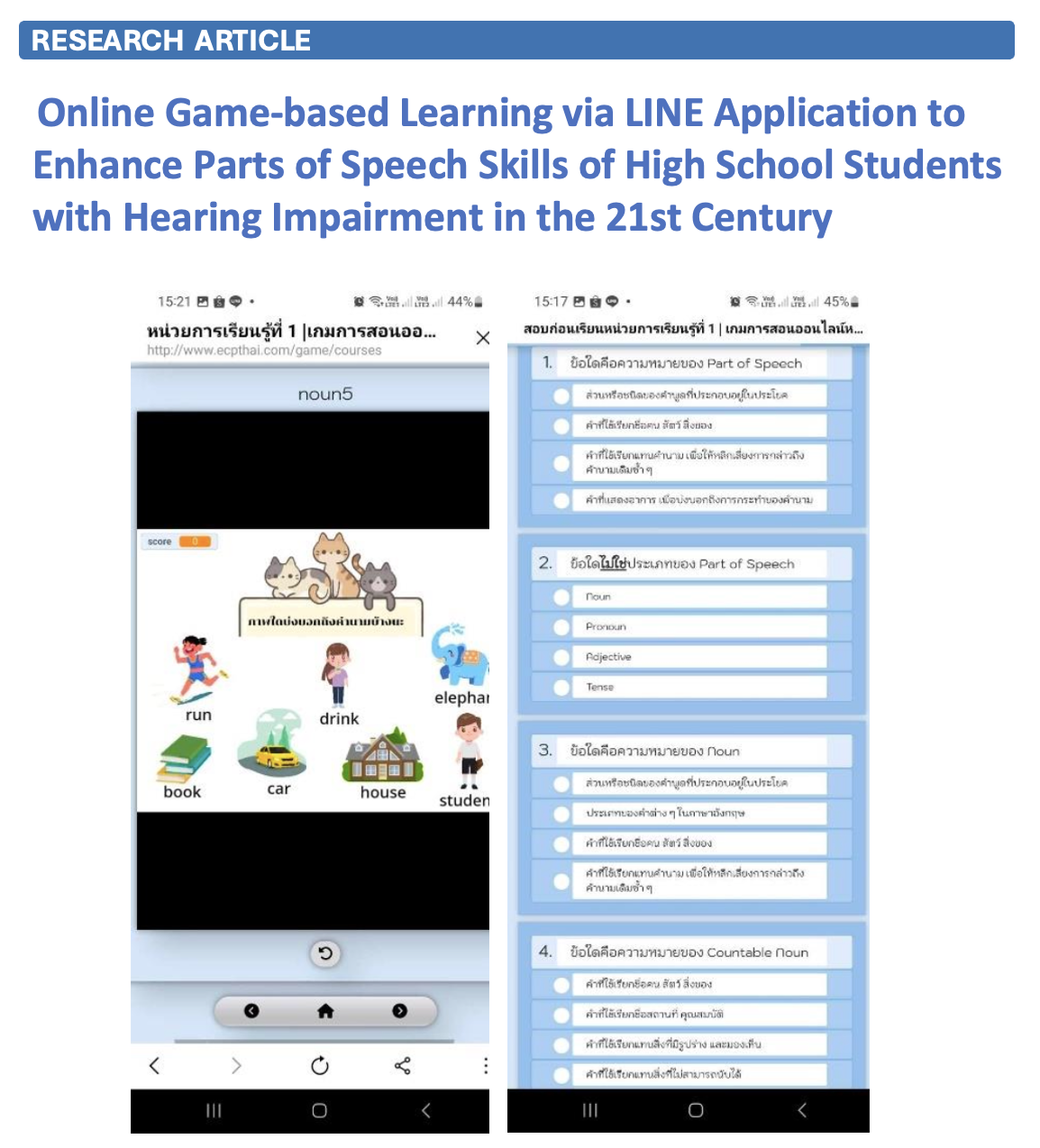
This study aimed to develop and evaluate an online game-based learning tool via LINE application to enhance English parts of speech skills among high school students with hearing impairments. The research objectives were to: (1) develop the online educational game, (2) assess its efficiency, (3) compare students' pre- and post-learning achievement, (4) examine students' learning progress, and (5) investigate the relationship between post-learning achievement and student satisfaction. The sample consisted of 27 high school students with hearing impairments from Surin School for the Deaf during the first semester of the 2024 academic year, selected through purposive sampling. Research instruments included the developed online game, pre- and post-tests, and a satisfaction survey. Data were analyzed using a dependent t-test, Pearson's correlation, percentages, and mean scores. The development process yielded 8 learning units and 109 online games. The system demonstrated high functionality, with an efficiency ratio of 1.46, exceeding McGuigan's criterion of 1.00. A significant improvement in students' post-test scores compared to pre-test scores was observed (p < 0.05). The average learning gain was 15.59%, which was lower than the hypothesized 50%. A significant positive correlation was found between student satisfaction and post-learning achievement (p < 0.05). These findings suggest that the developed online game-based learning tool effectively enhances English language skills among students with hearing impairments, offering insights into innovative educational approaches for this population.
Article Details

This work is licensed under a Creative Commons Attribution-NonCommercial-NoDerivatives 4.0 International License.
All authors need to complete copyright transfer to Journal of Applied Informatics and Technology prior to publication. For more details click this link: https://ph01.tci-thaijo.org/index.php/jait/copyrightlicense
References
Arayawinyoo, P. (1999). Education for children with special needs. Waenkaew, Bangkok.
Archwamety, T. and Tangdhanakanond, K. (2008). Cumulative relative gain score vs. chronological equivalence score. Journal of Research Methodology, 21(1):1–20. https://jrmarchive.vichaiedu.net/issues/vol21-no1-2008.html.
Boonthawee, P. and Sonsilphong, S. (2021). The development of game-based learning with online dialogue system to enhance problem-solving skill in design and technology subject of grade 11th students. Journal of Educational Technology and Communications, 4(12):67–81. https://so02.tci-thaijo.org/index.php/etcedumsujournal/article/view/249818.
Bureau of Policy and Planning, Office of the Permanent Secretary, Ministry of Interior (n.d.). Study report on opportunities and impacts of the ASEAN economic community on the ministry of interior (technical report). Technical report, Ministry of Interior. http://www.law.moi.go.th/pdf/asean_final.pdf.
Chaiyabutr, W. (2018). Media campaign through distance education. Journal of Educational Communications and Technology, 13(14-15):4–13. https://oet01.stou.ac.th/documents/pdf/ECT_Journal_Vol14-15.pdf.
Chajernsuk, N., Rodcheng, P., Lelapipitpat, C., and Saenboonsong, S. (2020). The comparison of grade 3 students learning achievement using animation media in adventures in the technology world at Wat Inkanlaya School. Journal of Applied Informatics and Technology, 2(2):104–115. DOI: 10.14456/jait.2020.8
Chinawong, P. and Chinatangkul, S. (2013). Learning organization model of schools for the deaf in Thailand. Silpakorn Educational Research Journal, 5(2):73–85. https://so05.tci-thaijo.org/index.php/suedureasearchjournal/article/view/26222.
Garris, R., Ahlers, R., and Driskell, J. E. (2002). Games, motivation, and learning: A research and practice model. Simulation & Gaming, 33(4):441–467. DOI: 10.1177/1046878102238607.
Gee, J. P. (2003). What video games have to teach us about learning and literacy. Computers in Entertainment (CIE), 1(1):1–4. DOI: 10.1145/950566.950595.
John, S., Gurario, S., and Halepota, J. A. (2021). The role of English language skills in career growth: A study of perceptions and strategies used to improve English language skills by graduate and undergraduate students of Karachi, Pakistan. Global Social Sciences Review, 6(1):346–355. DOI: 10.31703/gssr.2021(VI-I).35.
Kanjanawasee, S. (2009). Classical test theory. Chulalongkorn University, Bangkok, 6th edition.
Khemmanee, T. (2016). Teaching science: Knowledge for effective learning process management. Chulalongkorn University, Bangkok, 20th edition.
Khonngandee, P. K. and Nganman, S. (2024). Creating a learning environment that supports student development. Journal of Educational Management and Research Innovation, 6(2):471–482. https://so02.tci-thaijo.org/index.php/jemri/article/view/268363.
Kongjai, T. and Thathong, A. (2022). Development of a notification system for automatic events and appointments through the LINE application. Mahidol R2R e-Journal, 9(2):32–45. DOI: 10.14456/jmu.2022.14.
Kuljitjuerwong, S. (2013). LINE - communicating format on the creativity of smartphone: Benefits and limits of application. Executive Journal, 33(4):42–54. https://so01.tci-thaijo.org/index.php/executivejournal/article/view/80877.
Kumar, P. (2020). English for career development. Tathapi (UGC Care Journal), 19(35):292–299.
Laohajaratsang, T. (2002). Designing e-Learning: Principles of designing and creating web for teaching and learning. Aroon Printing, Bangkok.
Moonkham, S. and Moonkham, O. (2002). 19 learning management methods for knowledge and skill development. Phappim, Bangkok, 2nd edition.
Nakasan, N. and Nakasan, C. (2016). Game: Innovation for creative education. Romphruek Journalof the Humanities and Social Sciences, 34(3):159–162. https://so05.tci-thaijo.org/index.php/romphruekj/article/view/82421.
Namsaeng, W. (2015). The development of an online lexicon for hearing impaired persons. Master’s thesis, Information Technology, Suranaree University of Technology. http://sutir.sut.ac.th:8080/sutir/handle/123456789/5832.
National Institute of Educational Testing Service (2020). Summary of ordinary national educational test (O-NET) results for grade 12, academic year 2020. Technical report, National Institute of Educational Testing Service. http://www.newonetresult.niets.or.th/AnnouncementWeb/PDF/SummarONETM6_2562.pdf.
National Institute of Educational Testing Service (2021). Summary of ordinary national educational test (O-NET) results for grade 12, academic year 2021. Technical report, National Institute of Educational Testing Service. http://www.newonetresult.niets.or.th/AnnouncementWeb/PDF/SummaryONETM6_2563.pdf.
Panthasen, S., Kantathanawat, T., and Innoi, S. (2020). The online game based learning for creative using the internet of grade 8. Journal of Industrial Education, 19(1):25–34. https://ph01.tci-thaijo.org/index.php/JIE/article/view/239928.
Phiwma, N. (2021). Learning management using game-based learning by integrating computer game technology. Journal of Humanities and Social Sciences, Rajapruk University, 7(Special):1–15. https://so03.tci-thaijo.org/index.php/rpu/article/view/257367.
Phummun, P. (2001). Developing quality of pre-primary students towards academic achievements. Waenkaew.
Phutrakul, N., Juntiya, T., Panyasi, S., Kakaew, J., Teacho, C., and Sriprom, S. (2021). The development of English vocabulary recognition ability by using educational game for Matthayomsuksa 3 students in Wat Rai-Khing Wittaya School. Academic Journal of Phetchaburi Rajabhat University, 11(3):91–97. https://journal.pbru.ac.th/admin/upload/article/8285-2022-01-04.pdf.
Pitoonpong, S. (2017). Applying application Line in working process: A case study of Sahapalittapan Panich Company Limited. Master’s thesis, Department of Digital Marketing Communication, Bangkok University. http://dspace.bu.ac.th/bitstream/123456789/3440/6/smith.pito.pdf.
Polhan, P., Wattanakitkrileart, D., and Pongthavornkamol, K. (2019). The effects of education and inhaler skills program through Line application on symptom control among asthmatic patient. Journal of The Royal Thai Army Nurses, 20(3):93–103. https://he01.tci-thaijo.org/index.php/JRTAN/article/view/233089.
Pooworawan, Y. and Numprasertchai, S. (2003). ICT for Thai education. SE-ED Education, Bangkok.
Robrue, M. and Bamrungratanakul, L. (2015). The desired characteristics of the graduates in the field of English for business communication. Panyapiwat Journal, 7(2):221–231. https://so05.tci-thaijo.org/index.php/pimjournal/article/view/38501.
Saksiriphol, D. (2010). The development reading and spelling skill of students with hearing impairment in Pratom Suksa III through mind map with sign language. Technical report, Special Education Department, Faculty of Education, Srinakharinwirot University. https://ir.swu.ac.th/bitstreams/2788378d-47da-4791-b7ab-0633cafd76e1/download.
Secretariat of the House of Representatives (2013). Question No. 948 R. by a member of the house of representatives: Language proficiency and Thailand’s readiness for the ASEAN economic community (AEC). Technical report, Secretariat of the House of Representatives. https://web.parliament.go.th/question_asean/files/file_20180822065722_0.pdf.
Seel, B. and Glasgow, Z. (1998). Making instructional design decisions. Merrill, Upper Saddle River, NJ, 2nd edition.
Sirisawat, M., Sakunsin, A., and Radaket, N. (2021). Effect of using the for fun dental health booklet and for fun application on knowledge and behavior of early childhood parents in oral and dental health care. Journal of Sakon Nakhon Hospital, 24(3):12–22.
Sittiwong, T. and Namoungon, S. (2021). The effect of using multimedia electronic books on portable computers for high school students. Journal of Education and Innovation, 23(1):156–166. https://so06.tci-thaijo.org/index.php/edujournal_nu/article/view/211129.
Sungkasrisombut, K., Machara, S., Promsri, M., and Panit, N. (2022). Development of health education and health counseling model using LINE official account application for mothers in caring for infants with premature births. Regional Health Promotion Center 9 Journal, 16(2):623–641. https://he02.tci-thaijo.org/index.php/RHPC9Journal/article/view/257597.
Sungkawadee, R. and Sittiwong, T. (2024). Development of metaverse learning ecosystem to promote self-directed learning of university students. Journal of Education and Innovation, 26(2):57–69. https://so06.tci-thaijo.org/index.php/edujournal_nu/article/view/267034.
Supahuang, R. and In-Udom, W. (2012). The development of instructional games on web entitle the data communication for Mathayomsuksa IV students Khon Kaen Wittayayon II school. Journal of Education Graduate Studies Research, Khon Kaen University, 5(3):81–86. https://so02.tci-thaijo.org/index.php/EDGKKUJ/article/view/50582.
Tathong, B., Sritarapipat, P., and Kaewkhieo, B. (2019). Effect of teaching method for using LINE application based - learning on learning outcomes and satisfaction of the student nurses in nursing care of persons with health problems I course of Boromarajonani College of Nursing, Chai Nat. Boromarajonani College of Nursing, Uttaradit Journal, 11(1):155–168. https://he01.tci-thaijo.org/index.php/unc/article/view/183140.
Thabkrong, S., Nualcham, P., Wirote, N., and Duangchan, P. (2018). Effect of using LINE applications health media to diabetic knowledge and understanding of schools’ staff. Journal of Nursing, Siam University, 19(36):78–87. https://he01.tci-thaijo.org/index.php/nursingsiamjournal/article/view/146005.
Thaluang, C. and Rungsoongnern, P. (2024). The study results of perception and satisfaction of elementary school students with 2D animation cartoon: Primal hunter. Journal of Applied Informatics and Technology, 6(2):242–261. https://ph01.tci-thaijo.org/index.php/jait/article/view/254452, DOI: 10.14456/jait.2024.14.
Thepud, S. (2005). An error analysis in the writing of standard Thai by 6th grade deaf students at Setsathian school. Master’s thesis, Linguistics, Mahidol University. DOI: 10.14457/MU.the.2005.22.
Tiantong, M. (2002). Teaching and learning materials for courseware design and development for computer-assisted instruction. Department of Computer Education, Faculty of Technical Education, King Mongkut’s Institute of Technology North Bangkok, 1st edition.
Tiantong, M. (2005). Teaching and learning materials for courseware design and development for computer-assisted instruction. Department of Computer Education, Faculty of Technical Education, King Mongkut’s Institute of Technology North Bangkok, 2nd edition.
Vanichbuncha, K. (2006). Statistical Analysis: Statistics for Management and Research. Department of Statistics, Faculty of Commerce and Accountancy, Chulalongkorn University, Bangkok, 8th edition.
Wayo, W., Charoennukul, A., Kankayan, C., and Khonyai, C. (2020). Online learning under the COVID-19 epidemic: Concept and applications of teaching and learning management. Regional Health Promotion Center 9 Journal, 14(34):285–298. http://digital.nlt.go.th/dlib/items/show/18867.
Wongrattana, C. (2009). Techniques for Using Statistics in Research (Revised Edition). Taineramitkij Inter Progressive, Nonthaburi, 11th edition.
Wuttiwongsa, N. (2014). Motivational strategies: Enhancing English language skills. Executive Journal, 34(1):89–97. https://so01.tci-thaijo.org/index.php/executivejournal/article/view/81096.
Yimon, Y. (2014). The use of English in the careers of Thai graduates in Bangkok. Panyapiwat Journal, 5(2):191–204. https://so05.tci-thaijo.org/index.php/pimjournal/article/view/20177.
