
A Comparative Study of Game-Based Learning and Collaborative Learning in Computer Programming: Impact on Motivation to Learn, Programming Skills, and Learning Achievement
Article Sidebar
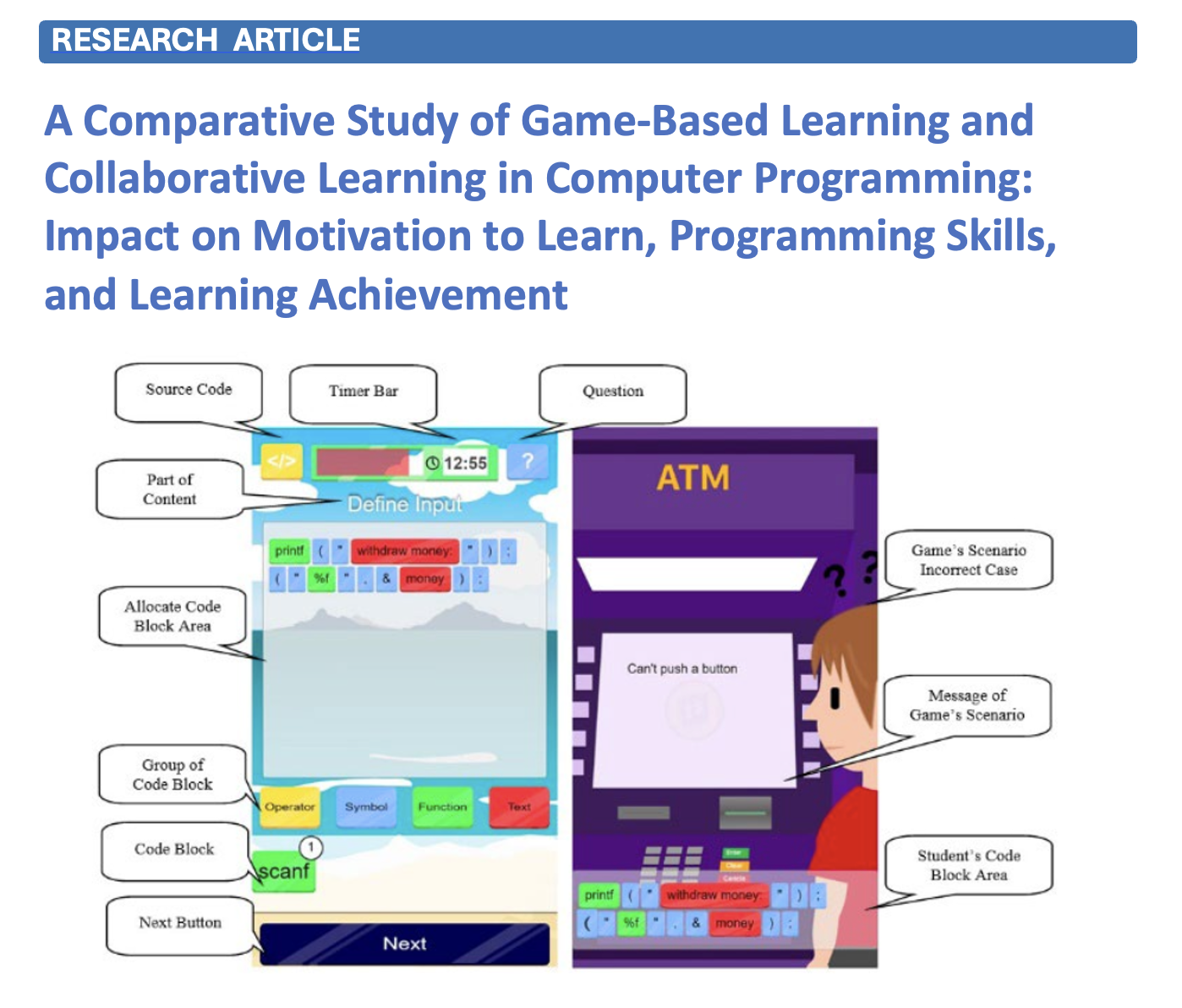
Main Article Content
Abstract
This study explores the effects of game-based learning and collaborative learning on students' motivation, programming skills, and learning achievement in computer programming. Participants included 198 first-year university students, divided into game-based learning environment (GBL-83 students) and collaborative learning environment (COL-115 students) groups. Four tools were utilised: pre-test, post-test, rubric scoring, and a motivation questionnaire. Results show that COL students exhibit significantly higher motivation across intrinsic, grade, self-determination, and self-efficacy dimensions. In programming skills, COL students excelled in identifying outputs, while GBL students demonstrated stronger abilities in identifying inputs and processes. No statistically significant difference in overall learning achievement was observed between the two groups. These findings underscore the advantages of collaborative learning in enhancing engagement and comprehension via teamwork and peer interaction, whereas game-based learning provides an interactive and enjoyable method for cultivating technical skills. Consequently, teachers ought to choose an appropriate pedagogical method and tools for their disciplines and learners.
Article Details

This work is licensed under a Creative Commons Attribution-NonCommercial-NoDerivatives 4.0 International License.
All authors need to complete copyright transfer to Journal of Applied Informatics and Technology prior to publication. For more details click this link: https://ph01.tci-thaijo.org/index.php/jait/copyrightlicense
References
Al-Jamili, O., Aziz, M., Mohammed, F., Almogahed, A., and Alawadhi, A. (2024). Evaluating the efficacy of computer games-based learning intervention in enhancing english speaking proficiency. Heliyon, 10(16):e36440. DOI: 10.1016/j.heliyon.2024.e36440.
Arnedo-Moreno, J. and Garc´ıa-Sol´orzano, D. (2025). Programming fun(damentals): Using commercial video games to teach basic coding to adult learners. Entertainment Computing, 52:100850. DOI: 10.1016/j.entcom.2024.100850.
Chen, C.-H. and Huang, K. (2024). The interplay of rewards and competition in digital game-based learning: Effects on intrinsic motivation, game performance and behaviors, and computational thinking. Learning and Instruction, 94:101995. DOI: 10.1016/j.learninstruc.2024.101995.
Cheng, Y.-P., Lai, C.-F., Chen, Y.-T., Wang, W.-S., Huang, Y.-M., and Wu, T.-T. (2023). Enhancing student’s computational thinking skills with student-generated questions strategy in a game-based learning platform. Computers & Education, 200:104794. DOI: 10.1016/j.compedu.2023.104794.
Daungcharone, K., Thongkoo, K., and Panjaburee, P. (2024). Integrating thinking process model technique with online collaborative learning to promote programming logical thinking. International Journal of Information and Education Technology, 14(3):501–509. DOI: 10.18178/ijiet.2024.14.3.2071.
Dilek¸ci, A. and Karatay, H. (2023). The effects of the 21st century skills curriculum on the development of students’ creative thinking skills. Thinking Skills and Creativity, 47:101229. DOI: 10.1016/j.tsc.2022.101229.
Glynn, S. M., Brickman, P., Armstrong, N., and Taasoobshirazi, G. (2011). Science motivation questionnaire ii: Validation with science majors and nonscience majors. Journal of Research in Science Teaching, 48(10):1159–1176. DOI: 10.1002/tea.20442.
Guti´errez Beltr´an, E. J. and Mart´ınez Arias, J. C. (2025). Mi superpoder es la programaci´on: A tool for teaching programming to children and youth. Science of Computer Programming, 240:103198. DOI: 10.1016/j.scico.2024.103198.
Hainey, T. and Baxter, G. (2024). A serious game for programming in higher education. Computers & Education: X Reality, 4:100061. DOI: 10.1016/j.cexr.2024.100061.
Hamari, J., Shernoff, D. J., Rowe, E., Coller, B., Asbell-Clarke, J., and Edwards, T. (2016). Challenging games help students learn: An empirical study on engagement, flow and immersion in game-based learning. Computers in Human Behavior, 54:170–179. DOI: 10.1016/j.chb.2015.07.045.
Ibarra-Torres, F., Caiza, G., Garc´ıa, M. V., and Barona-Pico, V. (2024). Use of basic programming tools to foster programming logic in university students with school preparation other than computer science. Procedia Computer Science, 237:413–419. DOI: 10.1016/j.procs.2024.05.122.
Joseph, S. (n.d.). Programmer competency matrix. https://www.sijinjoseph.com/programmer-competency-matrix/. Retrieved
July 18, 2025.
Koorsse, M., Cilliers, C., and Calitz, A. (2015). Programming assistance tools to support the learning of it programming in south african secondary schools. Computers & Education, 82:162–178. DOI: 10.1016/j.compedu.2014.11.020.
Lapitan, L. D. S., J., Chan, A. L. A., Sabarillo, N. S., Sumalinog, D. A. G., and Diaz, J. M. S. (2023). Design, implementation, and evaluation of an online flipped classroom with collaborative learning model in an undergraduate chemical engineering course. Education for Chemical Engineers, 43:58–72. DOI: 10.1016/j.ece.2023.01.007.
Lavi, R., Tal, M., and Dori, Y. J. (2021). Perceptions of stemalumni and students on developing 21st century skills through methods of teaching and learning. Studies in Educational Evaluation, 70:101002. DOI: 10.1016/j.stueduc.2021.101002.
Liang, Y. D., Chen, S., Abeysekera, R., O’Sullivan, H., Bray, J., and Keevill-Savage, I. (2024). Examining the adoption of technology-enhanced learning in universities and its effects on student performance, satisfaction, and motivation. Computers and Education Open, 7:100223. DOI: 10.1016/j.caeo.2024.100223.
Liao, C.-W., Chen, C.-H., and Shih, S.-J. (2019). The interactivity of video and collaboration for learning achievement, intrinsic motivation, cognitive load, and behavior patterns in a digital game-based learning environment. Computers & Education, 133:43–55. DOI: 10.1016/j.compedu.2019.01.013.
Molina, A. I., Bravo, C., Gallardo, J., Lacave, C., and Redondo, M. A. (2025). Awareness support in collaborative programming tools: An evaluation based on programmer’s perception and eye tracking. Journal of Systems and Software, 220:112276. DOI: 10.1016/j.jss.2024.112276.
Mu˜noz Miguel, J. P., Sim´on de Blas, C., Anguita Rodr´ıguez, F., and Garc´ıa Sipols, A. E. (2023). Collaborative learning in management subjects to university students: A multi-level research to identify group profile, engagement and academic performance. The International Journal of Management Education, 21(1):100762. DOI: 10.1016/j.ijme.2022.100762.
Rom´an-Gonz´alez, M., P´erez-Gonz´alez, J.-C., and Jim´enez-Fern´andez, C. (2017). Which cognitive abilities underlie computational thinking? criterion validity of the computational thinking test. Computers in Human Behavior, 72:678–691. DOI: 10.1016/j.chb.2016.08.047.
Santilli, T., Ceccacci, S., Mengoni, M., and Giaconi, C. (2025). Virtual vs. traditional learning in higher education: A systematic review of comparative studies. Computers & Education, 227:105214. DOI: 10.1016/j.compedu.2024.105214.
Scherer, R., Siddiq, F., and S´anchez Viveros, B. (2020). A meta-analysis of teaching and learning computer programming: Effective instructional approaches and conditions. Computers in Human Behavior, 109:106349. DOI: 10.1016/j.chb.2020.106349.
Serrano-C´amara, L. M., Paredes-Velasco, M., Alcover, C.-M., and Vel´azquez-Iturbide, J. (2014). An evaluation of students’ motivation in computer-supported collaborative learning of programming concepts. Computers in Human Behavior, 31:499–508. DOI: 10.1016/j.chb.2013.04.030.
Song, D., Hong, H., and Oh, E. Y. (2021). Applying computational analysis of novice learners’ computer programming patterns to reveal self-regulated learning, computational thinking, and learning performance. Computers in Human Behavior, 120:106746.
DOI: 10.1016/j.chb.2021.106746.
Thongkoo, K., Panjaburee, P., and Daungcharone, K. (2020). Implementation of mobile game-transformed lecture-based approach to promoting c programming languages learning. International Journal of Mobile Learning and Organisation, 14(2):236–254. DOI:
1504/IJMLO.2020.10026332.
van Niekerk, J. and Webb, P. (2016). The effectiveness of brain-compatible blended learning material in the teaching of programming logic. Computers & Education, 103:16–27. DOI: 10.1016/j.compedu.2016.09.008.
