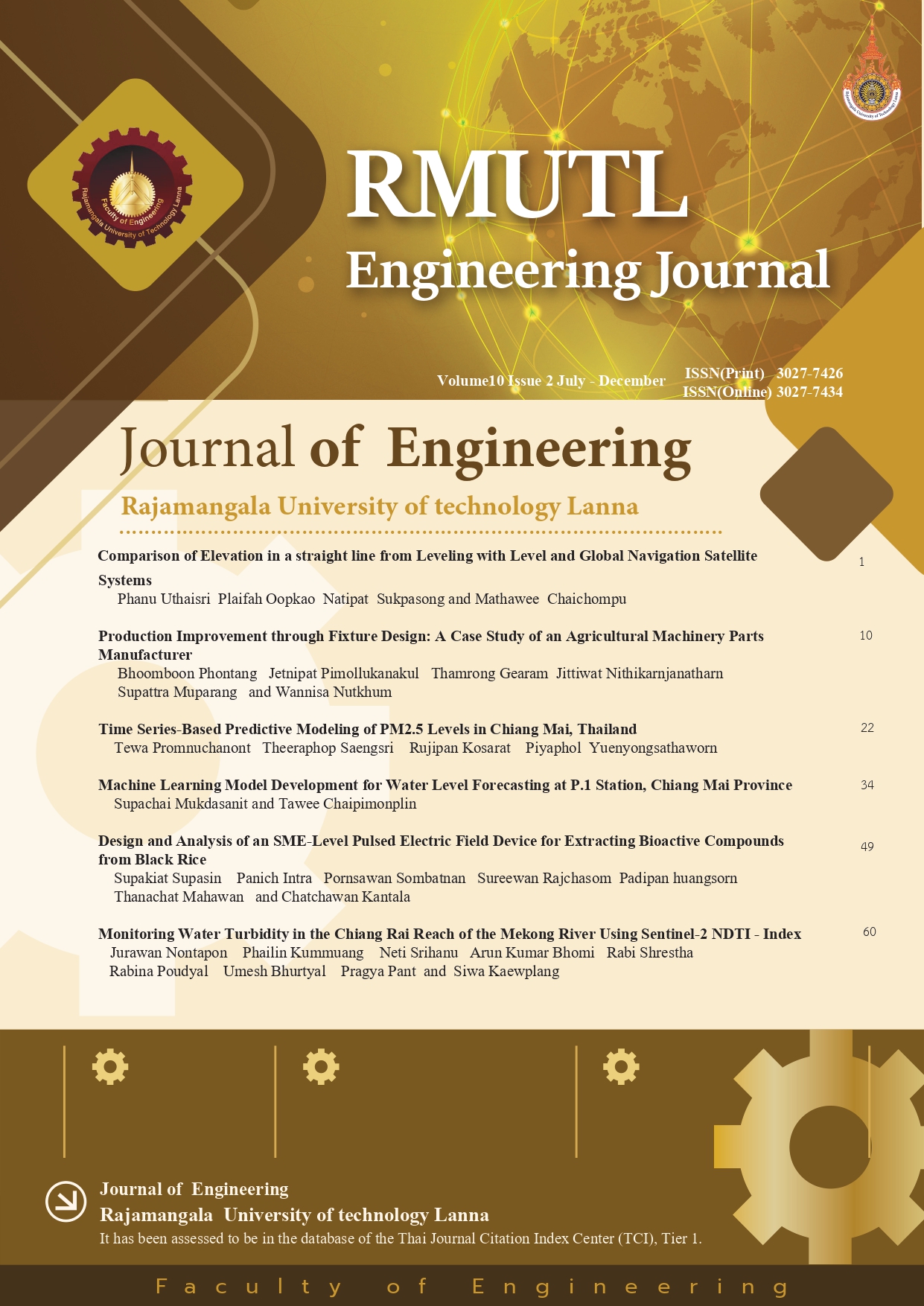
Monitoring Water Turbidity in the Chiang Rai Reach of the Mekong River Using Sentinel-2 NDTI
DOI:
https://doi.org/10.14456/rmutlengj.2025.14Keywords:
Mekong River, NDTI, MNDWI, Sentinel-2, TerraClimateAbstract
The Mekong River plays a vital role in regional ecology, food security, and water governance, yet turbidity monitoring in its upper reaches remains limited. The Chiang Rai sector, located at the first upstream entry point of the Lower Mekong Basin, functions as a sediment and flow gateway to downstream countries; however, no systematic satellite-based turbidity assessment has previously been conducted for this area. This study addresses this gap by applying the Normalized Difference Turbidity Index (NDTI) derived from Sentinel-2 MSI imagery to investigate spatial and seasonal turbidity dynamics from 2019 to 2024. Multi-temporal satellite datasets were processed using Google Earth Engine and integrated with monthly rainfall (TerraClimate) and water surface area extracted using the Modified Normalized Difference Water Index (MNDWI). Results revealed a clear monsoonal pattern, with turbidity peaking between June and September and declining during the dry season (November-April). Regression analysis showed a moderate correlation between rainfall and turbidity (R² = 0.37), while a stronger association with water surface area (R² = 0.514) indicates the dominant influence of hydromorphological processes such as sediment resuspension and floodplain connectivity. Although the absence of field-based turbidity measurements represents a key limitation, the findings demonstrate the potential of Sentinel-2-based NDTI as a cost-efficient monitoring tool in data-scarce transboundary basins. This study provides the first satellite-derived turbidity baseline for the northern Mekong and offers a practical framework to support basin-wide water-quality monitoring and policy decision-making under increasing hydropower regulation and climate variability.
References
Mekong River Commission n.d. https://www. mrcmekong.org/ (accessed September 14, 2025).
Douglas I. The Mekong river basin. Phys Geogr Southeast Asia Oxf Univ Press Oxf 2005:193–218.
Nontapon J, Srihanu N, Auttarapong D, Hasita S, Ratanachotinun J, Bhurtyal UB, et al. Assessment of Suspended Sediment Concentration in the Mekong River Using Landsat-8 Data. Eng Access 2025;11:233-42.
Bid S, Siddique G. Identification of seasonal variation of water turbidity using NDTI method in Panchet Hill Dam, India. Model Earth Syst Environ 2019;5:1179-200.
Kolli MK, Chinnasamy P. Estimating turbidity concentrations in highly dynamic rivers using Sentinel-2 imagery in Google Earth Engine: Case study of the Godavari River, India. Environ Sci Pollut Res 2024;31:33837-47.
Ogilvie A, Belaud G, Massuel S, Mulligan M, Le Goulven P, Calvez R. Surface water monitoring in small water bodies: potential and limits of multi-sensor Landsat time series. Hydrol Earth Syst Sci 2018;22:4349 -80.
Li C, Rousta I, Olafsson H, Zhang H. Lake water quality and dynamics assessment during 1990-2020 (A case study: Chao Lake, China). Atmosphere 2023;14:382.
Elhag M, Gitas I, Othman A, Bahrawi J, Gikas P. Assessment of water quality parameters using temporal remote sensing spectral reflectance in arid environments, Saudi Arabia. Water 2019;11:556.
Dabire N, Ezin EC, Firmin AM. Water Quality Assessment Using Normalized Difference Index by Applying Remote Sensing Techniques: Case of Lake Nokoue. 2024 IEEE 15th Control Syst. Grad. Res. Colloq. ICSGRC, IEEE; 2024, p. 1-6.
Ardyan PAN. Water Quality Analysis Using NDTI and TSS Parameters Based on Sentinel Image Data in Jakarta Bay Waters. Marit Park J Marit Technol Soc 2025:103-9.
Lacaux JP, Tourre YM, Vignolles C, Ndione JA, Lafaye M. Classification of ponds from high-spatial resolution remote sensing: Application to Rift Valley Fever epidemics in Senegal. Remote Sens Environ 2007;106:66-74.
Gorelick N, Hancher M, Dixon M, Ilyushchenko S, Thau D, Moore R. Google Earth Engine: Planetary-scale geospatial analysis for everyone. Remote Sens Environ 2017;202:18–27.
Abatzoglou JT, Dobrowski SZ, Parks SA, Hegewisch KC. TerraClimate, a high-resolution global dataset of monthly climate and climatic water balance from 1958-2015. Sci Data 2018;5:1-12.
Thoma DP. Management impacts and remote sensing applications for water quality assessment. University of Minnesota; 2003.
Xu H. Modification of normalised difference water index (NDWI) to enhance open water features in remotely sensed imagery. Int J. Remote Sens 2006;27:3025-33. https://doi.org /10.1080/01431160600589179.
Downloads
Published
How to Cite
Issue
Section
License

This work is licensed under a Creative Commons Attribution-NonCommercial-NoDerivatives 4.0 International License.



 For Author