
ผลของการเสริมดอกสุพรรณิการ์ผงในอาหารต่อการเจริญเติบโตและสีของปลาทอง
Article Sidebar
Main Article Content
บทคัดย่อ
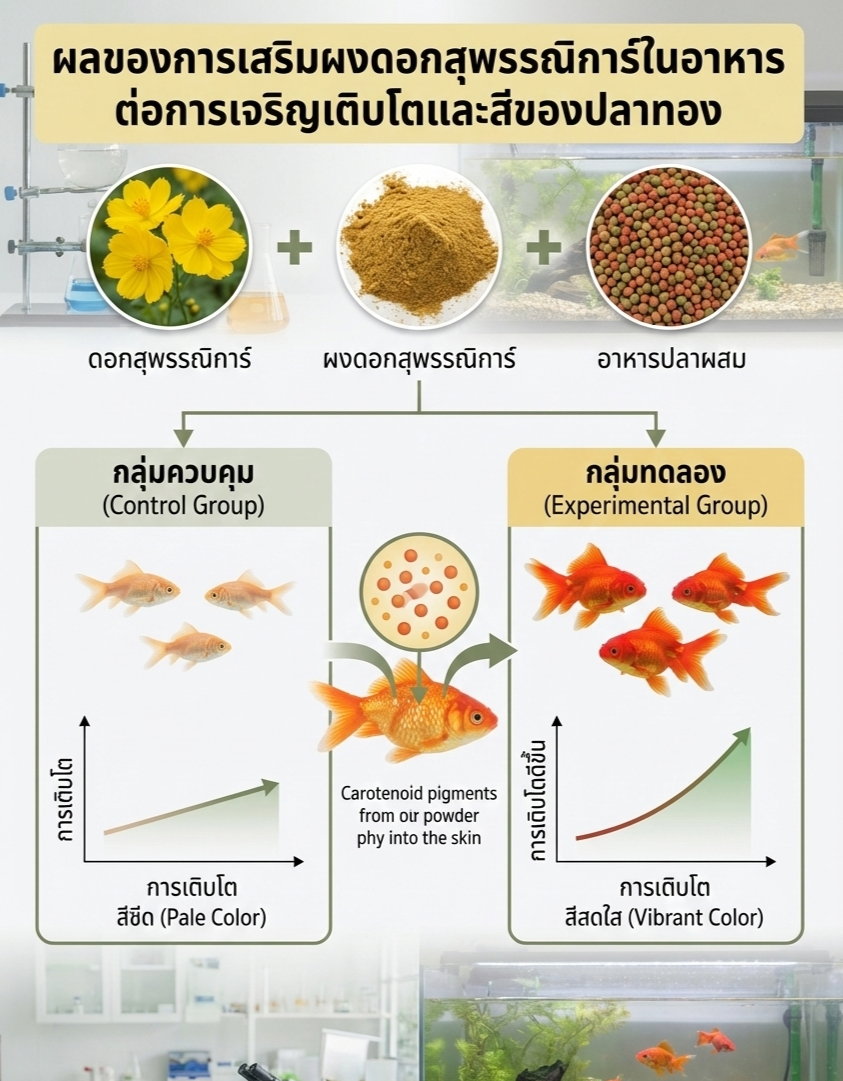
การวิจัยครั้งนี้มีวัตถุประสงค์เพื่อศึกษาผลของการเสริมดอกสุพรรณิการ์ผงในอาหารต่อการเจริญเติบโตและสีของปลาทอง (Carassius auratus) การทดลองถูกออกแบบแบบสุ่มสมบูรณ์ ประกอบด้วย 4 ชุดการทดลอง ได้แก่ ชุดควบคุม (ไม่เสริมดอกสุพรรณิการ์ผง) และชุดทดลองที่ได้รับอาหารเสริมดอกสุพรรณิการ์ผงในระดับร้อยละ 1.5, 3 และ 5 โดยแต่ละชุดมี 3 ซ้ำ อาหารที่ใช้เลี้ยงมีปริมาณโปรตีนร้อยละ 40 ให้ปลากินวันละ 2 ครั้ง เวลา 09.00–10.00 น. และ 15.00–16.00 น. เลี้ยงเป็นระยะเวลา 10 สัปดาห์ ระหว่างการทดลอง ได้ทำการสุ่มชั่งน้ำหนักและวัดค่าสีของปลาทองทุก 2 สัปดาห์ โดยประเมินค่าความสว่าง (L*), ค่าสีแดง (a*) และค่าสีเหลือง (b*) เพื่อศึกษาผลต่อการเจริญเติบโตและคุณภาพสีของปลา เมื่อสิ้นสุดการทดลองพบว่า การเสริมดอกสุพรรณิการ์ผงไม่มีผลต่ออัตราการเจริญเติบโตและอัตราการรอดตายของปลาทองอย่างมีนัยสำคัญทางสถิติ (p > .05) แต่ในด้านค่าสีของปลาทอง พบว่าค่าความสว่าง (L*), ค่าสีแดง (a*) และค่าสีเหลือง (b*) ของปลาที่ได้รับอาหารเสริมดอกสุพรรณิการ์ผงทุกระดับมีค่าสูงกว่าชุดควบคุมอย่างมีนัยสำคัญทางสถิติ (p > .05) โดยเฉพาะกลุ่มที่ได้รับอาหารเสริมดอกสุพรรณิการ์ผงร้อยละ 5 ให้ค่าสีดีที่สุด เนื่องจากดอกสุพรรณิการ์มีปริมาณแคโรทีนอยด์สูงถึง 28.91(0.43) mg ß-carotene/g ซึ่งสามารถทำหน้าที่เป็นสารให้สีธรรมชาติ (Coloring agent) ในอาหาร ส่งผลให้สีของปลาทองมีความสว่างเพิ่มขึ้น ลักษณะสีสันโดยรวมมีความสดใสและสังเกตได้ชัดเจน จึงเป็นแนวทางในการเพิ่มคุณภาพสีของปลาทอง และมีศักยภาพในการพัฒนาเป็นอาหารเชิงพาณิชย์สำหรับปลาสวยงามต่อไป
Downloads
Article Details

อนุญาตภายใต้เงื่อนไข Creative Commons Attribution-NonCommercial-NoDerivatives 4.0 International License.
เอกสารอ้างอิง
กรมประมง. (2566). กรมประมงเปิดกระแส 5 ลิสต์ปลาสวยงามไทยดังไกลทั่วโลก พร้อมดันมาตรฐานปลาไทย “สวยคุณภาพ” ออกผงาดตลาดต่างแดน. กรม. https://www4.fisheries.go.th/local/index.php/main/view_activities/1210/198482
กรมประมง. (2568). สถิติส่งออกสัตว์น้ำรายปี 2568. กรม. http://file.fisheries.go.th/f/85a5967485/
สุกัญยา แตงโม, สิริพร ห้าวหาญ, ประภาศิริ ใจผ่อง, พัทธนันท์ โกธรรม, Tuan Nguyen Ngoc, ศรัณญา สอนมณี, และสุภาวดี แหยมคง. (2562). การวิเคราะห์หาสารสำคัญและสารสีจากดอกไม้กินได้บางชนิดเพื่อใช้ในอาหารสัตว์ปีก. วารสารเกษตรนเรศวร, 16(1), 57-64. https://li01.tci-thaijo.org/index.php/aginujournal/article/view/247855
สุภาวดี แหยมคง, สุกัญญา แตงโม, สิริพร ห้าวหาญ, พันธนันท์ โกธรรม, ประภาศิริ ใจผ่อง, ต๋วน เหงียน ง๊อก, และศรัณญา สอนมณี. (2563). องค์ประกอบทางเคมี ฤทธิ์ด้านอนุมูลอิสระ ฟลาโวนอยด์ แคโรทีนอยด์ และฟีนอลิคทั้งหมดของดอกไม้บางชนิด. แก่นเกษตร, 48(พิเศษ 1), 1011-1018. https://agkb.lib.ku.ac.th/kku/search_detail/result/401835
สุภาวดี แหยมคง, สุกัญยา แตงโม, สิริพร ห้าวหาญ, พัทธนันท์ โกธรรม, ประภาศิริ ใจผ่อง, ทศพร อินเจริญ, และศิริวรรณ ม่วงทอง. (2564). ผลของการเสริมดอกแคแดง แคแสด และสุพรรณิการ์ในอาหารไก่ไข่ต่อสมรรถภาพการผลิตคุณภาพไข่ และค่าโลหิตวิทยา. แก่นเกษตร, 49(พิเศษ 2), 940-950. https://agkb.lib.ku.ac.th/kku/search_detail/result/413246
Association of Official Analytical Chemist. (2000). Official Method of Analytical (17th ed.). AOAC international.
Bandyopadhyay, P., Swain, S. K., & Mishra, S. (2005). Growth and dietary utilisation in goldfish (Carassius auratus Linn.) fed diets formulated with various local agro- produces. Bioresource Technology, 96(6), 731–740. https://doi.org/10.1016/j.biortech.2004.06.018
Blanco, A. M., & Unniappan, S. (2022). Goldfish (Carassius auratus): biology, husbandry, and research applications. In L. D’Angelo, & P. de Girolamo (Eds.), Laboratory Fish in Biomedical Research (pp.373–408). Academic Press. https://doi.org/10.1016/B978-0-12-821099-4.00012-2
Chakraborty, S. B., & Hancz, C. (2011). Application of phytochemicals as immunostimulant, antipathogenic and antistress agents in finfish culture. Reviews in Aquaculture, 3(3), 103–119. https://doi.org/10.1111/j.1753-5131.2011.01048.x
de Carvalho, C. C. R., & Caramujo, M. J. (2017). Carotenoids in aquatic ecosystems and aquaculture: A colorful business with implications for human health. Frontiers in Marine Science, 4, 93. https://doi.org/10.3389/fmars.2017.00093
Elshafey, A. E., Khalafalla, M. M., Zaid, A. A. A., Mohamed, R. A., & Abdel-Rahim, M. M. (2023). Source diversity of Artemia enrichment boosts goldfish (Carassius auratus) performance, ß-carotene content, pigmentation, immune-physiological and transcriptomic responses. Scientific Reports, 13, 21801. https://doi.org/10.1038/s41598-023-48621-4
Gomes, E., Dias, J., Silva, P., Valente, L., Empis, J., Gouveia, L., Bowen, J., & Young, A. (2002). Utilization of natural and synthetic sources of carotenoids in the skin pigmentation of gilthead seabraam (Sparus aurata). Eur. Food. Res. Technol, 214, 287-293. https://doi.org/10.1007/s00217-001-0475-9
Gouveia, L., & Rema, P. (2005). Effect of microalgal biomass concentration and temperature on ornamental goldfish (Carassius auratus) skin pigmentation. Aquaculture Nutrition, 11, 19–23. https://doi.org/10.1111/j.1365-2095.2004.00319.x
Harikrishnan, R., Balasundaram, C., & Heo, M. -S. (2011). Impact of plant products on innate and adaptiveimmune system of cultured finfish and shellfish. Aquaculture, 317(1-4), 1-15. https://doi.org/10.1016/j.aquaculture.2011.03.039
Khieokhajonkhet, A., Uanlam, P., Ruttarattanamongkol, K., Aeksiri, N., Tatsapong, P., & Kaneko, G. (2022). Replacement of fish meal by black soldier fly larvae meal in diet for goldfish Carassius auratus: growth performance, hematology, histology, total carotenoids, and coloration. Aquaculture, 561, 738618. https://doi.org/10.1016/j.aquaculture.2022.738618
Khieokhajonkhet, A., Suwannalers, P., Aeksiri, N., Ratanasut, K., Chitmanat, C., Inyawilert, W., Phromkunthong, W., & Kaneko, G., (2023). Effects of dietary red pepper extracts on growth, hematology, pigmentation, disease resistance, and growth- and immune-related gene expressions of goldfish (Carassius auratus). Animal Feed Science and Technology, 301, 115658. https://doi.org/10.1016/j.anifeedsci.2023.115658
Nishshanka, K. M., Radampola, K., & Bulugahapitiya, V. (2022). Effects of partial replacement of dietary fishmeal using plant-protein sources on the growth performance, coloration and liver histology of guppy fry (Poecilia reticulata) in outdoor farming conditions. Journal of Applied Aquaculture, 34(3), 715–733. https://doi.org/10.1080/10454438.2021.1886216
Novák, J., Kalous, L., & Patoka, J. (2020). Modern ornamental aquaculture in Europe: early history of freshwater fish imports. Reviews in Aquaculture, 12(4), 2042–2060. https://doi.org/10.1111/raq.12421
Reverter, M., Bontemps, N., Lecchini, D., Banaigs, B., & Sasal, P. (2014). Use of plant extracts in fish aquaculture as an alternative to chemotherapy: current status and future perspectives. Aquaculture, 433, 50-61. https://doi.org/10.1016/j.aquaculture.2014.05.048
Sivaram, V., Babu, M. M., Immanuel, G., Murugadass, S., Citarasu, T., & Marian, M. P. (2004). Growth and immune response of juvenile greasy groupers (Epinephelus tauvina) fed with herbal antibacterial active principle supplemented diets against Vibrio harveyi infections. Aquaculture, 237(1-4), 9-20. https://doi.org/10.1016/j.aquaculture.2004.03.014
