
EFFECTS OF SUPPLEMENTATION OF YELLOW SILK COTTON FLOWERS POWDER IN THE DIET ON THE GROWTH AND COLOR OF GOLDFISH
Article Sidebar
Main Article Content
Abstract
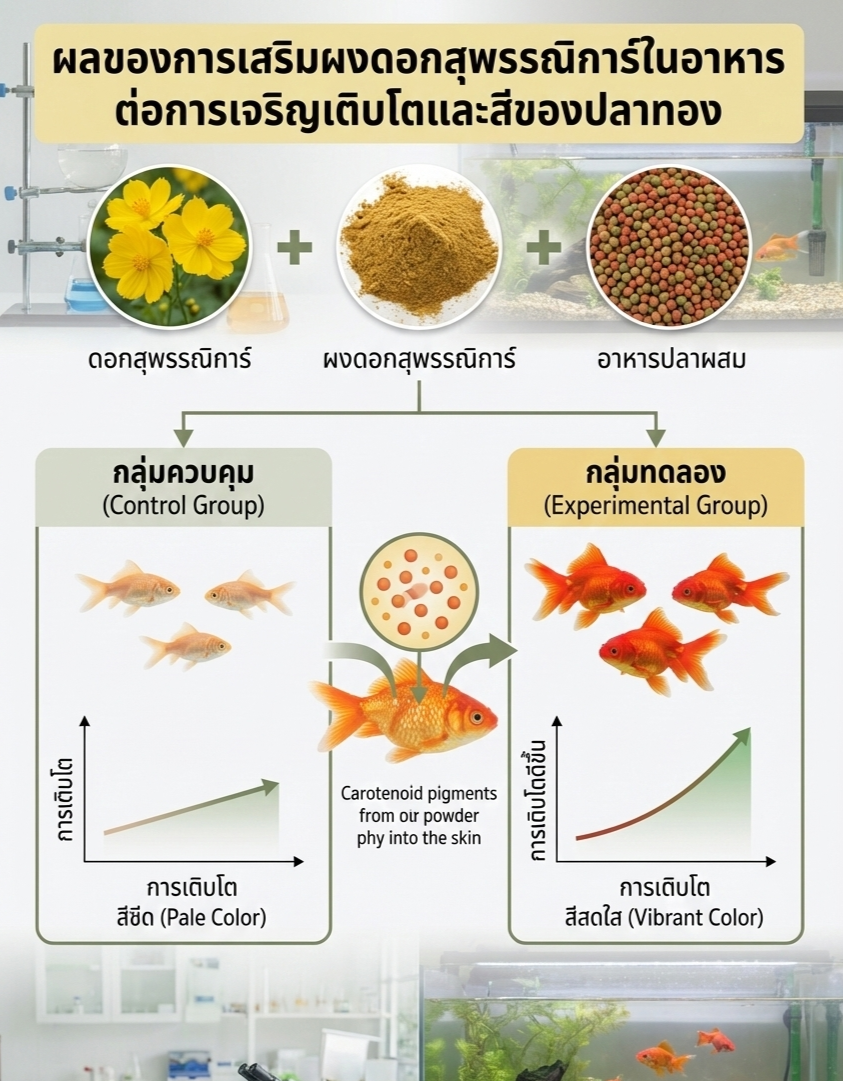
The objective of this study was to evaluate the effects of supplementing Marigold flower powder (Cochlospermum regium) in the diet on the growth and coloration of goldfish (Carassius auratus). The experiment was conducted using a completely randomized design with four treatments: control (0%) and diets supplemented with 1.5%, 3%, and 5% Marigold flower powder, each with three replicates. All diets contained 40% protein, and fish were fed twice daily (09:00–10:00 and 15:00–16:00) for 10 weeks. Fish were randomly weighed and measured for color parameters every two weeks, including lightness (L*), redness (a*), and yellowness (b*), to assess growth performance and color quality. At the end of the experiment, dietary supplementation with Marigold flower powder did not significantly affect growth performance or survival rate (p > .05). However, fish fed diets supplemented with Marigold flower powder at all levels exhibited significantly higher lightness (L*), redness (a*), and yellowness (b*) compared to the control (p > .05). Notably, fish receiving 5% supplementation showed the highest color values, which can be attributed to the high carotenoid content in Marigold flower (28.91(0.43) mg ß-carotene/g), acting as a natural coloring agent. This resulted in brighter and more vivid overall coloration. These findings indicated that Marigold flower powder could effectively enhance goldfish coloration and had potential for development as a commercial feed for ornamental fish.
Downloads
Article Details

This work is licensed under a Creative Commons Attribution-NonCommercial-NoDerivatives 4.0 International License.
References
กรมประมง. (2566). กรมประมงเปิดกระแส 5 ลิสต์ปลาสวยงามไทยดังไกลทั่วโลก พร้อมดันมาตรฐานปลาไทย “สวยคุณภาพ” ออกผงาดตลาดต่างแดน. กรม. https://www4.fisheries.go.th/local/index.php/main/view_activities/1210/198482
กรมประมง. (2568). สถิติส่งออกสัตว์น้ำรายปี 2568. กรม. http://file.fisheries.go.th/f/85a5967485/
สุกัญยา แตงโม, สิริพร ห้าวหาญ, ประภาศิริ ใจผ่อง, พัทธนันท์ โกธรรม, Tuan Nguyen Ngoc, ศรัณญา สอนมณี, และสุภาวดี แหยมคง. (2562). การวิเคราะห์หาสารสำคัญและสารสีจากดอกไม้กินได้บางชนิดเพื่อใช้ในอาหารสัตว์ปีก. วารสารเกษตรนเรศวร, 16(1), 57-64. https://li01.tci-thaijo.org/index.php/aginujournal/article/view/247855
สุภาวดี แหยมคง, สุกัญญา แตงโม, สิริพร ห้าวหาญ, พันธนันท์ โกธรรม, ประภาศิริ ใจผ่อง, ต๋วน เหงียน ง๊อก, และศรัณญา สอนมณี. (2563). องค์ประกอบทางเคมี ฤทธิ์ด้านอนุมูลอิสระ ฟลาโวนอยด์ แคโรทีนอยด์ และฟีนอลิคทั้งหมดของดอกไม้บางชนิด. แก่นเกษตร, 48(พิเศษ 1), 1011-1018. https://agkb.lib.ku.ac.th/kku/search_detail/result/401835
สุภาวดี แหยมคง, สุกัญยา แตงโม, สิริพร ห้าวหาญ, พัทธนันท์ โกธรรม, ประภาศิริ ใจผ่อง, ทศพร อินเจริญ, และศิริวรรณ ม่วงทอง. (2564). ผลของการเสริมดอกแคแดง แคแสด และสุพรรณิการ์ในอาหารไก่ไข่ต่อสมรรถภาพการผลิตคุณภาพไข่ และค่าโลหิตวิทยา. แก่นเกษตร, 49(พิเศษ 2), 940-950. https://agkb.lib.ku.ac.th/kku/search_detail/result/413246
Association of Official Analytical Chemist. (2000). Official Method of Analytical (17th ed.). AOAC international.
Bandyopadhyay, P., Swain, S. K., & Mishra, S. (2005). Growth and dietary utilisation in goldfish (Carassius auratus Linn.) fed diets formulated with various local agro- produces. Bioresource Technology, 96(6), 731–740. https://doi.org/10.1016/j.biortech.2004.06.018
Blanco, A. M., & Unniappan, S. (2022). Goldfish (Carassius auratus): biology, husbandry, and research applications. In L. D’Angelo, & P. de Girolamo (Eds.), Laboratory Fish in Biomedical Research (pp.373–408). Academic Press. https://doi.org/10.1016/B978-0-12-821099-4.00012-2
Chakraborty, S. B., & Hancz, C. (2011). Application of phytochemicals as immunostimulant, antipathogenic and antistress agents in finfish culture. Reviews in Aquaculture, 3(3), 103–119. https://doi.org/10.1111/j.1753-5131.2011.01048.x
de Carvalho, C. C. R., & Caramujo, M. J. (2017). Carotenoids in aquatic ecosystems and aquaculture: A colorful business with implications for human health. Frontiers in Marine Science, 4, 93. https://doi.org/10.3389/fmars.2017.00093
Elshafey, A. E., Khalafalla, M. M., Zaid, A. A. A., Mohamed, R. A., & Abdel-Rahim, M. M. (2023). Source diversity of Artemia enrichment boosts goldfish (Carassius auratus) performance, ß-carotene content, pigmentation, immune-physiological and transcriptomic responses. Scientific Reports, 13, 21801. https://doi.org/10.1038/s41598-023-48621-4
Gomes, E., Dias, J., Silva, P., Valente, L., Empis, J., Gouveia, L., Bowen, J., & Young, A. (2002). Utilization of natural and synthetic sources of carotenoids in the skin pigmentation of gilthead seabraam (Sparus aurata). Eur. Food. Res. Technol, 214, 287-293. https://doi.org/10.1007/s00217-001-0475-9
Gouveia, L., & Rema, P. (2005). Effect of microalgal biomass concentration and temperature on ornamental goldfish (Carassius auratus) skin pigmentation. Aquaculture Nutrition, 11, 19–23. https://doi.org/10.1111/j.1365-2095.2004.00319.x
Harikrishnan, R., Balasundaram, C., & Heo, M. -S. (2011). Impact of plant products on innate and adaptiveimmune system of cultured finfish and shellfish. Aquaculture, 317(1-4), 1-15. https://doi.org/10.1016/j.aquaculture.2011.03.039
Khieokhajonkhet, A., Uanlam, P., Ruttarattanamongkol, K., Aeksiri, N., Tatsapong, P., & Kaneko, G. (2022). Replacement of fish meal by black soldier fly larvae meal in diet for goldfish Carassius auratus: growth performance, hematology, histology, total carotenoids, and coloration. Aquaculture, 561, 738618. https://doi.org/10.1016/j.aquaculture.2022.738618
Khieokhajonkhet, A., Suwannalers, P., Aeksiri, N., Ratanasut, K., Chitmanat, C., Inyawilert, W., Phromkunthong, W., & Kaneko, G., (2023). Effects of dietary red pepper extracts on growth, hematology, pigmentation, disease resistance, and growth- and immune-related gene expressions of goldfish (Carassius auratus). Animal Feed Science and Technology, 301, 115658. https://doi.org/10.1016/j.anifeedsci.2023.115658
Nishshanka, K. M., Radampola, K., & Bulugahapitiya, V. (2022). Effects of partial replacement of dietary fishmeal using plant-protein sources on the growth performance, coloration and liver histology of guppy fry (Poecilia reticulata) in outdoor farming conditions. Journal of Applied Aquaculture, 34(3), 715–733. https://doi.org/10.1080/10454438.2021.1886216
Novák, J., Kalous, L., & Patoka, J. (2020). Modern ornamental aquaculture in Europe: early history of freshwater fish imports. Reviews in Aquaculture, 12(4), 2042–2060. https://doi.org/10.1111/raq.12421
Reverter, M., Bontemps, N., Lecchini, D., Banaigs, B., & Sasal, P. (2014). Use of plant extracts in fish aquaculture as an alternative to chemotherapy: current status and future perspectives. Aquaculture, 433, 50-61. https://doi.org/10.1016/j.aquaculture.2014.05.048
Sivaram, V., Babu, M. M., Immanuel, G., Murugadass, S., Citarasu, T., & Marian, M. P. (2004). Growth and immune response of juvenile greasy groupers (Epinephelus tauvina) fed with herbal antibacterial active principle supplemented diets against Vibrio harveyi infections. Aquaculture, 237(1-4), 9-20. https://doi.org/10.1016/j.aquaculture.2004.03.014
