
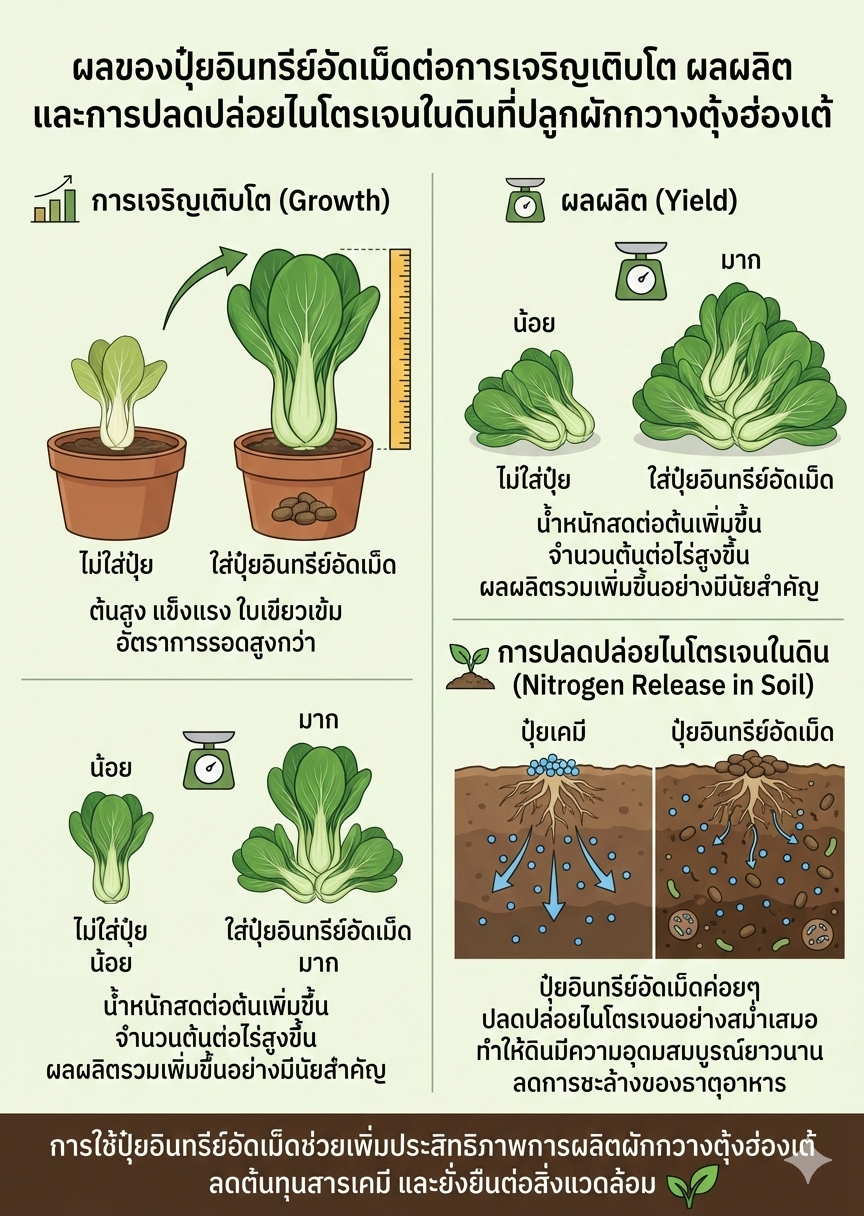
ผลของปุ๋ยอินทรีย์อัดเม็ดต่อการเจริญเติบโต ผลผลิต และการปลดปล่อยไนโตรเจนในดินที่ปลูกผักกวางตุ้งฮ่องเต้
Article Sidebar
Main Article Content
บทคัดย่อ
การวิจัยนี้มีวัตถุประสงค์เพื่อศึกษาประสิทธิภาพของปุ๋ยอินทรีย์อัดเม็ดต่อการเจริญเติบโตและผลผลิตของผักกวางตุ้งฮ่องเต้ และการปลดปล่อยไนโตรเจนที่เป็นประโยชน์ของปุ๋ยอินทรีย์อัดเม็ดต่อพืช วางแผนทดลองแบบสุ่มสมบูรณ์ (CRD) จำนวน 4 ซ้ำ ประกอบด้วย 6 ตำรับการทดลอง ดังนี้ T1) ไม่ใส่ปุ๋ย (ตำรับควบคุม) T2) -T6) ใส่ปุ๋ยอินทรีย์อัดเม็ด อัตรา 1,000, 2,000, 3,000, 4,000 และ 5,000 กิโลกรัมต่อไร่ ตามลำดับ เก็บข้อมูลการเจริญเติบโต และค่าความเขียวของใบ ทุก ๆ 7 วันหลังย้ายต้นกล้า เมื่อผักกวางตุ้งฮ่องเต้อายุเก็บเกี่ยว 42 วันหลังย้ายต้นกล้า เก็บข้อมูลผลผลิต และคำนวณปริมาณไนโตรเจนที่เป็นประโยชน์ต่อพืชจากการดูดใช้ไนโตรเจนของผักกวางตุ้งฮ่องเต้ ผลการทดลอง พบว่า ปุ๋ยอินทรีย์อัดเม็ดอัตรา 2,000 กิโลกรัมต่อไร่ ส่งผลทำให้ผักกวางตุ้งฮ่องเต้มีการเจริญเติบโตด้านความสูงของต้น ความกว้างใบ ความยาวใบ ความยาวก้านใบ และเส้นรอบวงโคนต้นดีที่สุด ทำให้ผักกวางตุ้งฮ่องเต้มีน้ำหนักส่วนต้นสดและรากสดมากที่สุด เท่ากับ 105.54 และ 18.60 กรัมต่อต้น ตามลำดับ ส่งผลทำให้ผักกวางตุ้งฮ่องเต้มีน้ำหนักแห้งส่วนต้นมากที่สุดเช่นเดียวกัน คือ 8.39 กรัมต่อต้น ปริมาณของปุ๋ยอินทรีย์อัดเม็ดมีผลต่อปริมาณการปลดปล่อยไนโตรเจนที่เป็นประโยชน์ต่อพืช โดยการใส่ปุ๋ยอินทรีย์อัดเม็ดอัตรา 2,000 กิโลกรัมต่อไร่ มีการปลดปล่อยไนโตรเจนเป็นประโยชน์ต่อพืชสอดคล้องกับการเจริญเติบโตของผักกวางตุ้งฮ่องเต้ เมื่อมีการใส่ปุ๋ยอินทรีย์อัดเม็ดโดยมีปริมาณไนโตรเจนที่เป็นประโยชน์เท่ากับ 714.52 และ 768 มิลลิกรัมต่อกิโลกรัม ในขณะที่การศึกษาที่อายุ 42 วัน ดินที่ใส่ปุ๋ยอินทรีย์อัดเม็ดมีอัตราการปลดปล่อยไนโตรเจนในดินเท่ากับ 6.36 มิลลิกรัมต่อกิโลกรัมต่อวัน จากผลการวิจัยในครั้งนี้เกษตรกรสามารถนำไปต่อยอดเพื่อเป็นแนวทางในการเลือกใช้ปุ๋ยอินทรีย์อัดเม็ดกับพืชที่มีการเจริญเติบโตยาวนาน เนื่องจากคุณสมบัติของปุ๋ยอัดเม็ดที่ละลายช้าจึงสามารถปลดปล่อยธาตุอาหารออกมาให้เป็นประโยชน์ต่อพืชที่มีอายุการเก็บเกี่ยวยาวนาน และลดการใส่ปุ๋ยหลายครั้งต่อฤดูกาลปลูกได้
Downloads
Article Details

อนุญาตภายใต้เงื่อนไข Creative Commons Attribution-NonCommercial-NoDerivatives 4.0 International License.
เอกสารอ้างอิง
ณัฐพล ภูมิสะอาด, จักรมาส เลาหวณิช, เชิดพงษ์ เชี่ยวชาญวัฒนา, และพีระยศ แข็งขัน. (2565). โครงการการจัดการผลผลิตทางการเกษตรโดยใช้เครื่องอัดเม็ดปุ๋ยเพื่อการพัฒนาชุมชนเพื่อความมั่นคง มั่งคั่งและยั่งยืน. สำนักงานการวิจัยแห่งชาติ (วช.).
ธีรภัทร บุญสมวล, วัชรพงษ์ มหานิล, ทศพร อินเจริญ, สุภาวดี แหยมคง, ประภาศิริ ใจผ่อง, ปุณณดา ทะรังศรี, และจักรกฤช ศรีละออ. (2566). อัตราส่วนที่เหมาะสมในการผลิตปุ๋ยอินทรีย์อัดเม็ดจากของเสียทางการเกษตรร่วมกับมูลจิ้งหรีดต่อการเจริญเติบโตและผลผลิตของผักกาดหอมกรีนโอ๊ค. วารสารแก่นเกษตร, พิเศษ(1), 475-482. https://agkb.lib.ku.ac.th/agrisservice/search_detail/result/427070
วันเพ็ญ โลหะเจริญ, ศีลวัต พัฒโนดม, ปราณี เกียรติประทับใจ, วีรดา ธงงาม, อิทธิสุนทร นันทกิจ, โสระยา ร่วมรังสี, และจุฑามาส คุ้มชัย. (2557). ผลของการขาดธาตุอาหารต่อการเจริญเติบโตและความเข้มข้นของธาตุอาหารในใบพริกหวาน. วารสารเกษตร, 30(1), 39-48. https://li01.tci-thaijo.org/index.php/joacmu/article/view/245865
วีณา นิลวงศ์. (2561). ศึกษาการปลดปล่อยไนโตรเจนที่เป็นประโยชน์ต่อพืชในดินที่มีการใช้ปุ๋ยอินทรีย์ชนิดต่าง ๆ. วารสารเกษตรพระจอมเกล้า, 36(3), 178-188. https://li01.tci-thaijo.org/index.php/agritechjournal/article/view/159811
ศุภชัย อำคา, เฉลิมขวัญ มุกสิกทอง, และพรไพรินทร์ รุ่งเจริญทอง. (2557). ผลของสัดส่วนความเป็นประโยชน์ของแอมโมเนียมและไนเทรตในปุ๋ยเคมีเกรด 15-15-15 ต่ออัตราการเติบโตและสมบัติของดินบางประการในการปลูกคะน้า. แก่นเกษตร, 42(พิเศษ3), 899-905. https://ag2.kku.ac.th/kaj/PDF.cfm?filename=V_038.pdf&id=1695&keeptrack=4
สัญญา เล่ห์สิงห์ และอรประภา อนุกูลประเสริฐ. (2559). ประสิทธิภาพของปุ๋ยอินทรีย์คุณภาพสูงต่อการเจริญเติบโตและการให้ผลผลิตของคะน้า. วารสารวิทยาศาสตร์และเทคโนโลยี, 24(2), 320-332. https://li01.tci-thaijo.org/index.php/tstj/article/view/50462
สำนักงานนโยบายและแผนทรัพยากรธรรมชาติและสิ่งแวดล้อม. กลุ่มงานนโยบายและยุทธศาสตร์. (2567). การบูรณาการประเด็นด้านการเปลี่ยนแปลงสภาพภูมิอากาศในการจัดทำแผนพัฒนาจังหวัดมหาสารคาม. สำนักงาน. https://www.mahasarakham.go.th/new/files/com_news_stash/2024-07_89c8e3311ae0ce2.pdf
Cardarelli, M., El Chami, A., Iovieno, P., Rouphael, Y., Bonini, P., & Colla, G. (2023). Organic fertilizer sources distinctively modulate productivity, Quality, Mineral composition, and Soil enzyme activity of greenhouse lettuce grown in degraded soil. Agronomy, 13(1), 194. https://doi.org/10.3390/agronomy13010194
El-Nakhel, C., Cristofano, F., Colla, G., Pii, Y., Secomandi, E., De Gregorio, M., Buffagi, V., Garcia-Perez, P., Lucini, L., & Rouphael, Y. (2023). Vegetal-derived biostimulants distinctively command the physiological and metabolomic signatures of lettuce grown in depleted nitrogen conditions. Scientia Horticulturae, 317, 112057. https://doi.org/10.1016/j.scienta.2023.112057
Elsaggan, M. A. (2020). Effect of organic fertilizer rates and sulfur on growth and productivity of broad bean under south sinai conditions. Egyptian Journal of Desert Research, 70(2), 137-151. https://doi.org/10.21608/ejdr.2021.45366.1075
Fonge, B. A., Bechem, E. E., & Awo, E. M. (2016). Fertilizer rate on growth, yield, and nutrient concentration of leafy vegetables. International Journal of Vegetable Science, 22(3), 274-288. https://doi.org/10.1080/19315260.2015.1005726
Gelaye, Y. (2024). A Systematic Review on Effects of Nitrogen Fertilizer Levels on Cabbage (Brassica oleracea var. capitata L.) Production in Ethiopia. The Scientific World Journal, 6086730. https://doi.org/10.1155/2024/6086730
Gorliczay, E., Szöllősi, N., Kiss, N. Éva, Tóth, F., Tamás, J., & Nagy, P. T. (2021). Examination of the effect of pelleted poultry manure products on a sunflower test plant in a laboratory model experiment. Acta Agraria Debreceniensis, 1, 83-88. https://doi.org/10.34101/actaagrar/1/8477
Jung, D. H., Choi, S., & Lee, J. (2025). Changes in the growth, photosynthesis, and nitrogen allocation characteristics of hydroponically grown lettuce under different nitrate levels in a nutrient solution. Horticulture, Environment, and Biotechnology, 66, 163-172. https://doi.org/10.1007/s13580-024-00645-z
Kaleeem Abbasi, M., Mahmood Tahir, M., Sabir, N., & Khurshid, M. (2015) Impact of the addition of different plant residues on nitrogen mineralization–immobilization turnover and carbon content of a soil incubated under laboratory conditions, Solid Earth, 6, 197–205, https://doi.org/10.5194/se-6-197-2015
Kumar, P., Bhattacharya, A., Prajapati, S. K., Malik, A., & Vijay, V. K. (2022). Anaerobic co-digestion of waste microalgal biomass with cattle dung in a pilot-scale reactor: effect of seasonal variations and long-term stability assessment. Biomass Conversion and Biorefinery, 12, 1203-1215. https://doi.org/10.1007/s13399-020-00778-y
Lambers, H., Raven, J. A., Shaver, G. R., & Smith, S. E. (2008). Plant physiological ecology (2nd ed.). Springer.
Liu, Z., Hao, Z., Sha, Y., Huang, Y., Guo, W., Ke, L., Chen, F., Yuan, L., & Mi, G. (2022). High responsiveness of maize grain yield to nitrogen supply is explained by high ear growth rate and efficient ear nitrogen allocation. Field Crops Research, 286, 108610. https://doi.org/10.1016/j.fcr.2022.108610
Marschner, H. (2012). Marschner's mineral nutrition of higher plants (3rd ed.). Academic press.
Molla, A., Solomou, A. D., Fountouli, A., Chatzikirou, E., Stamatakis, E., Stamatakis, P., & Skoufogianni, E. (2024). Influence of an organic fertilizer on agronomic characteristics and herbaceous plant diversity in a greek ecosystem: The case of cretan dittany (Origanum dictamnus L.). Nitrogen, 5(2), 426-438. https://doi.org/10.3390/nitrogen5020027
Mthiyane, P., Aycan, M., & Mitsui, T. (2024). Integrating biofertilizers with organic fertilizers enhances photosynthetic efficiency and upregulates chlorophyll-related gene expression in rice. Sustainability, 16(21), 9297. https://doi.org/10.3390/su16219297
Nelson, P. V. (2015). Greenhouse operation and management (7th ed.). Pearson Education.
Niedziński, T., Sierra, M. J., Łabętowicz, J., Noras, K., Cabrales, C., & Millán, R. (2021). Release of nitrogen from granulate mineral and organic fertilizers and its effect on selected chemical parameters of soil. Agronomy, 11(10), 1981-1994. https://doi.org/10.3390/agronomy11101981
Pavlou, G. C., Ehaliotis, C. D., & Kavvadias, V. A. (2007). Effect of organic and inorganic fertilizers applied during successive crop seasons on growth and nitrate accumulation in lettuce. Scientia Horticulturae, 111(4), 319-325. https://doi.org/10.1016/j.scienta.2006.11.003
Qiu, X., Wang, Y., Hu, G., Wang, Q., Zhang, X., & Dong, Y. (2013). Effect of different fertilization modes on physiological characteristics, yield and quality of Chinese cabbage. Journal of plant nutrition, 36(6), 948-962. https://doi.org/10.1080/01904167.2012.759972
Sharaf-Eldin, M. A., Peregi, K. E., & Pap, Z. (2015). Effects of different organic fertilizers on seedlings growth and photosynthesis of Chinese cabbage (Brassica rapa ssp. pekinensis). In M. Pospišil (Ed.), 50th Croatian and 10th International Symposium on Agriculture (pp.286-290). Faculty of Agriculture, University of Zagreb. https://sa.agr.hr/publication/13/50.+hrvatski+i+10.+me%C4%91unarodni+simpozij+agronoma+eZbornik+radova.Full+text
Sharma, N. K., Singh, R. J., & Kumar, K. (2012). Dry matter accumulation and nutrient uptake by wheat (Triticum aestivum L.) under Poplar (Populus deltoides) based agroforestry system. International Scholarly Research Notices, 359673. https://doi.org/10.5402/2012/359673
Shrestha, K., Miyazaki, A., Yoshii, D., Sakata, M., & Moritsuka, N. (2024). Effect of localized fertilizer application on deep root development during early growth in upland rice under upland condition. Plant Production Science, 27(3), 240–252. https://doi.org/10.1080/1343943X.2024.2376296
South, D. B. (2019). Potassium fertilization in bareroot nurseries in the southern US: a review. REFORESTA, 8, 25-59. https://doi.org/10.21750/REFOR.8.03.73
Wang, H., Inukai, Y., & Yamauchi, A. (2006). Root development and nutrient uptake. Critical Reviews in Plant Sciences, 25(3), 279-301. https://doi.org/10.1080/07352680600709917
