
INFLUENCE OF ORGANIC PELLETIZED FERTILIZER ON GROWTH, YIELD, AND SOIL NITROGEN RELEASE FOR BRASSICA CHINENSIS VAR. CHINENSIS
Article Sidebar
Main Article Content
Abstract
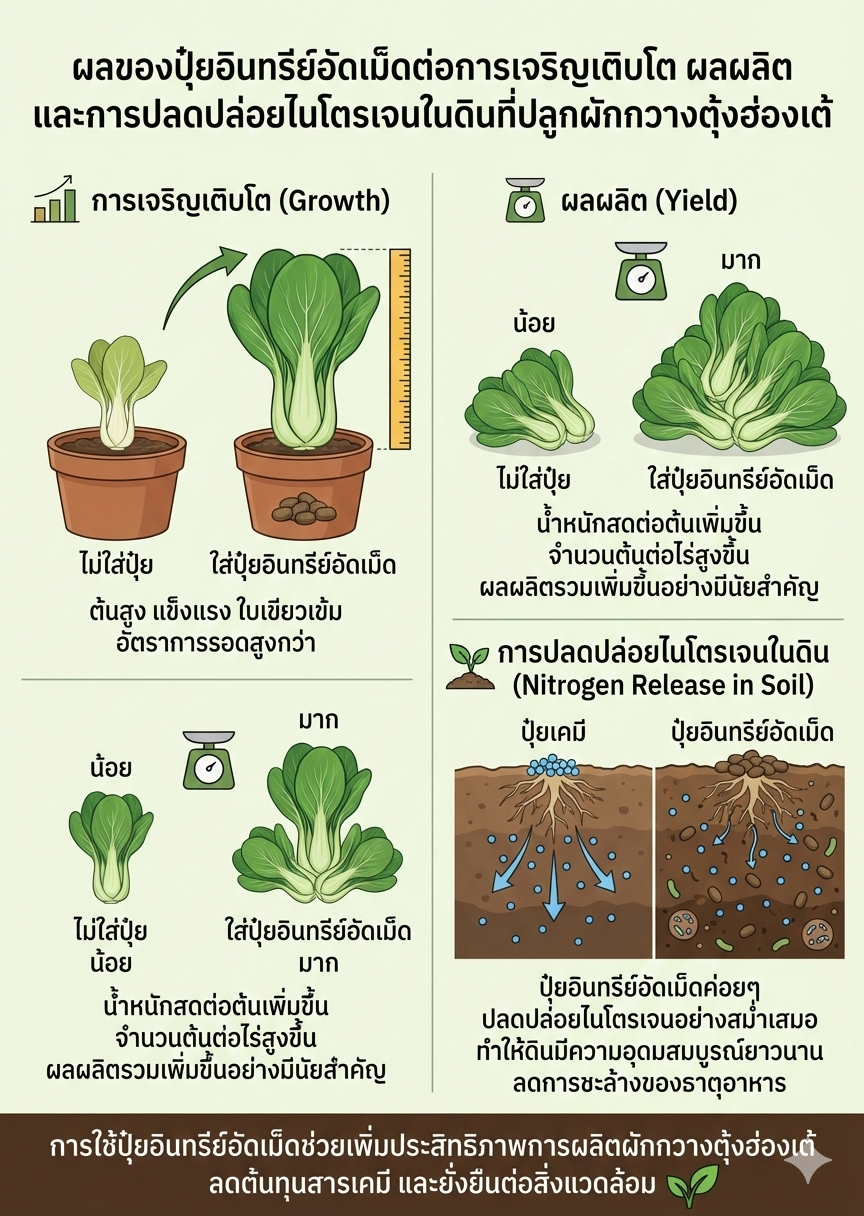
The objectives of this study were to evaluate the effectiveness of organic pelletized fertilizer on the growth and yield of Brassica chinensis var. chinensis (Chinese kale) over varying duration intervals, and to investigate the release of available nitrogen from the fertilizer to the plants. The experiment was designed using a completely randomized design (CRD) with four replications, incorporating six treatments: T1, a control treatment without fertilizer; and T2 to T6, which utilized organic pelletized fertilizer at application rates of 1,000, 2,000, 3,000, 4,000, and 5,000 kg/rai, respectively. Growth parameters and leaf greenness were recorded at 7-day intervals following transplanting, up to the harvest at 42 days after transplanting. Yield data were collected at harvest, and the amount of plant-available nitrogen was estimated based on the nitrogen uptake by Chinese kale. The experimental results indicated that the application of organic pelletized fertilizer at rates of 2,000 kg/rai significantly enhanced the growth of Chinese kale, as reflected in plant height, leaf width, leaf length, petiole length, and stem base circumference. The 2,000 kg/rai treatment yielded the highest fresh weights of plant stems and roots, recorded at 105.54 and 18.60 grams per plant, respectively. It also produced the highest dry weights of stems at 8.39 grams per plant. The rate of fertilizer application influenced the release of plant-available nitrogen, with the 2,000 kg/rai treatment showing the greatest nitrogen release beneficial to plant growth. This was evidenced by beneficial nitrogen levels of 714.52 and 768 milligrams per kilogram, corresponding with enhanced growth performance. Over the 42-day study period, soils treated with organic pelletized fertilizer demonstrated a nitrogen release rate of 6.36 mg/kg/day. Based on the findings of this study, the use of organic pelletized fertilizer could serve as a practical guideline for farmers selecting fertilizers for crops with extended growth duration. Due to their slow-release characteristics, organic pelletized fertilizer could provide a sustained nutrient supply, which was particularly advantageous for long-duration crops. This gradual nutrient release minimized the need for repeated fertilizer applications within a single growing season, thereby improving nutrient use efficiency and reducing labor inputs.
Downloads
Article Details

This work is licensed under a Creative Commons Attribution-NonCommercial-NoDerivatives 4.0 International License.
References
ณัฐพล ภูมิสะอาด, จักรมาส เลาหวณิช, เชิดพงษ์ เชี่ยวชาญวัฒนา, และพีระยศ แข็งขัน. (2565). โครงการการจัดการผลผลิตทางการเกษตรโดยใช้เครื่องอัดเม็ดปุ๋ยเพื่อการพัฒนาชุมชนเพื่อความมั่นคง มั่งคั่งและยั่งยืน. สำนักงานการวิจัยแห่งชาติ (วช.).
ธีรภัทร บุญสมวล, วัชรพงษ์ มหานิล, ทศพร อินเจริญ, สุภาวดี แหยมคง, ประภาศิริ ใจผ่อง, ปุณณดา ทะรังศรี, และจักรกฤช ศรีละออ. (2566). อัตราส่วนที่เหมาะสมในการผลิตปุ๋ยอินทรีย์อัดเม็ดจากของเสียทางการเกษตรร่วมกับมูลจิ้งหรีดต่อการเจริญเติบโตและผลผลิตของผักกาดหอมกรีนโอ๊ค. วารสารแก่นเกษตร, พิเศษ(1), 475-482. https://agkb.lib.ku.ac.th/agrisservice/search_detail/result/427070
วันเพ็ญ โลหะเจริญ, ศีลวัต พัฒโนดม, ปราณี เกียรติประทับใจ, วีรดา ธงงาม, อิทธิสุนทร นันทกิจ, โสระยา ร่วมรังสี, และจุฑามาส คุ้มชัย. (2557). ผลของการขาดธาตุอาหารต่อการเจริญเติบโตและความเข้มข้นของธาตุอาหารในใบพริกหวาน. วารสารเกษตร, 30(1), 39-48. https://li01.tci-thaijo.org/index.php/joacmu/article/view/245865
วีณา นิลวงศ์. (2561). ศึกษาการปลดปล่อยไนโตรเจนที่เป็นประโยชน์ต่อพืชในดินที่มีการใช้ปุ๋ยอินทรีย์ชนิดต่าง ๆ. วารสารเกษตรพระจอมเกล้า, 36(3), 178-188. https://li01.tci-thaijo.org/index.php/agritechjournal/article/view/159811
ศุภชัย อำคา, เฉลิมขวัญ มุกสิกทอง, และพรไพรินทร์ รุ่งเจริญทอง. (2557). ผลของสัดส่วนความเป็นประโยชน์ของแอมโมเนียมและไนเทรตในปุ๋ยเคมีเกรด 15-15-15 ต่ออัตราการเติบโตและสมบัติของดินบางประการในการปลูกคะน้า. แก่นเกษตร, 42(พิเศษ3), 899-905. https://ag2.kku.ac.th/kaj/PDF.cfm?filename=V_038.pdf&id=1695&keeptrack=4
สัญญา เล่ห์สิงห์ และอรประภา อนุกูลประเสริฐ. (2559). ประสิทธิภาพของปุ๋ยอินทรีย์คุณภาพสูงต่อการเจริญเติบโตและการให้ผลผลิตของคะน้า. วารสารวิทยาศาสตร์และเทคโนโลยี, 24(2), 320-332. https://li01.tci-thaijo.org/index.php/tstj/article/view/50462
สำนักงานนโยบายและแผนทรัพยากรธรรมชาติและสิ่งแวดล้อม. กลุ่มงานนโยบายและยุทธศาสตร์. (2567). การบูรณาการประเด็นด้านการเปลี่ยนแปลงสภาพภูมิอากาศในการจัดทำแผนพัฒนาจังหวัดมหาสารคาม. สำนักงาน. https://www.mahasarakham.go.th/new/files/com_news_stash/2024-07_89c8e3311ae0ce2.pdf
Cardarelli, M., El Chami, A., Iovieno, P., Rouphael, Y., Bonini, P., & Colla, G. (2023). Organic fertilizer sources distinctively modulate productivity, Quality, Mineral composition, and Soil enzyme activity of greenhouse lettuce grown in degraded soil. Agronomy, 13(1), 194. https://doi.org/10.3390/agronomy13010194
El-Nakhel, C., Cristofano, F., Colla, G., Pii, Y., Secomandi, E., De Gregorio, M., Buffagi, V., Garcia-Perez, P., Lucini, L., & Rouphael, Y. (2023). Vegetal-derived biostimulants distinctively command the physiological and metabolomic signatures of lettuce grown in depleted nitrogen conditions. Scientia Horticulturae, 317, 112057. https://doi.org/10.1016/j.scienta.2023.112057
Elsaggan, M. A. (2020). Effect of organic fertilizer rates and sulfur on growth and productivity of broad bean under south sinai conditions. Egyptian Journal of Desert Research, 70(2), 137-151. https://doi.org/10.21608/ejdr.2021.45366.1075
Fonge, B. A., Bechem, E. E., & Awo, E. M. (2016). Fertilizer rate on growth, yield, and nutrient concentration of leafy vegetables. International Journal of Vegetable Science, 22(3), 274-288. https://doi.org/10.1080/19315260.2015.1005726
Gelaye, Y. (2024). A Systematic Review on Effects of Nitrogen Fertilizer Levels on Cabbage (Brassica oleracea var. capitata L.) Production in Ethiopia. The Scientific World Journal, 6086730. https://doi.org/10.1155/2024/6086730
Gorliczay, E., Szöllősi, N., Kiss, N. Éva, Tóth, F., Tamás, J., & Nagy, P. T. (2021). Examination of the effect of pelleted poultry manure products on a sunflower test plant in a laboratory model experiment. Acta Agraria Debreceniensis, 1, 83-88. https://doi.org/10.34101/actaagrar/1/8477
Jung, D. H., Choi, S., & Lee, J. (2025). Changes in the growth, photosynthesis, and nitrogen allocation characteristics of hydroponically grown lettuce under different nitrate levels in a nutrient solution. Horticulture, Environment, and Biotechnology, 66, 163-172. https://doi.org/10.1007/s13580-024-00645-z
Kaleeem Abbasi, M., Mahmood Tahir, M., Sabir, N., & Khurshid, M. (2015) Impact of the addition of different plant residues on nitrogen mineralization–immobilization turnover and carbon content of a soil incubated under laboratory conditions, Solid Earth, 6, 197–205, https://doi.org/10.5194/se-6-197-2015
Kumar, P., Bhattacharya, A., Prajapati, S. K., Malik, A., & Vijay, V. K. (2022). Anaerobic co-digestion of waste microalgal biomass with cattle dung in a pilot-scale reactor: effect of seasonal variations and long-term stability assessment. Biomass Conversion and Biorefinery, 12, 1203-1215. https://doi.org/10.1007/s13399-020-00778-y
Lambers, H., Raven, J. A., Shaver, G. R., & Smith, S. E. (2008). Plant physiological ecology (2nd ed.). Springer.
Liu, Z., Hao, Z., Sha, Y., Huang, Y., Guo, W., Ke, L., Chen, F., Yuan, L., & Mi, G. (2022). High responsiveness of maize grain yield to nitrogen supply is explained by high ear growth rate and efficient ear nitrogen allocation. Field Crops Research, 286, 108610. https://doi.org/10.1016/j.fcr.2022.108610
Marschner, H. (2012). Marschner's mineral nutrition of higher plants (3rd ed.). Academic press.
Molla, A., Solomou, A. D., Fountouli, A., Chatzikirou, E., Stamatakis, E., Stamatakis, P., & Skoufogianni, E. (2024). Influence of an organic fertilizer on agronomic characteristics and herbaceous plant diversity in a greek ecosystem: The case of cretan dittany (Origanum dictamnus L.). Nitrogen, 5(2), 426-438. https://doi.org/10.3390/nitrogen5020027
Mthiyane, P., Aycan, M., & Mitsui, T. (2024). Integrating biofertilizers with organic fertilizers enhances photosynthetic efficiency and upregulates chlorophyll-related gene expression in rice. Sustainability, 16(21), 9297. https://doi.org/10.3390/su16219297
Nelson, P. V. (2015). Greenhouse operation and management (7th ed.). Pearson Education.
Niedziński, T., Sierra, M. J., Łabętowicz, J., Noras, K., Cabrales, C., & Millán, R. (2021). Release of nitrogen from granulate mineral and organic fertilizers and its effect on selected chemical parameters of soil. Agronomy, 11(10), 1981-1994. https://doi.org/10.3390/agronomy11101981
Pavlou, G. C., Ehaliotis, C. D., & Kavvadias, V. A. (2007). Effect of organic and inorganic fertilizers applied during successive crop seasons on growth and nitrate accumulation in lettuce. Scientia Horticulturae, 111(4), 319-325. https://doi.org/10.1016/j.scienta.2006.11.003
Qiu, X., Wang, Y., Hu, G., Wang, Q., Zhang, X., & Dong, Y. (2013). Effect of different fertilization modes on physiological characteristics, yield and quality of Chinese cabbage. Journal of plant nutrition, 36(6), 948-962. https://doi.org/10.1080/01904167.2012.759972
Sharaf-Eldin, M. A., Peregi, K. E., & Pap, Z. (2015). Effects of different organic fertilizers on seedlings growth and photosynthesis of Chinese cabbage (Brassica rapa ssp. pekinensis). In M. Pospišil (Ed.), 50th Croatian and 10th International Symposium on Agriculture (pp.286-290). Faculty of Agriculture, University of Zagreb. https://sa.agr.hr/publication/13/50.+hrvatski+i+10.+me%C4%91unarodni+simpozij+agronoma+eZbornik+radova.Full+text
Sharma, N. K., Singh, R. J., & Kumar, K. (2012). Dry matter accumulation and nutrient uptake by wheat (Triticum aestivum L.) under Poplar (Populus deltoides) based agroforestry system. International Scholarly Research Notices, 359673. https://doi.org/10.5402/2012/359673
Shrestha, K., Miyazaki, A., Yoshii, D., Sakata, M., & Moritsuka, N. (2024). Effect of localized fertilizer application on deep root development during early growth in upland rice under upland condition. Plant Production Science, 27(3), 240–252. https://doi.org/10.1080/1343943X.2024.2376296
South, D. B. (2019). Potassium fertilization in bareroot nurseries in the southern US: a review. REFORESTA, 8, 25-59. https://doi.org/10.21750/REFOR.8.03.73
Wang, H., Inukai, Y., & Yamauchi, A. (2006). Root development and nutrient uptake. Critical Reviews in Plant Sciences, 25(3), 279-301. https://doi.org/10.1080/07352680600709917
