แบบจำลองทางคณิตศาสตร์การอบแห้งสับปะรดด้วยระบบให้ความร้อนจากอุปกรณ์แลกเปลี่ยนความร้อนด้วยแก๊สหุงต้มกับตู้อบแห้งพลังงานแสงอาทิตย์
Article Sidebar
Main Article Content
บทคัดย่อ
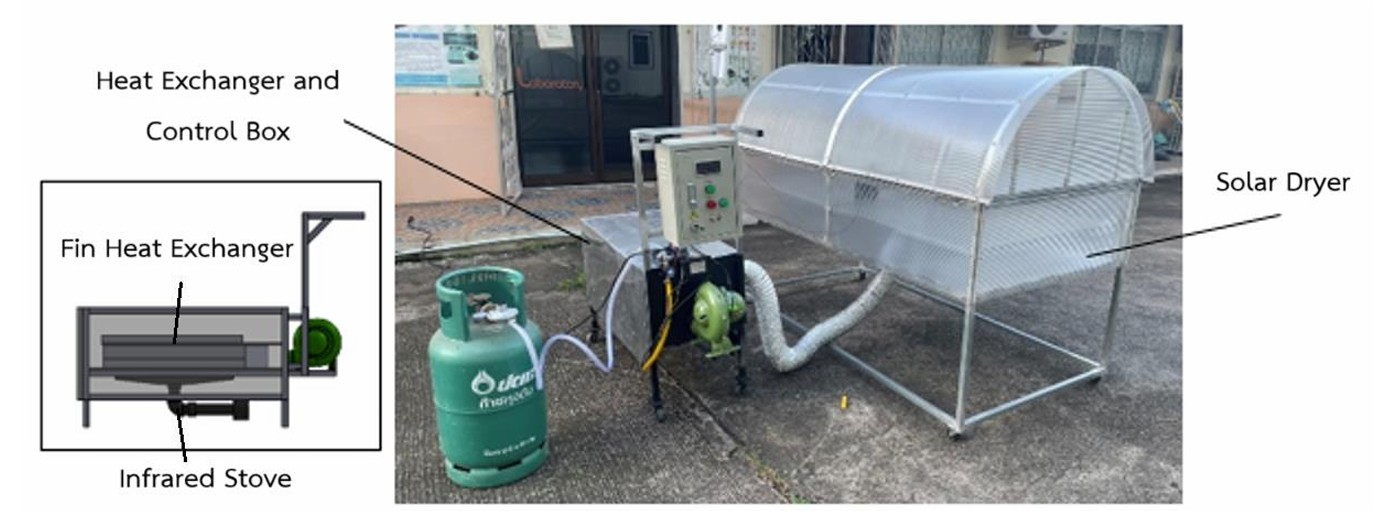
งานวิจัยนี้มีวัตถุประสงค์เพื่อศึกษาแบบจำลองทางคณิตศาสตร์ที่เหมาะสมสำหรับการอบแห้งสับปะรดด้วยระบบให้ความร้อนจากอุปกรณ์แลกเปลี่ยนความร้อนด้วยแก๊สหุงต้มร่วมกับตู้อบแห้งพลังงานแสงอาทิตย์ และศึกษาคุณสมบัติทางกายภาพของสับปะรดอบแห้งที่ได้จากการอบแห้งดังกล่าว แบบจำลองทางคณิตศาสตร์ใช้แบบจำลองเอมพิริคัลจำนวน 6 แบบจำลอง ทำการเปรียบเทียบอัตราส่วนความชื้น วิเคราะห์และเลือกแบบจำลองที่เหมาะสมที่สุด โดยใช้ค่าสัมประสิทธิ์การตัดสินใจ ค่าไคกำลังสอง และค่ารากที่สองของความคลาดเคลื่อนกำลังสองเฉลี่ยเป็นดัชนีชี้วัด สำหรับการวิเคราะห์คุณสมบัติทางกายภาพของสับปะรดอบแห้ง พบว่าสับปะรดแห้งที่ได้จากการอบด้วยระบบให้ความร้อนจากอุปกรณ์แลกเปลี่ยนความร้อนด้วยแก๊สหุงต้มร่วมกับตู้อบแห้งพลังงานแสงอาทิตย์มีคุณสมบัติดีกว่าสับปะรดแห้งที่ได้จากตู้อบแห้งพลังงานแสงอาทิตย์เพียงอย่างเดียว โดยการวัดสีแบบปริภูมิสีที่กำหนดโดยคณะกรรมการระหว่างประเทศว่าด้วยการส่องสว่าง พบว่าสีของสับปะรดอบแห้งด้วยอุปกรณ์แลกเปลี่ยนความร้อนด้วยแก๊สหุงต้มร่วมกับตู้อบแห้งพลังงานแสงอาทิตย์มีสีเหลืองสว่างกว่าสับปะรดที่ได้จากตู้อบแห้งพลังงานแสงอาทิตย์ และมีสีแดงคล้ำน้อยกว่า แต่ค่าการเปลี่ยนแปลงรวมของสีมีค่าใกล้เคียงกันที่ประมาณ 7.82 และการหดตัวของสับปะรดอบแห้งมีค่าร้อยละ 24.82±1.8 ซึ่งดีกว่าการอบแห้งด้วยตู้อบแห้งพลังงานแสงอาทิตย์
Article Details

อนุญาตภายใต้เงื่อนไข Creative Commons Attribution-NonCommercial-NoDerivatives 4.0 International License.
บทความที่ได้รับการตีพิมพ์ในวารสารฯ ท้ังในรูปแบบของรูปเล่มและอิเล็กทรอนิกส์เป็นลิขสิทธิ์ของวารสารฯ
เอกสารอ้างอิง
P. Maneewong, N. Narktim, and S. Maneewong, “Efficiency of Cost Management and Competitive Advantage of Pineapple Planter Groups in Prachuap Khiri Khan Province,” Journal of Humanities and Social Sciences Thonburi University, vol. 15, no.1, pp. 128-138, Jan. 2021.
N. Mahapaiboon, Strategy to Promote the Production and Marketing of Geographic Indicator Product for Export: A Case Study of Huay mum Pineapple, Nam pat, Uttaradit Province. Kasetthikarn Institute, Office of the Permanent Secretary for Ministry of Agriculture and Cooperatives, 2020.
I. Intaraprajob, S. Chanphong, K. Sukbua, and T. Srichan, “Innovative of processing of dried pineapple by the pineapple drying plant by using solar energy for farmers Sub-Sri Thong Subdistrict, Mueang District, Chaiyaphum Province,” Journal of Modern Learning Development, vol. 8, no. 12, pp. 453-475, Dec. 2023.
H. S. El-Mesery, A. I. El-Seesy, Z. Hu, and Y. Li, “Recent developments in solar drying technology of food and agricultural products: A review,” Renewable and Sustainable Energy Reviews, vol. 157, Apr. 2022.
N. Srisittipokakun, and K. Kirdsiri, “Drying pineapple using a mix mode solar dryer,” Advanced Materials Research, no. 979, pp. 11-15, Jun. 2014.
S Malakar, V. K. Arora, P. K. Nema, and D. K. Yadav, “Development of infrared-assisted hybrid solar dryer for drying pineapple slices: Investigation of drying characteristics, mass transfer parameters, and quality attributes,” Innovative Food Science & Emerging Technologies, vol. 88, Aug. 2023.
M. C. Gilago, and V. P. Chandramohan, “Study of drying parameters of pineapple and performance of indirect solar dryer supported with thermal energy storage: Comparing passive and active modes,” Journal of Energy Storage, vol. 61, May. 2023.
L. E. Daud, and I. N. Simate, “Drying kinetics of sliced pineapples in a solar conduction dryer,” Energy and Environment Research, vol. 7, no. 2, pp. 14-26, Sep. 2017.
L. C. Ignacio, L. C. I. Lorenzo, J. Serm, M. Busarakorn, N. Marcus, and M. Joachim, “Mathematical modelling of the thin layer drying of pineapple (Ananas comosus, L.): experiment at village scale in a greenhouse type solar dryer,” IngenIería InvestIgacIóny tecnología, vol. 20, no. 2, pp. 1-10, 2019.
A. Agrawal, and R.M. Sarviya, “A review of research and development work on solar dryers with heat storage,” Inter. J. Sustain. Energy, vol.35, pp. 583-605, Jun. 2016.
D. Evin, “Thin layer drying kinetics of Gundelia tournefortii,” L. Food and Bioproducts Processing, vol. 90, no.2, pp. 323-332. Apr. 2012.
M. Younis, D. Abdelkarim, and A.Z. El-Abdein, “Kinetics and mathematical modeling of infrared thinlayer drying of garlic slices,” Saudi Journal of Biological Sciences, vol. 25, pp. 332-338, Feb. 2018.
A. A. Faruq, M. Zhang, and D. Fan, “Modeling the Dehydration and Analysis of Dielectric Properties of Ultrasound and Microwave Combined Vacuum Frying Apple Slices,” Drying Technology, vol. 37, no. 3, pp. 409-423, May. 2018.
P. Rani, and P. P. Tripathy, “Investigating shrinkage corrected drying characteristics, rehydration, color profile and microstructural evolution during solar drying of pineapple slices,” Journal of Food Process Engineering, vol. 45, no. 8, pp. 1-13, Aug. 2022.
M. C. Gilago, V. R. Mugi, and C. VP, “Evaluating the performance of an indirect solar dryer and drying parameters of pineapple: comparing natural and forced convection,” Journal of Thermal Analysis and Calorimetry, vol. 148, no. 9, pp. 3701-3709, Jan. 2023.
P. Thanompongchart, P. Pintana, and N. Tippayawong, “Improving Solar Dryer Performance with Automatic Control of Auxiliary Heated Air,” Energy Reports, vol. 9, no. 12, pp. 109-113, Nov. 2023.
S. Weisberg, Applied linear regression, 4th ed, John Wiley & Sons, Cannada, 2014.
P. Malaikritsanachalee, W. Choosri, and T. Choosri, “Study on kinetics of flow characteristics in hot air drying of pineapple,” Food science and biotechnology, vol. 27, pp. 1047-1055, Mar. 2018.
