
THE EFFECTS OF SELF-MANAGEMENT SUPPORT VIA TELEHEALTH ON FOOD CONSUMPTION BEHAVIOR, IRON SUPPLEMENT ADHERENCE, AND HEMATOCRIT LEVEL IN PREGNANCIES WHO RECEIVE SERVICES IN CHIANG DAO HOSPITAL
Article Sidebar
Main Article Content
Abstract
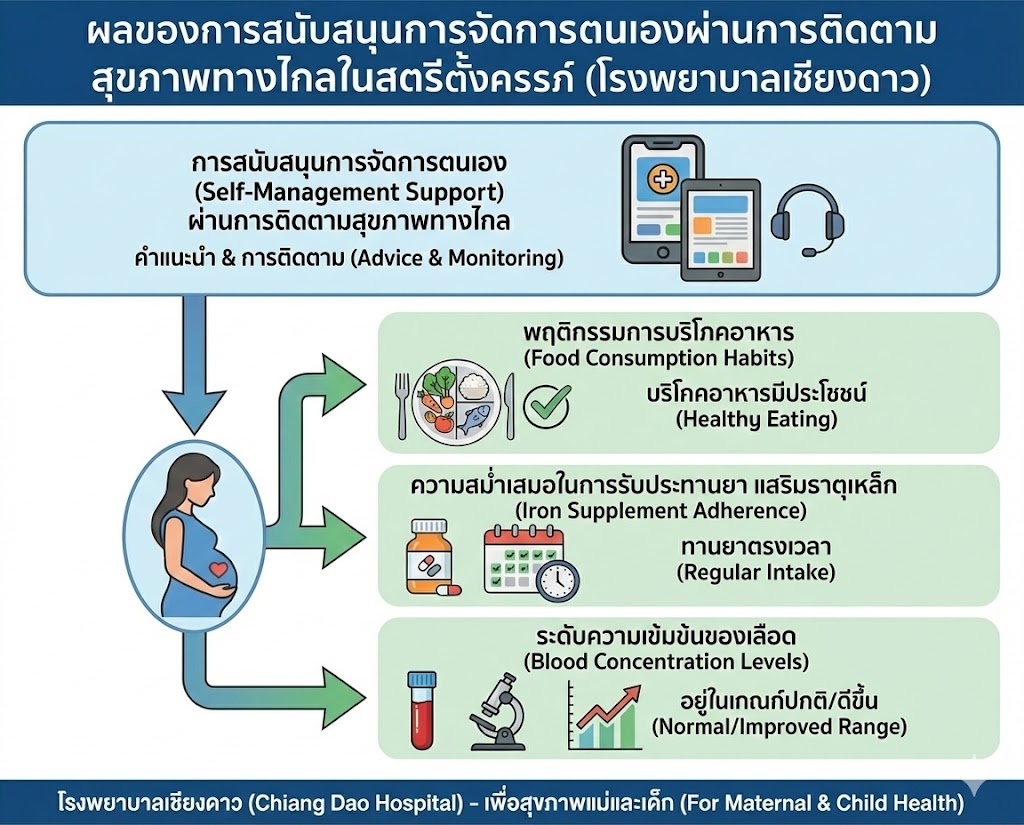
The objectives of this study were to investigate the incidences of anemia during pregnancy and to compare food consumption behavior, iron supplement adherence, and hematocrit levels before and after the intervention. This research was a quasi-experimental one-group study adopting a pretest–posttest design. The participants were 15 pregnant women attending antenatal care at Chiang Dao Hospital who had hematocrit levels of ≥33% and a gestational age (GA) of <16 weeks. Participants were selected using simple random sampling and were followed for a period of 20 weeks. Data were analyzed with computer programs using descriptive statistics, the Wilcoxon signed-rank test, and Paired t – test. The results showed that anemia occurred in 13.33% of the pregnancies during the study period (95% CI = 1.7– 40.5). The median scores of food consumption behavior at weeks 12 and 20 were significantly higher than before the intervention (Z = 3.420, p = .001) for both points in time. The median scores Iron supplement adherence increased progressively after the intervention, with significant differences observed at weeks 4, 12, 16, and 20 (Z = 2.014, p = .044; Z = 2.014, p = .044; Z = 2.060, p = .039; and Z = 2.060, p= .039, respectively). Although an improvement was observed at week 8, it was not statistically significant (p > .05). Furthermore, the mean scores of hematocrit levels showed no statistically significant difference (t = 1.11, p = .282). It was suggested that self-management support through telehealth could enhance pregnant women’s self-care capacity and serve as an alternative approach for anemia prevention during pregnancy.
Downloads
Article Details

This work is licensed under a Creative Commons Attribution-NonCommercial-NoDerivatives 4.0 International License.
References
กรมอนามัย. (2564). การป้องกันภาวะโลหิตจางจากการขาดธาตุเหล็ก [Video]. Facebook. ศูนย์อนามัยที่ 5 ราชบุรี. https://www.facebook.com/anamai5ratchaburi/videos/878091879766103/?extid=CL-UNK-UNK-UNK-IOS_GK0T-GK1C&ref=sharing
กรมอนามัย. (2565). ป้องกันภาวะโลหิตจาง [Video]. YouTube. ศูนย์อนามัยที่ 8 อุดรธานี. https://www.youtube.com/watch?v=rngsemOAmGA
กรมอนามัย. (2566). คู่มือแนวทางควบคุมและป้องกันภาวะโลหิตจาง. กรม. https://nutrition2.anamai.moph.go.th/th/book/download/?did=213240&id=104798&reloa
กระทรวงสาธารณสุข. (2566). ระบบสารสนเทศสนับสนุนงานส่งเสริมสุขภาพและอนามัยสิ่งแวดล้อม (DOH DASHBOARD) ภาวะโลหิตจางในหญิงตั้งครรภ์ ระดับเขตสุขภาพ. กองแผนงาน กรมอนามัย. https://dashboard.anamai.moph.go.th/dashboard/anemia/index?year=2023
โรงพยาบาลรามาธิบดี. คณะแพทย์ศาสตร์. (2560). เสริมธาตุเหล็ก บำรุงโลหิต ใช้อย่างไรให้พอเหมาะ [Video]. YouTube. https://www.youtube.com/watch?v=UyrY1RHe5ko
จิตตระการ ศุกร์ดี และภูษิตา ครุธดิลกานนท์. (2563). บทบาทพยาบาลในการดูแลสตรีตั้งครรภ์วัยรุ่นที่มีภาวะโลหิตจางจากการขาดธาตุเหล็ก. วารสารการพยาบาลและสุขภาพ, 14(2), 1–11. https://he01.tci-thaijo.org/index.php/NurseNu/article/view/241779
จรินทร์ทิพย์ สมประเสริฐ และจีรพรรณ โพธิ์สุวัฒนากุล. (2565). ภาวะโลหิตจางจากการขาดธาตุเหล็ก. พี.เอ.ลิฟวิ่ง.
ประภาภรณ์ เพชรมาก และวิชุดา ศรีวรสาร. (2566). ประสิทธิผลของโปรแกรมการสอนโรงเรียนพ่อแม่จิตประภัสสรตั้งแต่นอนอยู่ในครรภ์ผ่านสื่อสังคมออนไลน์ในหญิงตั้งครรภ์แรก โรงพยาบาลสมเด็จพระยุพราชเดชอุดม. วารสารสาธารณสุขและสุขภาพศึกษา, 3(3), 1-14. https://he02.tci-thaijo.org/index.php/tjphe/article/view/263603
ปรีดี นุกุลสมปรารถนา. (2564). จำนวน Sample Size ที่เหมาะกับการทำ Research. Popticles. https://www.popticles.com/marketing/research-sample-size/
พันธุ์ทิพย์ ภักดีพัฒนาทร และประยูร ภักดีพัฒนาทร. (2567). ผลของโปรแกรมการให้ความรู้ต่อความรู้และพฤติกรรมการดูแลตนเองของหญิงตั้งครรภ์เพื่อลดภาวะโลหิตจางจากการขาดธาตุเหล็ก. วารสารอนามัยสิ่งแวดล้อมและสุขภาพชุมชน, 9(4), 459–470. https://he03.tci-thaijo.org/index.php/ech/article/view/3075
มุก อิงคประเสริฐ และสมสกูล นีละสมิต. (2567). ผลของโปรแกรมการให้ความรู้เรื่องภาวะโลหิตจางร่วมกับการสนับสนุนจากครอบครัวแบบออนไลน์ต่อการรับรู้เกี่ยวกับภาวะโลหิตจาง พฤติกรรมการรับประทานอาหารและยาเสริมธาตุเหล็กของสตรีตั้งครรภ์วัยรุ่นในโรงพยาบาลชุมชน. วารสารการพยาบาลสุขภาพและการศึกษา, 7(2), 42-54. https://he02.tci-thaijo.org/index.php/NHEJ/article/view/270226
โรงพยาบาลเชียงดาว. (2568). รายงานภาวะโลหิตจางในหญิงตั้งครรภ์ ปี พ.ศ. 2565–2567 [รายงาน]. โรงพยาบาล.
ศรัณยา ลาโมะ, สุนันทา ยังวนิชเศรษฐ, และเบญญาภา ธิติมาพงษ์. (2564). ผลของโปรแกรมการส่งเสริมโภชนาการต่อพฤติกรรมการบริโภคอาหารและยาเสริมธาตุเหล็กในหญิงตั้งครรภ์วัยรุ่นที่มีภาวะโลหิตจาง. วารสารพยาบาลกระทรวงสาธารณสุข, 31(1), 224-236. https://he02.tci-thaijo.org/index.php/tnaph/article/view/250710
สาริศา สืบจากดี และรุจิพัชญ์ เพ็ชร์สินเดชากุล. (2567). ผลของโปรแกรมการส่งเสริมความรอบรู้ด้านสุขภาพการดูแลตนเองของหญิงตั้งครรภ์ที่มีภาวะโลหิตจางจากการขาดธาตุเหล็กที่มาฝากครรภ์ โรงพยาบาลส่งเสริมสุขภาพ ศูนย์อนามัยที่ 3. วารสารศูนย์อนามัยที่ 10, 12(2), 88-103. https://he03.tci-thaijo.org/index.php/HPC10Journal/article/view/3262
สุรางรัตน์ โฆษิตธนสาร, วิไลลักษณ์ ปิยะวัฒนพงษ์, นงลักษณ์ แสนกิตะ, และอภัสรา มาประจักษ์. (2564). ประสิทธิผลของโปรแกรมการสอนโรงเรียนพ่อแม่ผ่านสื่อสังคมออนไลน์ในหญิงตั้งครรภ์แรก โรงพยาบาลส่งเสริมสุขภาพ ศูนย์อนามัยที่ 7 ขอนแก่น. วารสารศูนย์อนามัยที่ 7 ขอนแก่น, 13(1), 74-87. https://he01.tci-thaijo.org/index.php/johpc7/article/view/251280
Alam, M., Banwell, C., & Lokuge, K. (2020). The effect of women’s differential access to messages on their adoption of mobile health services and pregnancy behavior in Bangladesh: Retrospective cross-sectional study. JMIR mHealth and uHealth, 8(7), e17665. https://doi.org/10.2196/17665
American College of Obstetricians and Gynecologists. (2021). Anemia in pregnancy: ACOG Practice bulletin, number 233. Obstetrics and Gynecology, 138(2), e55–e64. https://doi.org/10.1097/AOG.0000000000004477
Atkinson, J., Hastie, R., Walker, S., Lindquist, A., & Tong, S. (2023). Telehealth in antenatal care: recent insights and advances. BMC Med, 21, 332. https://doi.org/10.1186/s12916-023-03042-y
Bernard, R. (2000). Fundamentals of biostatistics (5th ed.). Thomson learning.
Brunken, G. S., De França, G. V. A., Luiz, R. R., & Szarfarc, S. C. (2016). Agreement assessment between hemoglobin and hematocrit to detect anemia prevalence in children less than 5 years old. Cadernos Saúde Coletiva, 24(1), 118-123. https://doi.org/10.1590/1414-462X201600010x01
Cohen, J. (1988). Statistical power analysis for the behavioral sciences (2nd ed.). Lawrence Erlbaum Associates.
Insiripong, S., Supattarobol, T., & Jetsrisuparb, A. (2013). Comparison of hematocrit/hemoglobin ratios in subjects with alpha-thalassemia, with subjects having chronic kidney disease and normal subjects. The Southeast Asian journal of tropical medicine and public health, 44(4), 707–711.
Kanfer, F. H., & Gaelick-Buys, L. (1991). Self-management methods. In F. H. Kanfer & A. P. Goldstein (Eds.), Helping people change: A textbook of methods (4th ed., pp.305–360). Pergamon Press.
Knop, M. R., Nagashima-Hayashi, M., Lin, R., Saing C. H., Ung, M., Oy, S., Yan, E. L. Y., Zahari, M., & Yi, S. (2024). Impact of mHealth interventions on maternal, newborn, and child health from conception to 24 months postpartum in low- and middle-income countries: A systematic review. BMC Medicine, 22, 196. https://doi.org/10.1186/s12916-024-03417-9
Kim, H., & Park, E. (2023). Effectiveness of telehealth-based interventions on maternal health outcomes during pregnancy: A systematic review. Journal of Telemedicine and Telecare, 29(3), 120–133.
Mangkalard, P., Ruekngarm, L., & Ponta, S. (2022). Effects of nutrition counselling on iron deficiency anemia in pregnancy. Life Sciences, Medicine and Biomedicine, 6(1). https://doi.org/10.28916/lsmb.6.1.2022.104
Mishra, M., Parida, D., Murmu, J., Singh, D., Rehman, T., Kshatri, J. S., & Pati, S. (2023). Effectiveness of mHealth interventions for monitoring antenatal care among pregnant women in low- and middle-income countries: A systematic review and meta-analysis. Healthcare, 11(19), 2635. https://doi.org/10.3390/healthcare11192635
Ngamjarus, C., & Chongsuvivatwong, V. (2014). n4Studies: Sample size and power calculations for android. The Royal Golden Jubilee Ph.D. Program, The Thailand Research Fund & Prince of Songkla University.
Rahman, M. O., Yamaji, N., Nagamatsu, Y., & Ota, E. (2022). Effects of mHealth interventions on improving antenatal care visits and skilled delivery care in low-and middle-income countries: Systematic review and meta-analysis. J Med Internet Res, 24(4), e34061.
Srisai, R., Thinkhamrop, J., Chaiyarach, S., & Kreetiyutanont, S. (2021). Compliance of iron supplementation during pregnancy. Srinagarind Medical Journal, 36(5), 527-533. https://thaidj.org/index.php/smnj/article/view/10990
Verma, P., & Roy, A. (2024). Iron deficiency anemia (IDA) in pregnancy: Prevalence and management. An International Journal of Research in AYUSH and Allied Systems, 11(3), 257-261. https://doi.org/10.47070/ayushdhara.v11i3.1614
World Health Organization. (2017). Nutritional anaemias: Tools for effective prevention and control. https://www.who.int/publications/i/item/9789241513067
World Health Organization. (2022). Consolidated telemedicine implementation guide. https://www.who.int/publications/i/item/9789240059184
World Health Organization. (2023). WHO guidance for the prevention and treatment of anaemia in pregnancy. WHO.
World Health Organization. (2025). Anaemia. https://www.who.int/news-room/fact-sheets/detail/anaemia
