
QUALITY AND MANAGEMENT OF DRINKING WATER IN RURAL SCHOOLS: A CASE STUDY OF HEALTH REGION 4
Article Sidebar
Main Article Content
Abstract
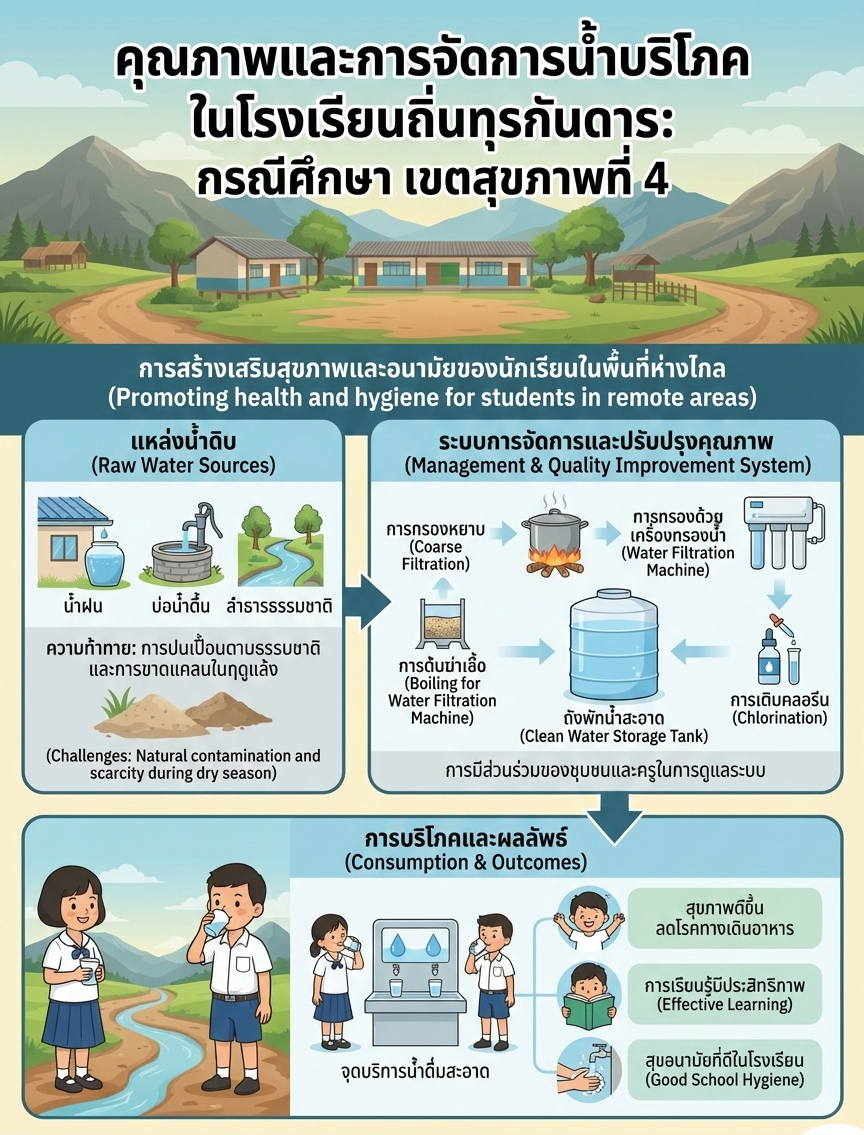
The objectives of this study were to investigate the management of drinking water and analyze its physical, chemical, and biological quality from 35 rural schools chosen by purposive selection in Health Region 4, including Ayutthaya, Pathum Thani, and Nakhon Nayok provinces. Primary survey data was collected by a school water management questionnaire and drinking water sample collection for quality analysis following standard methods; secondary data was gathered by compiling the comparative previous five years of water quality analysis results. Variable relationships were analyzed by t-test and logistic regression. Drinking water management analysis indicated that rural schools used the groundwater supply (51.4%), Provincial Waterworks Authority plumbing (40%), surface water (2.9%), and 20-liter bottled water (5.7%), mainly filtered. Between 2018 and 2023, the percentage of schools meeting physical, chemical, and biological water quality standards rose from 54.3% to 77.1%. Compliance with toxic heavy metals standards was highest at 100%, followed by general chemical parameters at 95.2%, physical parameters at 94.8%, heavy metals at 91.0%, and biological parameters at 73.8%. A significant association was found between biological water quality and the presence of algae in dispensers/taps and insufficient funding for water quality management (p < .050). Eighteen schools (51.42%) lacked a water management budget. After the Coronavirus disease 2019 (COVID-19) pandemic began, a significant reduction in total coliform bacteria was observed in drinking water (p < .001). These findings suggested that water dispensers should be cleaned regularly and related agencies must fund access to safe drinking water. Such measures would promote students’ health through the consumption of clean water and reduce the incidence of illnesses associated with waterborne and foodborne diseases.
Downloads
Article Details

This work is licensed under a Creative Commons Attribution-NonCommercial-NoDerivatives 4.0 International License.
References
กรมควบคุมโรค. (2563). กรมควบคุมโรค แนะประชาชนช่วงวันหยุดเข้าพรรษานี้ ยึดหลัก “สุก ร้อน สะอาด” ป้องกันโรคติดต่อทางอาหารและน้ำ. กรม. https://shorturl.asia/2o6RF
กรมอนามัย. (2563). สรุปสถานการณ์คุณภาพน้ำอุปโภค - บริโภคของโรงเรียนในถิ่นทุรกันดาร (กพด.) ปีงบประมาณ 2563. กรม. https://foodsan.anamai.moph.go.th/th/royal-projects-4/download?id=109810&mid=38437&mkey=m_document&lang=th&did=32804
กรมอนามัย. (2564). สรุปการประชุมถอดบทเรียนการดำเนินงานพัฒนาคุณภาพน้ำบริโภค ประจำปีงบประมาณ 2564. กรม. https://foodsan.anamai.moph.go.th/th/royal-projects-4/download?id=99089&mid=37685&mkey=m_document&lang=th&did=30376
กรมอนามัย. (2565). พื้นที่ข้อมูลฟลูออไรด์ในแหล่งน้ำบาดาล. กรม. https://lookerstudio.google.com/reporting/862539a0-5f5d-4ad6-87de-0d3e445db6c2/page/U3FsD
ชัญญานุช เวียงแก้ว, พรเพชร ศักดิ์ศิริชัยศิลป์, และเอมอร ขันมี. (2564). การศึกษาการจัดการคุณภาพน้ำบริโภคของโรงเรียนตำรวจตระเวนชายแดน. https://cordpcenter.anamai.moph.go.th/download-file/258
พรเพชร ศักดิ์ศิริชัยศิลป์ และชัญญานุช เวียงแก้ว. (2565). การศึกษาการจัดการน้ำ สุขาภิบาล และสุขอนามัยของโรงเรียนในถิ่นทุรกันดาร. การประชุมวิชาการส่งเสริมสุขภาพและอนามัยสิ่งแวดล้อมแห่งชาติ ครั้งที่15. ก้าวผ่านโควิด ส่งเสริมการใช้ชีวิตสุขภาพดี (น.190). กรมอนามัย.
ภารดี อาสา, รจฤดี โชติกาวินทร์, โกวิท สุวรรณหงส์, และมนัสนันท์ พิบาลวงค์. (2564). สถานการณ์คุณภาพน้ำดื่มในโรงเรียนประถมศึกษา จังหวัดชลบุรี. วารสารวิจัย มข. (ฉบับบัณฑิตศึกษา), 21(4), 222-232.
รชยา กุลดารมย์ และมาศ ไม้ประเสริฐ. (2563). คุณภาพน้ำดื่มในโรงเรียนประถมศึกษาในเขตลาดกระบัง คลองสามวา และเขตหนองจอก กรุงเทพมหานคร. วารสารสุทธิปริทัศน์, 34(111), 126-134. https://so05.tci-thaijo.org/index.php/DPUSuthiparithatJournal/article/view/247203
ศิริกัญญา ธานีพูน, สรรพวัต ทองใบ, ศิริวรรณ วัฒนภักดี, ธารินี ลีละทีป, ขวัญฤทัย โสมสัย, ต่อศักดิ์ ดาบโสมศ, และเหลืองแก้ว โกยทรัพย์. (2567). คุณภาพน้ำดื่มทางกายภาพและจุลินทรีย์จากตู้กดน้ำดื่มของโรงเรียนในพื้นที่ตำบลบางทราย และวิทยาลัยการสาธารณสุขสิรินธร จังหวัดชลบุรี. วารสารวิทยาศาสตร์ คชสาส์น, 46(1), 13-19. https://doi.org/10.14456/kcsj.2024.3
สำนักงานสาธารณสุขจังหวัดพระนครศรีอยุธยา. (2561). ผลการตรวจวิเคราะห์ปริมาณฟลูออไรด์ในน้ำ จังหวัดอยุธยา ปี พ.ศ. 2561. สำนักงาน.
เสถียร ฉันทะ, สำราญ เชื้อเมืองพาน, อรุณี อินเทพ, และจันทร์จิรา ขันเสริฐ. (2567). สถานะการพัฒนาที่ยั่งยืนเป้าหมายที่ 6: การจัดการน้ำและสุขาภิบาลของประเทศไทย พ.ศ.2559-2565. วารสารวิชาการ มหาวิทยาลัยราชภัฏอุตรดิตถ์, 19(2), 13-27. https://ph01.tci-thaijo.org/index.php/uruj/article/view/255743
Chilaule, S. M., Macuacua, X. V., Mabica, A. P., Miranda, N. A., Pereira, H. d. S., Gudo, E. S., Marrufo, T., García-López, S., & Lopes, M. (2024). Natural disasters’ impact on water quality and public health: A case study of the cyclonic season (2019–2023). Pollutants, 4(2), 212-230. https://doi.org/10.3390/pollutants4020014
Desye, B. (2021). COVID-19 Pandemic and water, sanitation, and hygiene: Impacts, challenges, and mitigation mitigation strategies. Environmental Health Insights, 15. https://doi.org/10.1177/11786302211029447
Hach. (2025). DR900 Multiparameter portable colorimeter. https://ca.hach.com/dr900-multiparameter-portable-colorimeter/product-downloads?id=15684103253
JMP. (2021). JMP Methodology for wash in schools. https://washdata.org/reports/jmp-2021-methodology-wash-in-schools
Poague, K. I. H. M., Blanford, J. I., & Anthonj, C. (2022). Water, sanitation and hygiene in schools in low- and middle-income countries: A systematic review and implications for the COVID-19 pandemic. International Journal of Environmental Research and Public Health, 19(5), 3124. https://doi.org/10.3390/ijerph19053124
Poague, K. I. H. M., Blanford, J. I., Martínez, J. A., & Anthonj, C. (2023). Water, sanitation and hygiene (WASH) in schools in Brazil pre-and peri-COVID-19 pandemic: Are schools making any progress?. International Journal of Hygiene and Environmental Health, 247, 114069. https://doi.org/10.1016/j.ijheh.2022.114069
Rice, E. W., Baird, R. B, & Eaton, A. D. (Eds.). (2017). Standard methods for the examination of water and wastewater (23rd ed.). American Public Health Association, American Water Works Association, Water Environment Federation.
Tang, C.-S., Paleologos, E. K., Vitone, C., Du, Y.-D., Li, J.-S., Jiang, N.-J., Deng, Y.-F., Chu, J., Shen, Z., Koda, E., Andrea, D., Fei, X., Vaverková, M. D., Osiński, P., Chen, X., Asadi, A., Takeuchi, M. R. H., Bo, M. W., Abuel-Naga, H., … Singh, D. N. (2021). Environmental geotechnics: Challenges and opportunities in the post-Covid-19 wold. Environmental Geotechnics, 8(3), 172-192. https://doi.org/10.1680/jenge.20.00054
World Health Organization. (2018). WHO water, sanitation and hygiene strategy 2018–2025 (WHO/CED/PHE/WSH/18.03). WHO. https://iris.who.int/handle/10665/274273
World Health Organization. (2020). Water, sanitation, hygiene, and waste management for SARS-CoV-2, the virus that causes COVID-19: Interim guidance (WHO/2019-nCoV/IPC_WASH/2020.4). WHO. https://www.who.int/publications/i/item/WHO-2019-nCoV-IPC-WASH-2020.4
World Health Organization. (2025). Water services: basic and safely managed drinking water services. WHO. https://www.who.int/data/gho/data/indicators/indicator-details/GHO/population-using-at-least-basic-drinking-water-services-(-)
World Health Organization & United Nations Children’s Fund. (2022). Progress on drinking-water, sanitation and hygiene in schools: 2000-2021 data update. WHO/UNICEF. https://apps.who.int/iris/handle/10665/360841
