
DEVELOPMENT OF A SUSTAINABLE WATER UTILIZATION AND MANAGEMENT MODEL FOR SUSTAINABLE AGRICULTURE: A CASE STUDY OF BAN NONG BUA COMMUNITY, CHOENG DOI SUBDISTRICT, DOI SAKET DISTRICT, CHIANG MAI PROVINCE
Article Sidebar
Main Article Content
Abstract
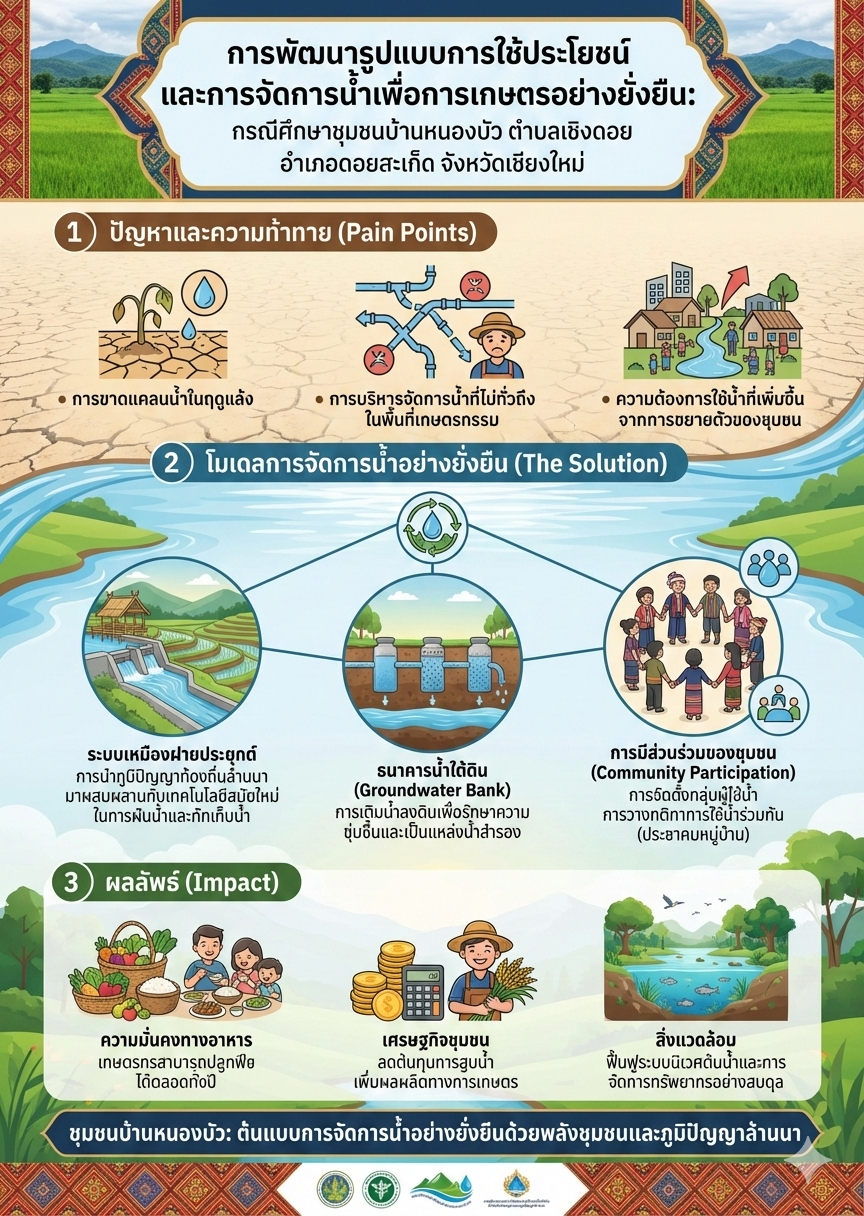
The objectives of this study were to analyze the current utilization and management of water resources for agriculture in Ban Nong Bua Community, Choeng Doi Subdistrict, Doi Saket District, Chiang Mai Province, and to develop a sustainable model for agricultural water utilization and management. A Participatory Action Research (PAR) approach was employed. The key informants consisted of community leaders, village committee members, subdistrict heads, village heads, representatives from government and private organizations, and local residents-a total of 25 participants. Data were collected through document analysis, in-depth interviews, focus group discussions, and field observations, and were analyzed using content analysis and descriptive presentation. The results revealed that Ban Nong Bua Community relied mainly on rainfall for cultivation, with limited secondary water sources such as Mueang Fai irrigation canals, streams, and groundwater wells, which would often dry up during the dry season, causing disruptions in farming activities. The community lacked a systematic and transparent water allocation mechanism, resulting in unequal access and occasional conflicts among farmer groups. Nevertheless, local wisdom-such as traditional Mueang Fai systems, the construction of bamboo check dams, and household-level water sharing-remained a vital social and cultural asset. Furthermore, results from the present study developed a Sustainable Agricultural Water Management Model integrating local wisdom with appropriate technology, consisting of three main components: 1) participatory community-based water management through the establishment of a community water management committee representing all sectors; 2) integration of local wisdom with modern technology, such as real-time water-level sensors, automatic water control systems, and supplementary reservoirs for drought periods; and 3) capacity building and promotion of responsible water use through training, knowledge sharing, and transparent water-use recording. The findings revealed three key impacts: 1) community impact; the community established a transparent and equitable participatory water management system that reduced conflicts; 2) policy impact; the developed model served as a prototype for local administrative organizations and aligns with the Sustainable Development Goals (SDG 6 and SDG 13); and 3) knowledge impact; new insights were generated on integrating indigenous wisdom with technological innovation for sustainable water resource management.
Downloads
Article Details

This work is licensed under a Creative Commons Attribution-NonCommercial-NoDerivatives 4.0 International License.
References
กรรณิการ์ ธรรมพานิชวงค์, กฤษฎีเลิศ สัมพันธารักษ์, และสวิสา พงษ์เพ็ชร. (2567). การเปลี่ยนแปลงสภาพภูมิอากาศกับเศรษฐกิจ: ตอนที่ 1 สถานการณ์และผลกระทบของการเปลี่ยนแปลงสภาพภูมิอากาศ. สถาบันวิจัยเศรษฐกิจป๋วย อึ๊งภากรณ์. https://www.pier.or.th/pierspectives/002/#ref-Nipon2015
ความเสี่ยงภัยแล้งและน้ำท่วม ปี 2567: ผลกระทบต่อภาคเกษตรและอุตสาหกรรมเกี่ยวเนื่อง. (2567). วิจัยกรุงศรี. https://www.krungsri.com/th/research/research-intelligence/drought-2024
จิณณวัฒน์ รัตนโยธาสกุล และจักรวาล สุขไมตรี. (2568). การจัดการทรัพยากรน้ำของท้องถิ่นไทย. วารสารส่งเสริมและพัฒนาวิชาการสมัยใหม่, 3(2), 17-31. https://so12.tci-thaijo.org/index.php/MADPIADP/article/view/1923
ฐิติวัฒน์ ว่องวรรณกุล. (2567). การบริหารจัดการน้ำของชุมชนเพื่อการเกษตรโดยภูมิปัญญาล้านนา. Journal of Roi Kaensarn Academi, 9(8), 383–398. https://so02.tci-thaijo.org/index.php/JRKSA/article/view/270743
ดลฤดี จันทร์แก้ว และวิรินดา สุทธิพรม. (2559). ปัจจัยที่มีอิทธิพลต่อการใช้องค์ความรู้และภูมิปัญญาท้องถิ่นด้านเกษตรกรรม เพื่อสร้างความเข้มแข็งทางเศรษฐกิจชุมชนในภาคตะวันออกเฉียงเหนือตอนล่างของประเทศไทย. วารสารการพัฒนาชุมชนและคุณภาพชีวิต, 4(2), 188–199. https://so02.tci-thaijo.org/index.php/JCDLQ/article/view/129619
เทวิน สมยาเย็น, บุญเลิศ วงค์โพธิ์, วินัย วีระวัฒนานนท์, และธัศษณพัฒน์ ปานพรม. (2566). การสร้างและพัฒนาฝายมีชีวิตด้วยกระบวนการมีส่วนร่วมของภาคประชาสังคม. วารสารวิทยาลัยนครราชสีมา สาขามนุษยศาสตร์และสังคมศาสตร์, 17(3), 19–33. https://so03.tci-thaijo.org/index.php/hsjournalnmc/article/view/268903
นฤพจน์ พุธวัฒนะ. (2561). ภูมิปัญญาท้องถิ่นกับการศึกษาและเรียนรู้วิทยาศาสตร์. วารสารหน่วยวิจัยวิทยาศาสตร์ เทคโนโลยี และสิ่งแวดล้อมเพื่อการเรียนรู้ (JSTEL), 9(2), 352-369. https://ejournals.swu.ac.th/index.php/JSTEL/article/view/11093
นิติภา วรพันธ์ตระกูล, ชัชวาลย์ เผ่าเพ็ง, และสายรัก ไชยลังกา. (2565). อิทธิพลของข้อมูลสภาพอากาศและนโยบายต่อการตัดสินใจปลูกพืชทางเลือกและช่องทางการรับรู้ข้อมูลของเกษตรกรในพื้นที่เสี่ยงภัยแล้ง จังหวัดอุทัยธานี. วารสารเกษตรพระจอมเกล้า, 40(2), 125- 133. https://li01.tci-thaijo.org/index.php/agritechjournal/article/view/252675
ปกิตน์ สันตินิยม. (2564). การบริหารจัดการน้ำตามหลักธรรมาภิบาล. วารสารมหาจุฬานาครทรรศน์, 8(1), 20–32. https://so03.tci-thaijo.org/index.php/JMND/article/view/249610
ปิยนาถ อิ่มดี. (2567). วาทกรรมที่ทำให้เกษตรกรต้องปรับตัวภายใต้ภาวะการเปลี่ยนแปลงสภาพภูมิอากาศของเกษตรกรในพื้นที่ลุ่มน้ำท่าจีน จังหวัดนครปฐม. วารสาร มจร พุทธปัญญาปริทรรศน์, 9(6), 128–142. https://so03.tci-thaijo.org/index.php/jmbr/article/view/279376
พระครูอุทัยสุตกิจ ตฤณ บริบูรณ์. (2567). การมีส่วนร่วมในการพัฒนาพื้นที่ความหลากหลายทางชีวภาพ ในระบบนิเวศวิทยาชุมชน. วารสารสันติศึกษาปริทรรศน์ มจร, 12(6), 2535–2551. https://so03.tci-thaijo.org/index.php/journal-peace/article/view/281135
เมธาฤทธิ์ แนมสัย, ธเรศ ปาปะกัง, และฤทัยทิพย์ มะมา. (2566). ความผันแปรของปริมาณน้ำไหลเข้าอ่างเก็บน้ำขนาดใหญ่ในประเทศไทย. การประชุมวิศวกรรมโยธาแห่งชาติ ครั้งที่ 28 (WRE12-1). คณะวิศวกรรมศาสตร์ มหาวิทยาลัยสงขลานครินทร์ วิทยาเขตหาดใหญ่. https://conference.thaince.org/index.php/ncce28/article/view/2629
รัตนชาติ ทองดี. (2567). ปัจจัยที่มีผลต่อความสำเร็จในการบริหารจัดการทรัพยากรน้ำแบบบูรณาการสู่ความยั่งยืนในระดับพื้นที่กรณีศึกษา: การบริหารจัดการน้ำขององค์การบริหารส่วนตำบลหนองฝ้าย อำเภอเลาขวัญ จังหวัดกาญจนบุรี [สารนิพนธ์รัฐประศาสนศาสตรมหาบัณฑิต, จุฬาลงกรณ์มหาวิทยาลัย]. คลังปัญญาจุฬาฯ. https://doi.org/10.58837/CHULA.IS.2024.71
วรวิทย์ นพแก้ว. (2566). ปัจจัยที่มีอิทธิพลต่อการมีส่วนร่วมของประชาชนในการจัดการทรัพยากรธรรมชาติและสิ่งแวดล้อมเพื่อการท่องเที่ยวโดยชุมชนในพื้นที่ตำบลห้วยแก้ว อำเภอแม่ออน จังหวัดเชียงใหม่. วารสารภูมินิเวศพัฒนาอย่างยั่งยืน, 4(2), 40–55. https://so09.tci-thaijo.org/index.php/AJ-SHaDa/article/view/3442
ศุจินันทท์ ไตรระเบียบ, ชนัญชิดา ทิพย์ญาณ, และอมร หวังอัครางกู. (2567). เครือข่ายความร่วมมือในการพัฒนากลุ่มเกษตรกรทำสวนทุ่งคาวัด อำเภอละแม จังหวัดชุมพร ภายใต้แนวคิดการเสริมสร้างพลังอำนาจ. วารสารสังคมศาสตร์และศาสตร์รวมสมัย, 5(2), 93–107. https://so09.tci-thaijo.org/index.php/JSMIS/article/view/4813
สถาบันสารสนเทศทรัพยากรน้ำ. (2567). รายงานสถานการณ์น้ำประเทศไทย ปี 2567. สถาบัน. https://www.thaiwater.net/uploads/contents/current/YearlyReport2024/rain2.html
สิทธิโชค พรรค์พิทักษ์, กาญจนา ดงสงคราม, ศศิธร อ่อนเหลา, กฤตภาส ยุทธอาจ, และอุดมศักดิ์ พิมพ์พาศรี. (2564). การพัฒนาระบบควบคุมการให้น้ำอัตโนมัติผ่านเซ็นเซอร์ไร้สายเพื่อเพิ่มผลผลิต อ้อยคั้นน้ำ. วารสารวิชาการการประยุกต์ใช้เทคโนโลยีสารสนเทศ, 7(2), 17–30. https://ph02.tci-thaijo.org/index.php/project-journal/article/view/245616
อดิศร ภู่สาระ และสุมาลินี สาดส่าง. (2564). การจัดการทรัพยากรร่วม. วารสารวิเทศศึกษามหาวิทยาลัยสงขลานครินทร์, 11(2), 93–114. https://so03.tci-thaijo.org/index.php/jis/article/view/243948
อภิญญา ศรีเงินยวง และรภัสสรณ์ คงธนจารุอนันต์. (2568). ปัจจัยที่มีผลต่อการปรับตัวของเกษตรกรที่ได้รับผลกระทบเกี่ยวกับการเปลี่ยนแปลงสภาพภูมิอากาศ ในอำเภอเมือง จังหวัดลำปาง. วารสารวิชาการรัตนบุศย์, 7(2), 56–71. https://so07.tci-thaijo.org/index.php/rtnb/article/view/7401
Ostrom, E. (1990). Governing the Commons: The Evolution of Institutions for Collective Action. Cambridge University Press.
