
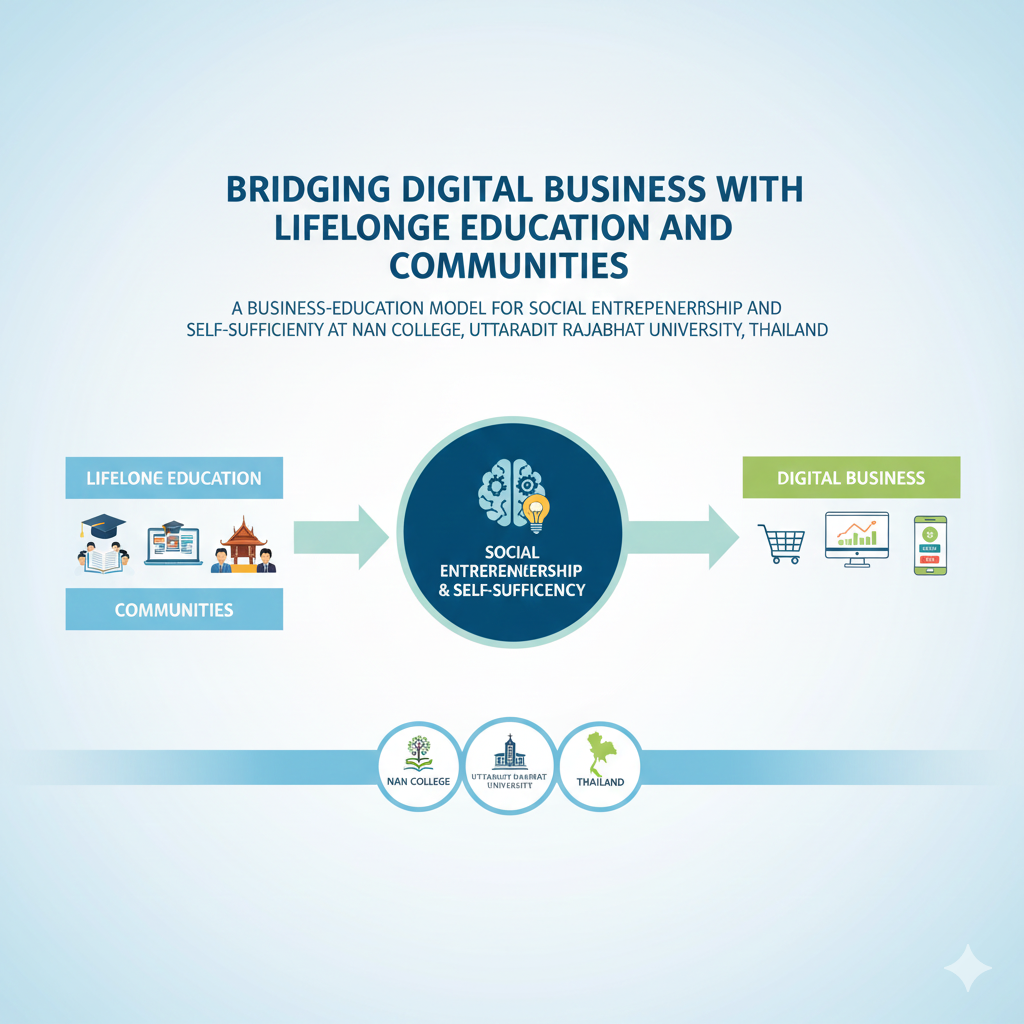
BRIDGING DIGITAL BUSINESS WITH LIFELONG EDUATION AND COMMUNITIES: A BUSINESS-EDUCATION MODEL FOR SOCIAL ENTREPRENEURSHIP AND SELF-SUFFICIENCY AT NAN COLLEGE, UTTARADIT RAJABHAT UNIVERSITY, THAILAND
Article Sidebar
Main Article Content
บทคัดย่อ
The objectives of this study were to synthesize the stakeholders’ prioritized needs of Nan College, a regional satellite of Uttaradit Rajabhat University (URU), to develop its business-education master plan for social entrepreneurship and self-sufficiency; and to test the master and strategic plan appropriateness within the education and social entrepreneurship for self-sufficiency of Nan College. A qualitative research technique was mainly applied to conduct this study with 5 groups of stakeholders and experts- namely, university executives and council members, administrators and faculty members of Nan College, local government and private sector representatives in Nan Province, Grade 12 students from local public schools, and experts in higher education and educational business. Those people were regarded as the stakeholders which were selected from a list of people concerned with Nan College affairs. The purposively selected stakeholders and experts functioned as the key informants and were involved in the model testing and verification. Data collection methods included using questionnaires, in-depth interviews, participant observation, expert seminars, and focus group discussions. Statistical analysis and qualitative content analysis were performed. Content analysis was employed for category identification relevant to the research objectives. The findings indicated that there was a gap between the needs of the URU and stakeholders, resulting in a decision on an integrated digital lifelong education teaching and learning method in Nan Province. The college and URU should reinvent themselves in line with an education business-based approach, fostering social entrepreneurship and self-sufficiency, based on the results of the integrated Triple Bottom Line (TBL), Systems Theory, and PESTLE analysis under the CIPP Model of the Nan College context. A master plan was developed and tested. It contained an integrated characteristic of social entrepreneurship, self-sufficiency, digital lifelong education, and sustainability. Consequently, the study established an empirically grounded operational strategy for social business within a hybrid digital and conventional education ecosystem. All the plan’s components and strategies were found appropriate and viable in transitioning the college into a self-reliant educational and business institution across economic, environmental, social, and systemic dimensions. Policy, academic, and strategic recommendations were proposed to ensure holistic and interdisciplinary development across URU's knowledge domains.
Downloads
Article Details

อนุญาตภายใต้เงื่อนไข Creative Commons Attribution-NonCommercial-NoDerivatives 4.0 International License.
เอกสารอ้างอิง
Aguilar, F. J. (1967). Scanning the business environment. Macmillan.
Checkland, P. (1999). Systems thinking, systems practice. Wiley.
Dees, J. G. (1998). The Meaning of Social Entrepreneurship. Stanford University.
Drucker, P. F. (2007). The practice of management. Routledge.
Elkington, J. (1994). Towards the sustainable corporation: Win-win-win business strategies for sustainable development. California Management Review, 36(2), 90–100. https://doi.org/10.2307/41165746
Elkington, J. (1998). Cannibals with forks: Triple bottom line of 21st century business. New Society.
Kaplan, R. S., & Norton, D. P. (1996). The balanced scorecard: Translating strategy into action. Harvard Business Review Press.
Knowles, M. S. (1975). Self-directed learning: A guide for learners and teachers. Prentice Hall.
Kotler, P., Kartajaya, H., & Setiawan, I. (2017). Marketing 4.0: Moving from traditional to digital. John Wiley & Sons.
Kotler, P., & Murphy, P. E. (1981). Strategic planning for higher education. The Journal of Higher Education, 52(5), 470–489. https://doi.org/10.1080/00221546.1981.11778119
Marginson, S. (2016). The dream is over: The crisis of Clark Kerr’s California Idea of higher education. University of California Press.
Norman, W., & MacDonald, C. (2004). Getting to the bottom of “Triple Bottom Line”. Business Ethics Quarterly, 14(2), 243–262. https://doi.org/10.5840/beq200414211
Organisation for Economic Co-operation and Development. (2021). OECD Digital education outlook 2021: Pushing the frontiers with AI, blockchain, and robots. https://doi.org/10.1787/589b283f-en
Panyanuwat, A. (2005). Pluralistic approaches to community studies: Lessons from field research. Project to enhance learning for a happy community. https://dol.thaihealth.or.th/Media/Index/41f7b4a8-c9ed-e711-80e3-00155d65ec2e (In Thai)
Porter, M. E. (2008). The five competitive forces that shape strategy. Harvard Business Review, 86(1), 78–93.
Selwyn, N. (2021). Education and technology: Key issues and debates (3rd ed.). Bloomsbury.
Skyttner, L. (2005). General systems theory: Problems, perspectives, practice (2nd ed.). World Scientific.
Slaper, T. F., & Hall, T. J. (2011). The triple bottom line: What is it and how does it work. Indiana Business Review, 86(1), 4–8.
Stufflebeam, D. L., & Coryn, C. L. S. (2014). Evaluation theory, models, and applications (2nd ed.). Jossey-Bass.
United Nations Educational, Scientific and Cultural Organization. (2021). Reimagining our futures together: A new social contract for education. UNESCO. https://unesdoc.unesco.org/ark:/48223/pf0000379707
United Nations Educational, Scientific and Cultural Organization. (2022). Lifelong learning opportunities for all: medium-term strategy 2022–2029. UNESCO. https://unesdoc.unesco.org/ark:/48223/pf0000380778.locale=en
Uttaradit Rajabhat University. (2025). Five-year strategic plan (2024-2028). Uttaradit Rajabhat University.
von Bertalanffy, L. (1972). General system theory: Foundations, development, applications (Rev. ed.). George Braziller.
Williamson, B., & Eynon, R. (2020). Historical threads, missing links, and future directions in AI in education. Learning, Media and Technology, 45(3), 223–235. https://doi.org/10.1080/17439884.2020.1798995
Zahra, S. A., Gedajlovic, E., Neubaum, D. O., & Shulman, J. M. (2009). A typology of social entrepreneurs: Motives, search processes and ethical challenges. Journal of Business Venturing, 24(5), 519–532. https://doi.org/10.1016/j.jbusvent.2008.04.007
