
การพัฒนากระบวนการผลิตยาสีฟันสมุนไพรของกลุ่มวิสาหกิจชุมชน เพื่อเพิ่มประสิทธิภาพและยกระดับผลิตภัณฑ์ชุมชน
Article Sidebar
Main Article Content
บทคัดย่อ
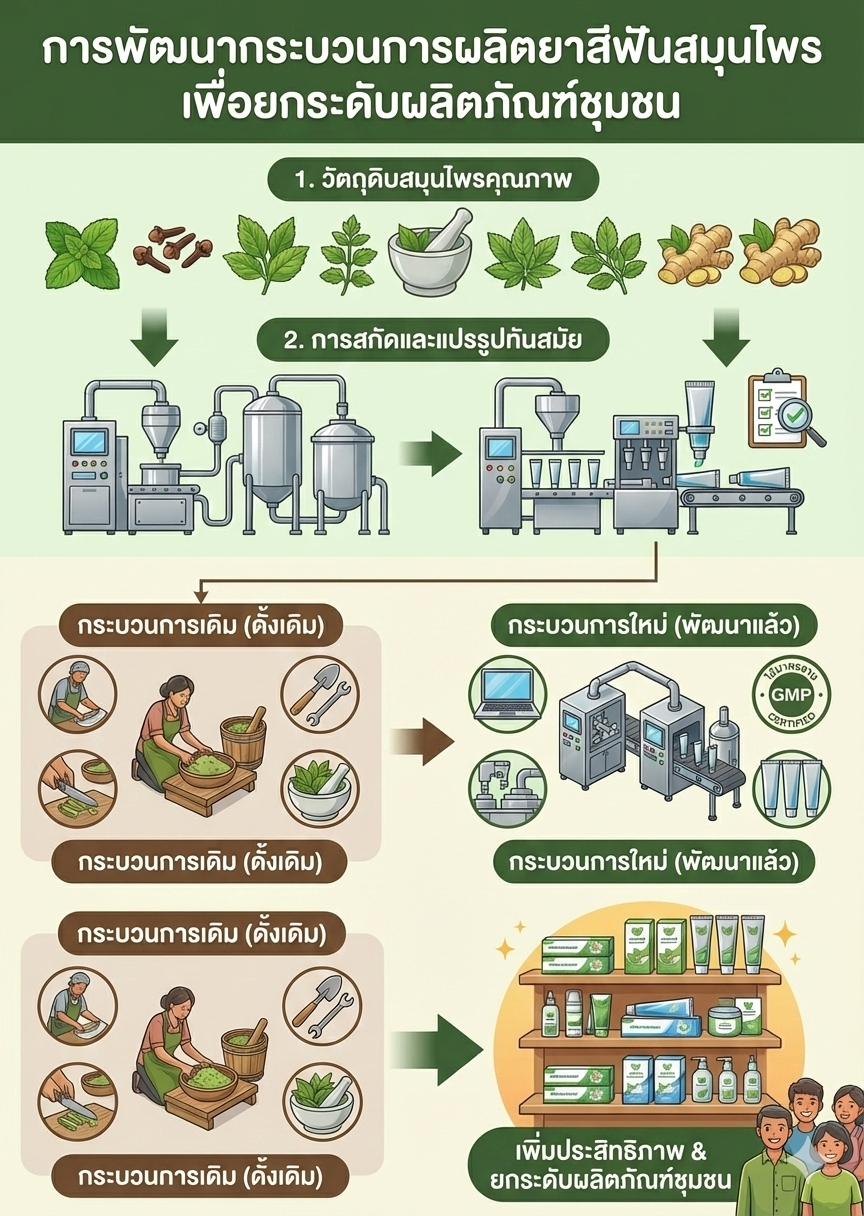
การวิจัยนี้มีวัตถุประสงค์เพื่อพัฒนาสูตรและกระบวนการผลิตยาสีฟันสมุนไพรของกลุ่มวิสาหกิจชุมชนให้มีคุณภาพ ความคงตัว และเหมาะสมสำหรับการผลิตในระดับชุมชน เพื่อเพิ่มประสิทธิภาพการผลิตโดยใช้เครื่องผสมแบบหัวตะกร้อแทนการผสมด้วยแรงงานคน จากนั้นจึงทำการทดสอบคุณภาพของยาสีฟันที่ได้จากสูตรและกระบวนการผลิตที่พัฒนาขึ้น และถ่ายทอดองค์ความรู้ดังกล่าวให้แก่กลุ่มวิสาหกิจชุมชนท่าพระฝั่งคลอง อำเภออู่ทอง จังหวัดสุพรรณบุรี เพื่อการผลิตอย่างยั่งยืน การวิจัยนี้เป็นการวิจัยเชิงทดลองโดยใช้วัตถุดิบสมุนไพรจากกลุ่มวิสาหกิจชุมชนในการทดสอบในห้องปฏิบัติการ การศึกษาประกอบด้วยการวัดความชื้นของสมุนไพรแห้ง การปรับสัดส่วนกลีเซอรีน การใช้สารยึดเกาะคาร์บอกซีเมทิลเซลลูโลส และการใช้เครื่องผสมแบบหัวตะกร้อแทนการผสมด้วยแรงงานคน วิเคราะห์ข้อมูลเชิงพรรณนาโดยใช้ค่าเฉลี่ยและส่วนเบี่ยงเบนมาตรฐาน ผลการทดลองพบว่า สูตรที่มีกลีเซอรีนร้อยละ 30 โดยน้ำหนัก ให้เนื้อสัมผัสและความชุ่มชื้นที่ดี โดยไม่จำเป็นต้องเติมสารยึดเกาะเพิ่มเติม การใช้เครื่องผสมแบบหัวตะกร้อช่วยลดระยะเวลาการผลิตจาก 4 ชั่วโมง เหลือ 20 นาที และเพิ่มปริมาณการผลิตต่อรอบจาก 2 กิโลกรัม เป็น 4 กิโลกรัม ผลิตภัณฑ์ที่ได้มีค่า pH อยู่ในช่วง 8.5–8.7 มีเนื้อสัมผัสที่ดี ไม่แยกชั้น และคงสภาพได้ดีหลังการทดสอบในสภาวะเร่ง ผลการถ่ายทอดองค์ความรู้ให้กับกลุ่มเป้าหมายทำให้กลุ่มสามารถผลิตได้เอง ควบคุมคุณภาพได้ดี และเพิ่มกำลังการผลิตจาก 50 กระปุกต่อเดือน เป็น 300 กระปุกต่อเดือน การวิจัยครั้งนี้จึงมีส่วนช่วยยกระดับผลิตภัณฑ์สมุนไพรของชุมชน สร้างรายได้และความเข้มแข็งแก่เศรษฐกิจในท้องถิ่นอย่างยั่งยืน
Downloads
Article Details

อนุญาตภายใต้เงื่อนไข Creative Commons Attribution-NonCommercial-NoDerivatives 4.0 International License.
เอกสารอ้างอิง
กรมการแพทย์แผนไทยและการแพทย์ทางเลือก. (2561). ยาสีฟันสมุนไพรสูตรผสมเกลือ. กรม.
กรมการแพทย์แผนไทยและการแพทย์ทางเลือก. (2565). รายงานประจำปี 2565 กรมการแพทย์แผนไทยและการแพทย์ทางเลือก. กรม.
ดวงสุรีย์ แสนสีระ. (2566). การศึกษาฤทธิ์ต้านแบคทีเรียในช่องปากของสารสกัดต้นขลู่เพื่อพัฒนาตำรับยาสีฟันสมุนไพร. วารสารวิจัย มทร. กรุงเทพ, 17(2), 58-69. https://ph02.tci-thaijo.org/index.php/rmutk/article/view/250548
สำนักงานมาตรฐานผลิตภัณฑ์อุตสาหกรรม. (2560). มาตรฐานผลิตภัณฑ์ชุมชน ยาสีฟันสมุนไพร: มผช. 909–2560. สำนักงาน.
Akotakar, A. M., Thenge, R. R., Patil, A. V., Ghonge, A. B., & Bhaltadak, M. B. (2018). Formulation and comparative standardization of toothpaste. International Journal of Pharmaceutical Science and Research, 3(4), 12-15. https://www.pharmacyjournal.net/archives/2018/vol3/issue4/3-4-23
Becker, L. C., Bergfeld, W. F., Belsito, D. V., Hill, R. A., Klaassen, C. D., Liebler, D. C., Marks, J. G., Shank, R. C., Slaga, T. J., Snyder, P. W., Gill, L. J., & Heldreth, B. (2019). Safety assessment of glycerin as used in cosmetics. International Journal of Toxicology, 38(3 Suppl), 6S-22S. https://doi.org/10.1177/1091581819883820
Chen, H. J., Lee, P. Y., Chen, C. Y., Huang, S. L., Huang, B. W., Dai, F. J., Chau, C. F., Chen, C. S., & Lin, Y. S. (2022). Moisture retention of glycerin solutions with various concentrations: a comparative study. Scientific Reports, 12, 10232. https://doi.org/10.1038/s41598-022-13452-2
Gokhale, R., & Trivedi, N. R. (2016). Wet granulation in low-and high-shear mixers. In Handbook of Pharmaceutical Granulation Technology (pp. 199-219). CRC Press.
International Council for Harnonisation of Technical Requirements for Pharmaceuticals for Human Use. (1993). Stability testing of new drug substances and products. ICH. https://www.columbiapharma.com/reg_updates/international/ich/q1a.pdf
Håkansson, A. (2018). Rotor-stator mixers: from batch to continuous mode of operation a review. Processes, 6(4), 32. https://doi.org/10.3390/pr6040032
Kanoja, A. P., Ghuge, P. V., Holap, P. B., & Jagdale, A. (2023). To formulate and evaluate herbal toothpaste. International Journal of Pharmaceutical Sciences, 1(12), 557-568. https://doi.org/10.5281/zenodo.10405575
Mangilal, T., & Ravikumar, M. (2016). Preparation and evaluation of herbal toothpaste and compared with commercial herbal toothpastes: an invitro study. International Journal of Ayurvedic and Herbal Medicine, 6(3), 2251-2266. http://www.interscience.org.uk/index.php/archive/volume-6-issue-3-may-june-2016/preparation-and-evaluation-of-herbal-toothpaste-and-compared-with-commercial-herbal-toothpastes-an-invitro-study
Niazi, S. K. (2019). Handbook of Pharmaceutical Manufacturing Formulations: Volume two, Uncompressed Solid Products. CRC press.
Pal, R., Pandey, P., Thakur, S. K., Khadam, V. K. R., Dutta, P., Arushi, Chawra, H. S., & Singh, R. P. (2024). The significance of pharmaceutical packaging and materials in addressing challenges related to unpacking pharmaceutical products. International Journal of Pharmaceutical and Healthcare Innovation, 1(3), 149-173. https://www.researchgate.net/publication/381126537
Rangarajan, M., & Sangeetha, R. (2015). Mixing technologies in the pharmaceutical and food industries. In G. N. Tiwari, & R. K. Mishra (Eds.), Advanced Food Process Engineering (pp. 231–260). CRC Press.
Rodarte, D., Zamora, A., Trujillo, A.-J., & Juan, B. (2018). Effect of ultra-high pressure homogenization on cream: Shelf life and physicochemical characteristics. LWT-Food Science and Technology, 92, 108-115. https://doi.org/10.1016/j.lwt.2018.02.020
Rowe, R. C., Sheskey, P. J., & Quinn, M. E. (Eds.). (2009). Handbook of Pharmaceutical Excipients (6th ed.). Pharmaceutical Press.
Škrinjar, M. M., & Nemet, N. T. (2009). Antimicrobial effects of spices and herbs essential oils. Acta Periodica Technologica, 40, 195-209. https://doi.org/10.2298/APT0940195S
Sutoro, M., Falya, Y., & Damayanti, R. H. (2022). Method and Critical Aspect of Semisolid Mixing. Sciences of Pharmacy, 1(1), 18-26. https://doi.org/10.58920/sciphar01010020
Zhang, J., Xu, S., & Li, W. (2012). High shear mixers: A review of typical applications and studies on power draw, flow pattern, energy dissipation and transfer properties. Chemical Engineering and Processing: Process Intensification, 57-58, 25-41. ttps://doi.org/10.1016/j.cep.2012.04.004
